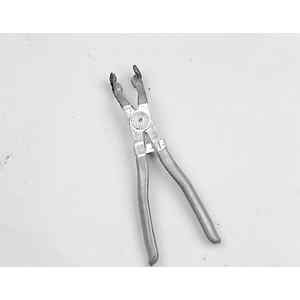
| These pliers are insulated and help protect the user from shock and prevent the plug wires from being damaged.
|
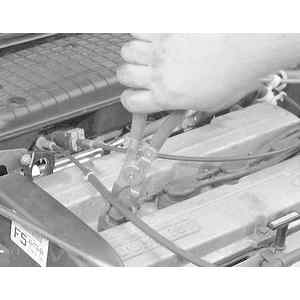
| To perform the cylinder drop test, remove one wire at a time and . . .
|
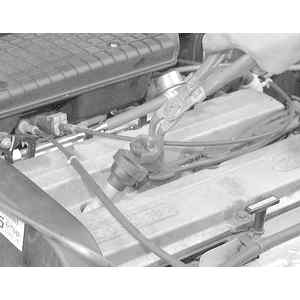
| . . . note the idle speed and idle characteristics of the engine. The cylinder(s) that provide the least amount of drop is the problem cylinder(s)
|
The cylinder drop test is performed to determine which cylinder is misfiring. When diagnosing the ignition system this test will help in determining which cylinder is not receiving adequate spark.
WARNING
Do not disconnect any spark plug (secondary) wires when the engine is running. The high voltage created in the ignition coil will damage the module that controls the ignition coil(s).
To perform a cylinder drop test, a piece of vacuum hose approximately one inch in length for each cylinder, a test light is and a tachometer is required. Having a notepad to record your observations is also helpful. If a tachometer is not used observe and record how the engine is running before shorting cylinders. Perform the cylinder drop test in a logical order. Follow the firing order or systematically work beginning with cylinder number one.
The vacuum hose will be installed between the distributor plug wire tower and the spark plug wire. When the vacuum hose is cut to fit be sure that it is long enough for the test light to touch the vacuum hose and fit between the wire and the distributor cap. If the hose is too long it can affect how the spark plug fires. Working one cylinder at a time:
CAUTION
Do not connect the test light clip directly to the battery. Do not allow ignition the high voltage developed in the ignition systems to flow directly into the battery. Secondary voltage is significantly higher than the voltage of the battery. The battery can be damaged or even explode.
CAUTION
The cylinder drop test is performed while the engine is running. Follow all safety precautions and ensure that all test equipment is clear of any moving parts underhood.
WARNING
Do not make contact with any metal parts of the car when performing a cylinder drop test. The voltage created in the secondary ignition system is very high (thousands of volts) and you can be shocked by it.
NOTE: Before testing the cylinder that has the tachometer connected to it relocate the tachometer lead to another cylinder.