Boost Pressure Sensor with IAT Sensor-2 Inspection
Precautions: General safety (00)
Boost Pressure Sensor
NOTICE:
Failure to take proper precautions when checking the boost pressure sensor with IAT sensor-2 will damage the sensor.
Take the following precautions to reduce the risk of the damage to the sensor.
•Do not heat the boost pressure sensor with IAT sensor-2 to a temperature higher than 100 °C (212 °F).
•Do not apply vacuum more than –60 kPa (–0.6 kgf/cm2, –8.7 psi, –0.6 bar) to boost pressure sensor with IAT sensor-2.
•Do not apply pressure more than 100 kPa (1.0 kgf/cm2, 14.5 psi, 1.0 bar) to boost pressure sensor with IAT sensor-2.
•Do not apply vacuum more than –60 kPa (–0.6 kgf/cm2, –8.7 psi, –0.6 bar) to boost pressure sensor with IAT sensor-2.
•Do not apply pressure more than 100 kPa (1.0 kgf/cm2, 14.5 psi, 1.0 bar) to boost pressure sensor with IAT sensor-2.
1)Check boost pressure sensor output voltage as follows. If check result is not as specified, replace boost pressure sensor with IAT sensor-2.
NOTE:
Environmental condition affects output voltage largely.
The sensor voltage below is reference value when measuring under the following condition.
•Atmospheric pressure: 101.3 kPa (1.01 kgf/cm2, 14.7 psi, 1.01 bar)
a)Arrange 3 new 1.5 V batteries (1) in series, and check total voltage is 4.5 to 5.0 V.
b)Connect voltmeter (2), special tool, hose and batteries to boost pressure sensor with IAT sensor-2 as shown in figure.
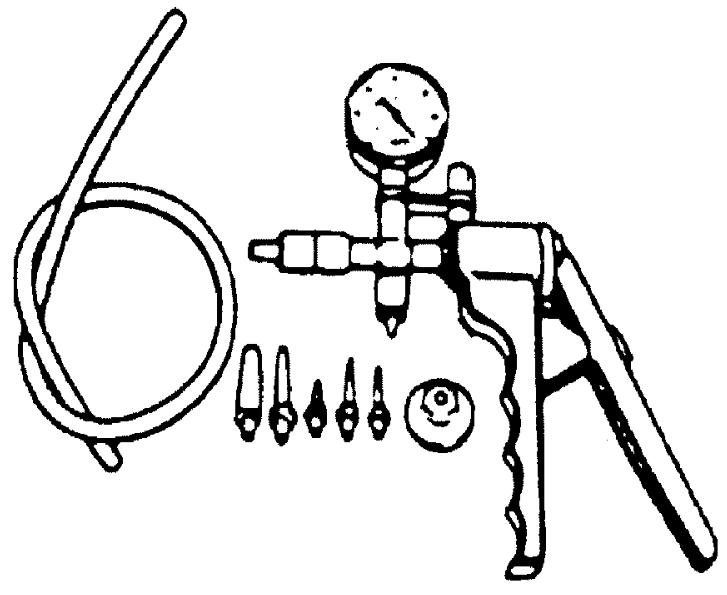
c)Check voltage varies gradually when vacuum is gradually applied with special tool.
d)Disconnect special tool.
e)Connect special tool and hose to boost pressure sensor with IAT sensor-2 as shown in figure.
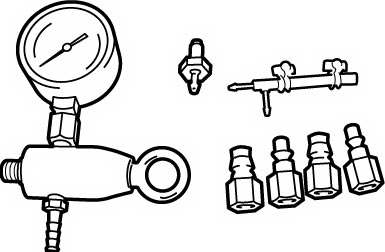
f)Check voltage varies gradually when pressure is gradually applied with special tool.
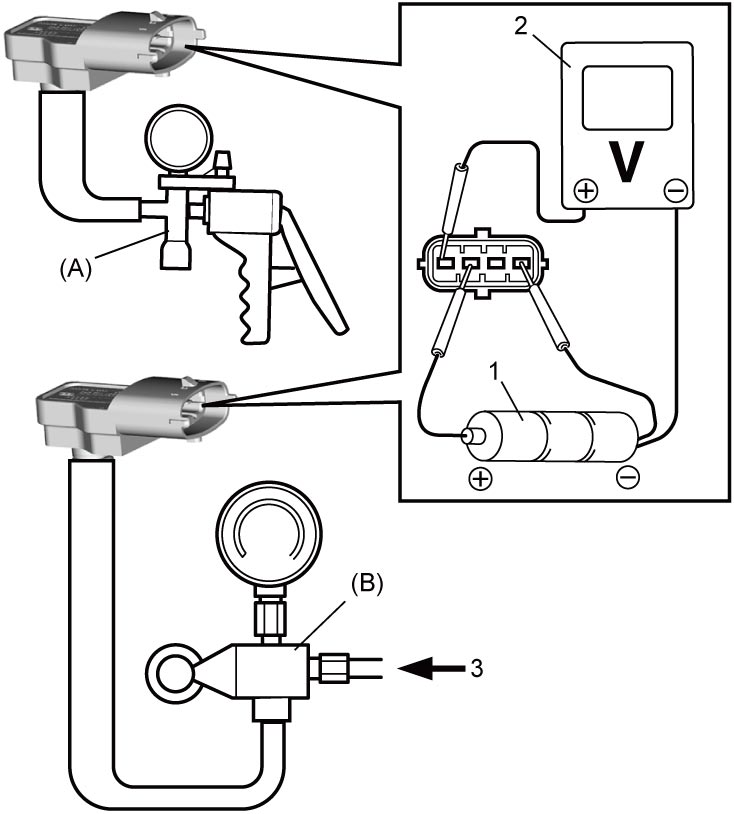

Boost pressure sensor output voltage
Atmospheric pressure: Approx. 1.5 V
Vacuum –30 kPa (–0.3 kgf/cm2, –4.35 psi, –0.3 bar): Approx. 1 V
Positive pressure 30 kPa (0.3 kgf/cm2, 4.35 psi, 0.3 bar): Approx. 2 V
| 3. | Compressed air |
IAT Sensor-2
Measure resistance between sensor terminals while blowing hot air against temperature sensing part of boost pressure sensor with IAT sensor-2 (1) using hot air drier (2). If faulty condition is found, replace boost pressure sensor with IAT sensor-2.
IAT sensor-2 resistance
–20 °C (–4 °F): 14 to 17 kΩ
20 °C (68 °F): 2 to 3 kΩ
60 °C (140 °F): 0.5 to 0.7 kΩ
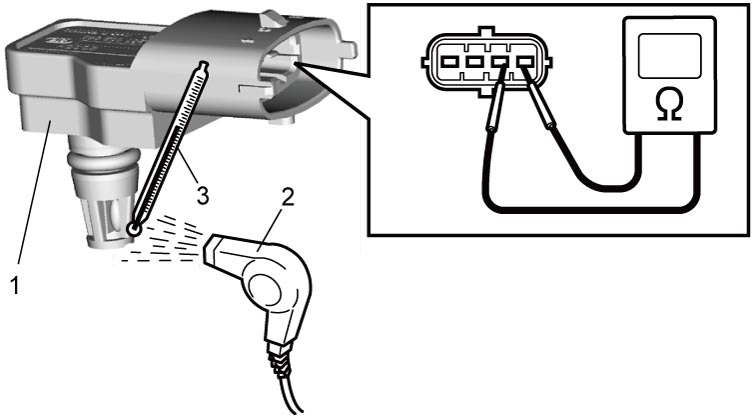
| 3. | Temperature gouge |