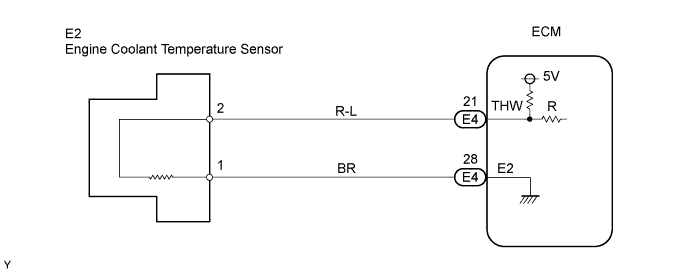
DTC P0115 Engine Coolant Temperature Circuit |
DTC P0117 Engine Coolant Temperature Circuit Low Input |
DTC P0118 Engine Coolant Temperature Circuit High Input |
| DTC No. | Proceed to | DTC Detection Condition | Trouble Area |
| P0115 | Step 1 | Open or short in Engine Coolant Temperature (ECT) sensor circuit for 0.5 seconds |
|
| P0117 | Step 4 | Short in ECT sensor circuit for 0.5 seconds |
|
| P0118 | Step 2 | Open in ECT sensor circuit for 0.5 seconds |
|
| Temperature Displayed | Malfunction |
| -40°C (-40°F) | Open circuit |
| 140°C (284°F) or more | Short circuit |
| Related DTCs | P0115: ECT sensor range check (fluttering) P0117: ECT sensor range check (low resistance) P0118: ECT sensor range check (high resistance) |
| Required Sensors/Components (Main) | ECT sensor |
| Required Sensors/Components (Related) | - |
| Frequency of Operation | Continuous |
| Duration | 0.5 seconds |
| MIL Operation | Immediate |
| Sequence of Operation | None |
| Monitor will run whenever these DTCs are not present | None |
| The typical enabling condition is not available | - |
| ECT sensor voltage [Engine coolant temperature] | Less than 0.14 V, or more than 4.91 V (More than 140°C (284°F), or less than -40°C (40°F)) |
| ECT sensor voltage [Engine coolant temperature] | Less than 0.14 V (More than 140°C (284°F)) |
| ECT sensor voltage [Engine coolant temperature] | More than 4.91 V (Less than -40°C (-40°F)) |
| ECT sensor voltage [ECT] | 0.14 V (140°C (284°F)) to 4.91 V (-40°C (-40°F)) |
| 1.READ VALUE OF INTELLIGENT TESTER (ENGINE COOLANT TEMPERATURE) |
Connect the intelligent tester to the DLC3 with CAN VIM.
Turn the ignition switch ON and turn the intelligent tester ON.
Enter the following menus: DIAGNOSIS / ENHANCED OBD II / DATA LIST / ALL / COOLANT TEMP.
Read the values.
| Engine Coolant Temperature | Proceed to |
| -40°C (-40°F) | A |
| 140°C (284°F) or more | B |
| OK (same as present temperature) | C |
|
| ||||
|
| ||||
| A | |
 |
| 2.READ VALUE OF INTELLIGENT TESTER (CHECK FOR OPEN IN WIRE HARNESS) |
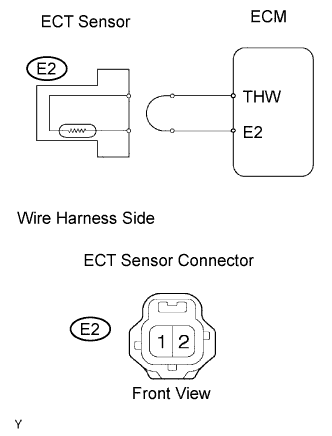 |
Disconnect the E2 Engine Coolant Temperature (ECT) sensor connector.
Connect terminals 1 and 2 of the ECT sensor wire harness side connector.
Connect the intelligent tester to the CAN VIM. Then connect the CAN VIM to the DLC3.
Turn the ignition switch ON and turn the intelligent tester ON.
Enter the following menus: DIAGNOSIS / ENHANCED OBD II / DATA LIST / ALL / COOLANT TEMP.
Read the value.
Reconnect the ECT sensor connector.
|
| ||||
| NG | |
|
| 3.READ VALUE OF INTELLIGENT TESTER (CHECK FOR OPEN IN ECM) |
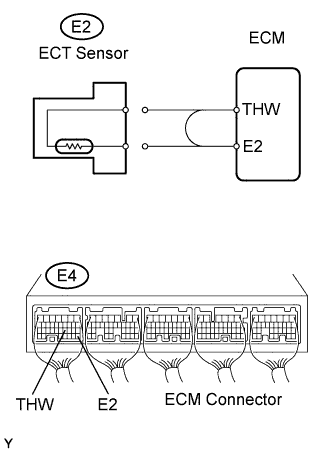 |
Disconnect the E2 ECT sensor connector.
Connect terminals THW and E2 of the E4 ECM connector.
Connect the intelligent tester to the DLC3 with CAN VIM.
Turn the ignition switch ON and turn the intelligent tester ON.
Enter the following menus: DIAGNOSIS / ENHANCED OBD II / DATA LIST / ALL / COOLANT TEMP.
Read the value.
Reconnect the ECT sensor connector.
|
| ||||
| OK | ||
 | ||
| ||
| 4.READ VALUE OF INTELLIGENT TESTER (CHECK FOR SHORT IN WIRE HARNESS) |
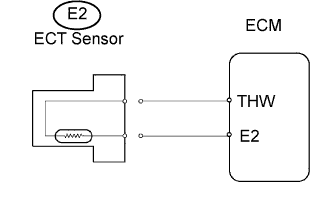 |
Disconnect the E2 ECT sensor connector.
Connect the intelligent tester to the DLC3 with CAN VIM.
Turn the ignition switch ON and turn the intelligent tester ON.
Enter the following menus: DIAGNOSIS / ENHANCED OBD II / DATA LIST / ALL / COOLANT TEMP.
Read the value.
Reconnect the ECT sensor connector.
|
| ||||
| NG | |
|
| 5.READ VALUE OF INTELLIGENT TESTER (CHECK FOR SHORT IN ECM) |
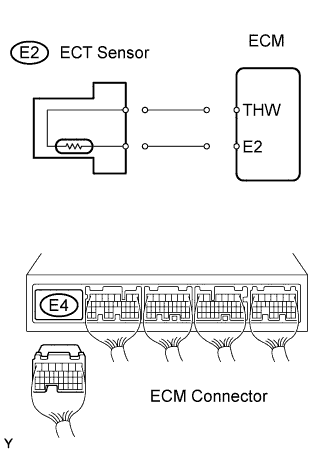 |
Disconnect the E2 ECT sensor connector.
Disconnect the E4 ECM connector.
Connect the intelligent tester to the DLC3 with CAN VIM.
Turn the ignition switch ON and turn the intelligent tester ON.
Enter the following menus: DIAGNOSIS / ENHANCED OBD II / DATA LIST / ALL / COOLANT TEMP.
Read the value.
Reconnect the ECT sensor connector.
Reconnect the ECM connector.
|
| ||||
| OK | ||
| ||
| ||

