Home › ENGINE · 2UZ-FE › IGNITION › IGNITION SYSTEM

IGNITION SYSTEM > INSPECTION

for Preparation Click here


1. INSPECT SPARK PLUG

NOTICE:
  1. Never use a wire brush for cleaning.
  2. Never attempt to adjust the electrode gap on a used spark plug.
  3. The spark plug should be replaced every 200,000 km (120,000 miles).


    IG00147E05
  1. Check the electrode.

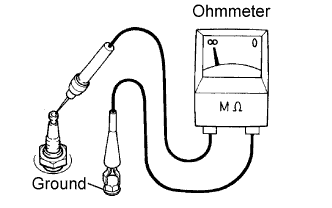
    1. Using an ohmmeter, measure the insulation resistance.
      Correct insulation resistance:
      10 MΩ or more

      If the resistance is below the specified range, go to procedure "A".

      HINT:
      If an ohmmeter is not available, the following simple inspection provides fairly accurate results.


    B001301
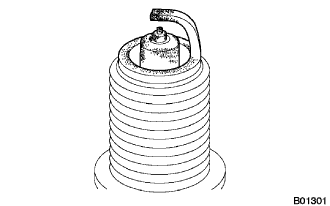
  1. Simple Method:

    1. Quickly race the engine to 4,000 rpm 5 times.

    2. Remove the spark plug.

    3. Visually check the spark plug.

    4. If the electrode is dry... OK.

    5. If the electrode is wet... Go to procedure "B".

    6. Reinstall the spark plug.


    IG00316
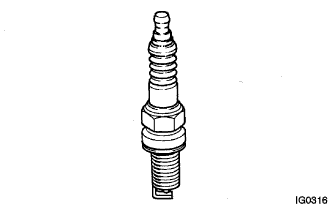
  1. Check the spark plug for thread or insulator damage (Procedure "B").
    If damaged, replace the spark plug.
    Recommended spark plug: 
    DENSO made
    NGK made
    SK20R11
    IFR6A11


    B002101E09
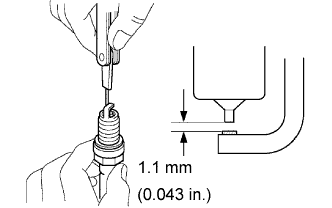
  1. Measure the spark plug electrode gap (Procedure "A")

    Maximum electrode gap for used spark plug:
    1.3 mm (0.051 in.)

    If the gap is greater than the maximum, replace the spark plug.

    Correct electrode gap for new spark plug:
    1.0 to 1.1 mm (0.039 to 0.043 in.)


    B062019
  1. Clean the spark plugs.
    If the electrode has traces of wet carbon, allow it to dry and then clean with a spark plug cleaner.

    Air pressure:
    Below 588 kPa (6 kgf/cm2, 85 psi)

    Duration:
    20 seconds or less

    HINT:
    If there are traces of oil, remove them with gasoline before using a spark plug cleaner.


2. INSPECT VVT SENSOR
  1. Using an ohmmeter, measure the resistance between the terminals.

    Resistance:
    Cold:
    835 to 1,400 Ω
    Hot:
    1,060 to 1,645 Ω

    NOTICE:
    "Cold" and "Hot" above mean the temperature of the coils themselves. "Cold" is from -10°C (14°F) to 50°C (122°F) and "Hot" is from 50°C (122°F) to 100°C (212°F).


3. INSPECT CRANKSHAFT POSITION SENSOR
  1. Using an ohmmeter, measure the resistance between the terminals.

    Resistance:
    Cold:
    1,630 to 2,740 Ω
    Hot:
    2,065 to 3,225 Ω

    NOTICE:
    "Cold" and "Hot" above mean the temperature of the coils themselves. "Cold" is from -10°C (14°F) to 50°C (122°F) and "Hot" is from 50°C (122°F) to 100°C (212°F).