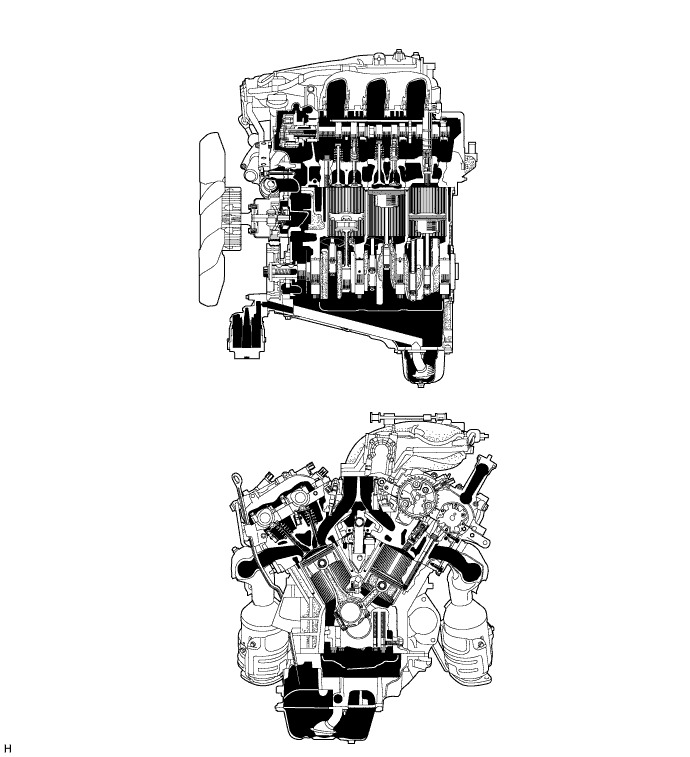
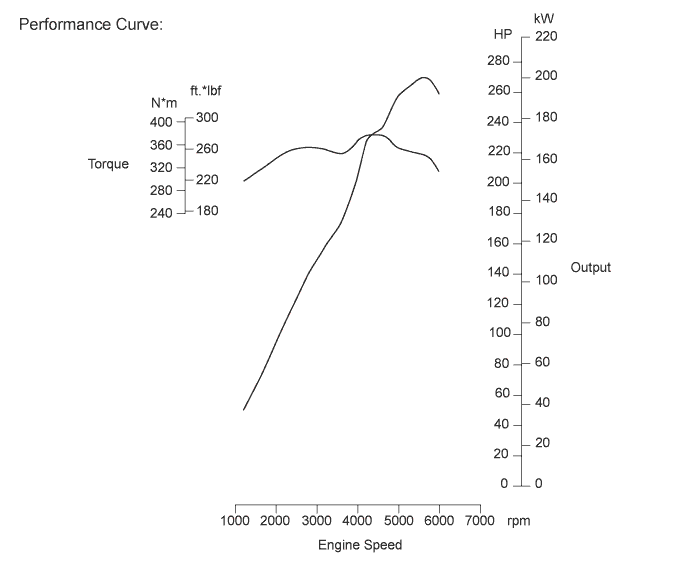
Engine Type
| 1GR-FE
|
No. of Cyls. & Arrangement
| 6-Cylinder, V Type
|
Valve Mechanism
| 24-Valve DOHC, Chain Drive (With Dual VVT-i)
|
Combustion Chamber
| Pentroof Type
|
Flow of Intake and Exhaust Gasses
| Cross-Flow
|
Fuel System
| SFI
|
Ignition System
| DIS
|
Displacement
| 3956 cm3 (241.4 cu. in.)
|
Bore X Stroke
| 94.0 X 95.0 mm (3.70 X 3.74 in.)
|
Compression Ratio
| 10.4 : 1
|
Max. Output [SAE-NET]*1
| 270 HP@5600 rpm (201 kW@5600 rpm)
|
Max. Torque [SAE-NET]*1
| 278 ft.*lbf@4400 rpm (377 N*m@4400 rpm)
|
Valve Timing
| Intake
| Open
| -11° to 29° BTDC
|
Closed
| 71° to 31° ABDC
|
Exhaust
| Open
| 60° to 25° BBDC
|
Closed
| 4° to 39° ATDC
|
Spark Plug
| Manufacturer
| DENSO
|
Type
| SK16HR11 (Iridium)
|
Plug Gap
| 1.0 - 1.1 mm (0.0394 - 0.0433 in.)
|
Firing Order
| 1 - 2 - 3 - 4 - 5 - 6
|
Octane rate (Research Octane Number)
| 87 or higher (91RON or higher)
|
Emission Regulation
| U LEVII, SFTP
|
Tier2 - bin 5
|
Engine Service Mass*2 (Reference)
| 189.0 kg (416.7 lb)
|
Item
| (1)
| (2)
| (3)
| (4)
| (5)
|
Engine Proper
| A steel laminate type cylinder head gasket is used.
| ○
| -
| -
| -
| -
|
A taper squish shape is used for combustion chamber.
| ○
| -
| -
| -
| ○
|
A cylinder block sub-assembly made of aluminum alloy is used.
| -
| -
| ○
| -
| -
|
The skirt portion of each piston has a resin coating applied to reduce friction.
| ○
| ○
| -
| -
| ○
|
An oil pan sub-assembly made of aluminum alloy is used.
| -
| ○
| ○
| -
| -
|
Valve Mechanism
| The Dual Variable Valve Timing-intelligent (Dual VVT-i) system is used.
| ○
| -
| -
| -
| ○
|
Hydraulic valve lash adjuster assemblies are used.
| ○
| ○
| -
| ○
| -
|
A timing chain sub-assembly, chain tensioner assembly (primary), and No. 2 chain tensioner assembly (secondary) are used.
| -
| ○
| ○
| ○
| -
|
Roller No.1 valve rocker arm sub-assemblies are used.
| ○
| -
| -
| -
| ○
|
Lubrication System
| An oil filter with a replaceable element is used.
| -
| -
| -
| ○
| -
|
Cooling System
| Toyota Genuine Super Long Life Coolant (SLLC) is used.
| -
| -
| -
| ○
| -
|
Intake and Exhaust Systems
| A cable-less type throttle body is used.
| -
| -
| ○
| ○
| -
|
An intake air surge tank made of plastic is used.
| -
| -
| ○
| -
| -
|
Stainless steel exhaust manifold sub-assemblies (RH and LH) are used.
| -
| -
| ○
| -
| ○
|
An ultra thin-wall, high-cell density ceramic type Three-Way Catalytic converter (TWC) is used.
| -
| -
| -
| -
| ○
|
Fuel System
| A fuel delivery pipe sub-assembly made of plastic is used.
| -
| -
| ○
| -
| -
|
Compact 12-hole type fuel injector assemblies are used.
| ○
| -
| -
| -
| ○
|
A multi-layer plastic fuel tank assembly is used.
| -
| -
| ○
| -
| ○
|
Quick connectors are used to connect the fuel hose with the fuel pipe.
| -
| -
| -
| ○
| -
|
Ignition System
| The Direct Ignition System (DIS) is used.
| ○
| -
| -
| ○
| ○
|
Long-reach type iridium-tipped spark plugs are used.
| ○
| -
| -
| ○
| ○
|
Charging System
| A segment conductor type generator assembly is used.
| ○
| -
| ○
| -
| -
|
A generator clutch pulley with a one-way clutch is used.
| ○
| -
| -
| -
| ○
|
Starting System
| Conventional reduction type starter (RA) is used.
| -
| -
| ○
| -
| -
|
Serpentine Belt Drive System
| A serpentine belt drive system is used.
| -
| -
| ○
| ○
| -
|
Engine Control System
| Magnetic Resistance Element (MRE) type VVT sensors are used.
| ○
| -
| -
| -
| -
|
The Electronic Throttle Control System-intelligent (ETCS-i) is used.
| ○
| -
| -
| -
| ○
|
The cranking hold function* is used.
| ○
| -
| -
| -
| -
|
An evaporative emission control system is used.
| -
| -
| -
| -
| ○
|
An air injection system is used.
| -
| -
| -
| -
| ○
|