AIRBAG SYSTEM > GENERAL


OUTLINE
  1. The SRS driver and front passenger airbags are used as supplements to the seat belts to help reduce impact to the head and chest of the driver and front passenger in the event of a frontal collision.

  2. The SRS knee airbags are used as supplements to the seat belt to help restrain the occupant's lower body (mainly knees), enhancing the effectiveness of occupant protection.

  3. The SRS side airbags are used in the event of a side collision to help reduce the impact to the chests of the driver, front passenger.


  4. The SRS curtain shield airbags are used in the event of a side or side rear collision to help reduce the impact to the head of the front passenger or rear passenger.
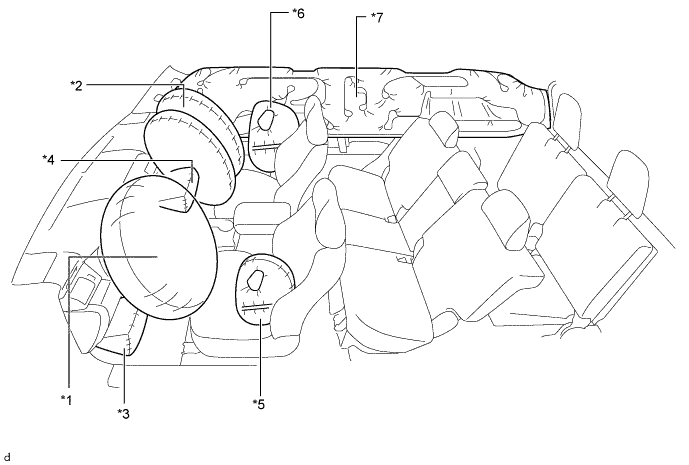

    V105151E01


    Text in Illustration 
    *1
    Steering Pad (Driver Side Squib)
    *2
    Front Passenger Side Airbag Assembly
    *3
    Driver Side Knee Airbag Assembly
    *4
    Front Passenger Side Knee Airbag Assembly
    *5
    Front Seat Side Airbag Assembly LH
    *6
    Front Seat Side Airbag Assembly RH
    *7
    Curtain Shield Airbag Assembly RH
    -
    -


PRECAUTION
  1. Event Data Recorder

    1. This vehicle has ECUs that monitor and control vehicle operation. These ECUs assist in driving and maintaining optimal vehicle performance. Besides storing data useful for troubleshooting, there is a system to record data in a crash or near crash event. This is called an Event Data Recorder (EDR). The center airbag sensor assembly contains the EDR.

    2. In a crash or a near car crash event, this device may record some or all of the following information:

      1. Whether the driver and front passenger wore the seat belts or not.
      2. SRS airbag deployment data.
      3. SRS airbag system diagnostic data.

    3. The information above is intended to be used for the purpose of improving vehicle safety performance. Unlike general data recorders, the EDR does not record sound data such as conversation between passengers.

    4. Toyota will not disclose the data recorded in an EDR to a third party except when:

      1. An agreement from the vehicle's owner (or the leasing company for a leased vehicle) is obtained.
      2. Officially requested by the police or other authorities.
      3. Used as a defense for Toyota in a law suit.
      4. Ordered by the court.

    5. However, if necessary, Toyota will:

      1. Use the data for research on Toyota vehicle safety performance.
      2. Disclose the data to a third party for research purposes without disclosing details of the vehicle owner, and only when it is deemed necessary.
      3. Disclose summarized data cleared of vehicle identification information to a non-Toyota organization for research purposes.