AIRBAG SYSTEM > DETAILS


FUNCTION OF MAIN COMPONENTS
  1. The main components have the following functions:

    Component
    Function
    Center Airbag Sensor Assembly
    1. The center airbag sensor assembly receives signals from the deceleration sensor and safing sensor built into the center airbag sensor assembly and one of the front airbag sensors, determines whether the driver airbag, front passenger airbag, driver side knee airbag, passenger side knee airbag and front seat belt pretensioners should be activated. It also diagnoses system malfunctions.
    2. The center airbag sensor assembly receives signals from the safing sensor built into the center airbag sensor assembly, side airbag sensors and floor side airbag sensor, and determines whether the front seat side airbag and curtain shield airbag should be activated. It also diagnoses system malfunctions.
    3. The center airbag sensor assembly sends an airbag deployment signal to the ECM through the Controller Area Network (CAN) to operate the fuel pump control.
    Airbag Assembly
    Driver and Front Passenger
    The airbag assemblies are used as supplements to the seat belts to help reduce impact to the occupants.
    Driver and Front Passenger Side Knee
    Front Seat Side LH/RH
    Curtain Shield LH/RH
    Front Airbag Sensor LH/RH
    Based on the deceleration of the vehicle during a frontal collision, a distortion is created in the sensor and converted into an electrical signal. Accordingly, the extent of the initial collision can be detected in detail.
    Side Airbag Sensor Assembly LH/RH
    Based on the deceleration of the vehicle during a side or side rear collision, a distortion is created in the sensor and converted into an electrical signal.
    Rear Airbag Sensor LH/RH
    Floor Side Airbag Sensor
    The seat position sensor detects the slide position of the driver seat.
    Front Seat Outer Belt Assembly
    Driver and Front Passenger
    The front seat outer belt assemblies are used as supplements to help to reduce the impacts to the occupants.
    Front Seat Inner Belt Assembly
    Driver Seat Belt Buckle Switch
    The driver seat belt buckle switch detects if the driver seat belt is fastened.
    Front Passenger Seat Belt Buckle Switch
    The front passenger seat belt buckle switch detects if the front passenger seat belt is fastened.
    Occupant Classification ECU
    The occupant classification ECU judges whether the front passenger seat is occupied using signals from 4 occupant classification sensors and front passenger seat belt buckle switch.
    Front Occupant Classification Sensor LH/RH
    The resistance values of these sensors, which vary in accordance with the distortion that acts on the brackets, are output to the occupant classification ECU.
    Rear Occupant Classification Sensor LH/RH
    Combination Meter Assembly
    SRS Warning Light
    The SRS warning light turns to alert the driver when the center airbag sensor assembly detects a malfunction in the airbag system.


OPERATING CONDITION


  1. If the impact of a collision is greater than the specified value, the SRS is activated automatically. The center airbag sensor assembly includes the safing sensor and deceleration sensor. The safing sensor is designed to turn on at a lower deceleration rate than the deceleration sensor.

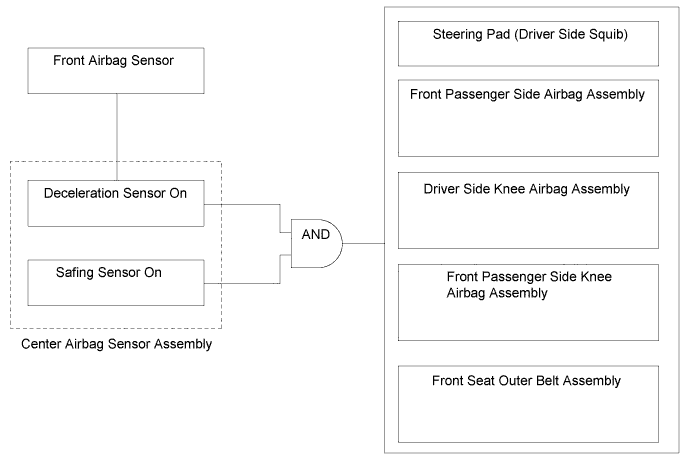
    1. In case of a frontal collision, the center airbag sensor assembly determines whether airbag deployment or pretensioner activation is necessary based on signals from the deceleration sensor and the front airbag sensor. If the safing sensor turns on simultaneously, current flows to the squibs to deploy the SRS components as shown in the illustration below.


    2. However, a deployment ignition signal may be output with the deceleration sensor on signal even without a signal from a front airbag sensor.

      V100405E02


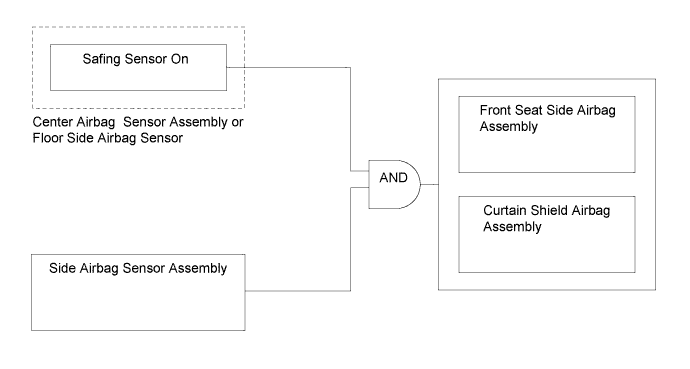
    3. In case of a side collision, the center airbag sensor assembly determines whether airbag deployment is necessary based on signals from the side airbag sensor assembly and safing sensor. If the safing sensor and side airbag sensor assembly turn on simultaneously, current flows to the squibs to deploy the SRS components shown in the illustration below.

      V100406E02


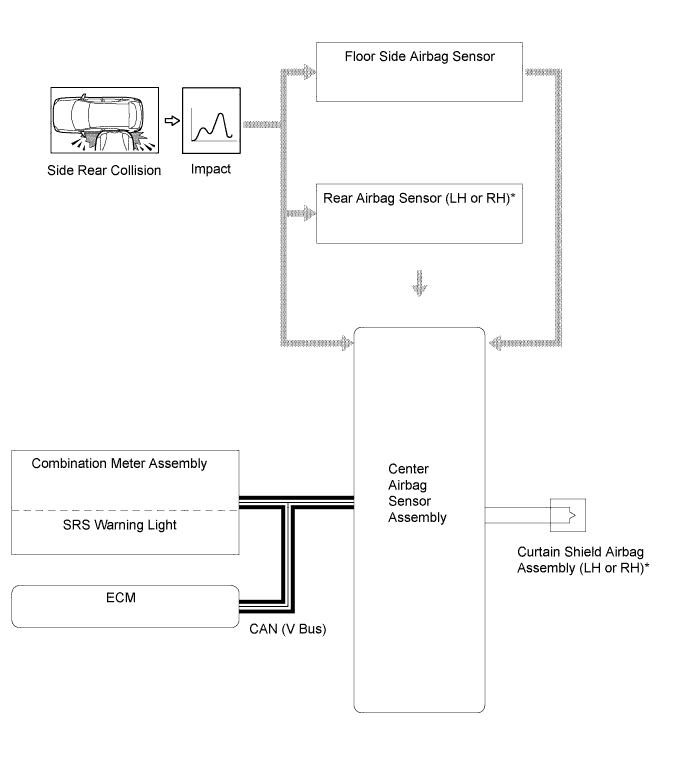
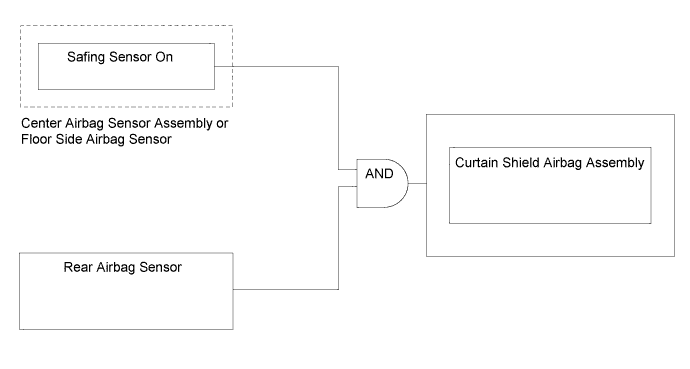
    4. In case of a rear side collision, the center airbag sensor assembly determines whether airbag deployment is necessary based on signals from the rear airbag sensor and safing sensor. If the safing sensor and side airbag sensor assembly turn on simultaneously, current flows to the squibs to deploy the SRS components shown in the illustration below.

      V100407E02


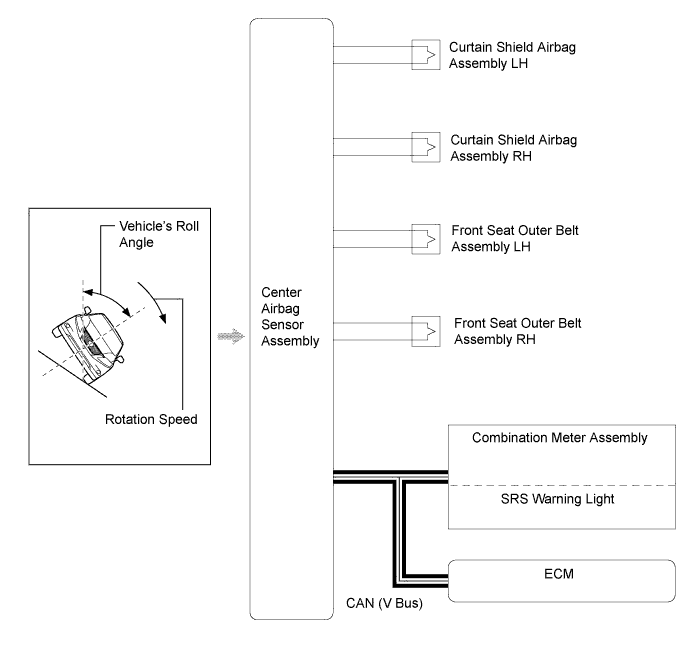
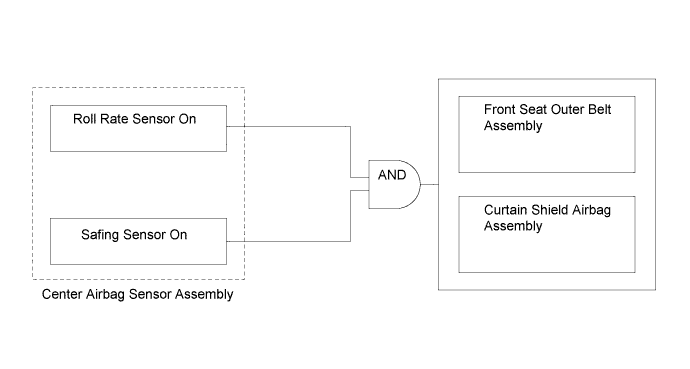
    5. In case of a roll over, the center airbag sensor assembly determines whether airbag deployment and pretensioner activation is necessary based on signals from the safing sensor and roll rate sensor. If the safing sensor and roll rate sensor turn on simultaneously, current flows to the squibs to deploy the SRS components as shown in the illustration below.
      V100408E02


SYSTEM CONTROL


  1. Airbag for Frontal Collision

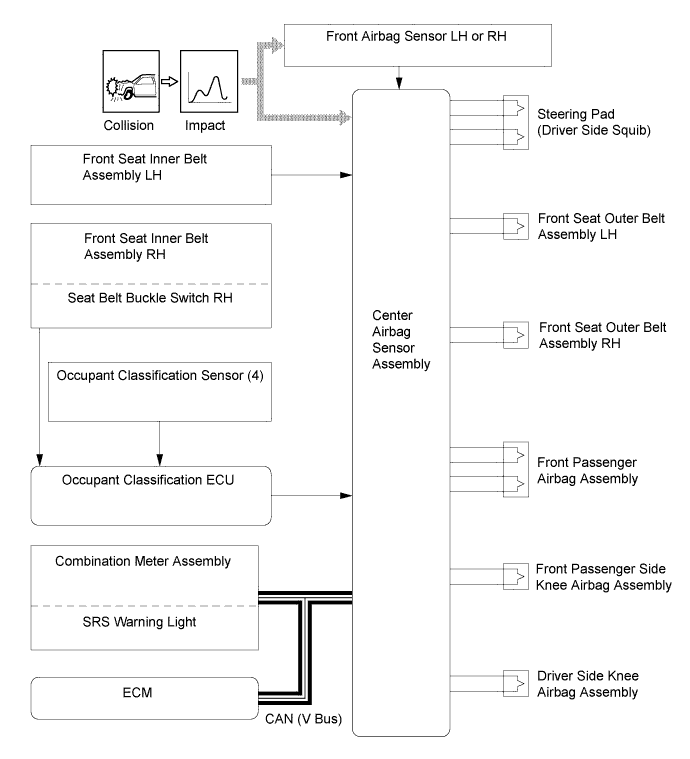
    1. There are 4 airbags which deploy in the event of a frontal collision: the steering pad, front passenger airbag assembly, driver side knee airbag assembly and passenger side knee airbag assembly. These airbags deploy simultaneously. The steering pad and front passenger airbag assembly use dual-stage control.

    2. The center airbag sensor assembly detects the information indicated below from various sources in order to activate the dual-stage control.


    3. For a frontal collision, if a front airbag sensor detects an impact, it informs the center airbag sensor assembly. The center airbag sensor assembly causes the steering pad, front passenger airbag assembly, driver side knee airbag assembly and passenger side knee airbag assembly to deploy. Meanwhile, the center airbag sensor assembly activates the seat belt pretensioners for the driver, front passenger and rear seat outer passengers.

      Airbag
      Information
      Source
      Driver
      Extent of Impact
      1. Front Airbag Sensor (LH or RH)
      2. Center Airbag Sensor Assembly
      Seat Belt Condition
      Front Seat Inner Belt Assembly (Driver Seat Belt Buckle Switch) (Non-contact Type)
      Front Passenger
      Extent of Impact
      1. Front Airbag Sensor (LH or RH)
      2. Center Airbag Sensor Assembly
      Occupant Classification
      4 Occupant Classification Sensors*
      Seat Belt Condition
      Front Seat Inner Belt Assembly (Front Passenger Seat Belt Buckle Switch) (Non-contact Type)*

      1. *: Connected to the center airbag sensor assembly through the occupant classification ECU.

      V100409E02


  2. Airbag for Side/Side Rear Collision

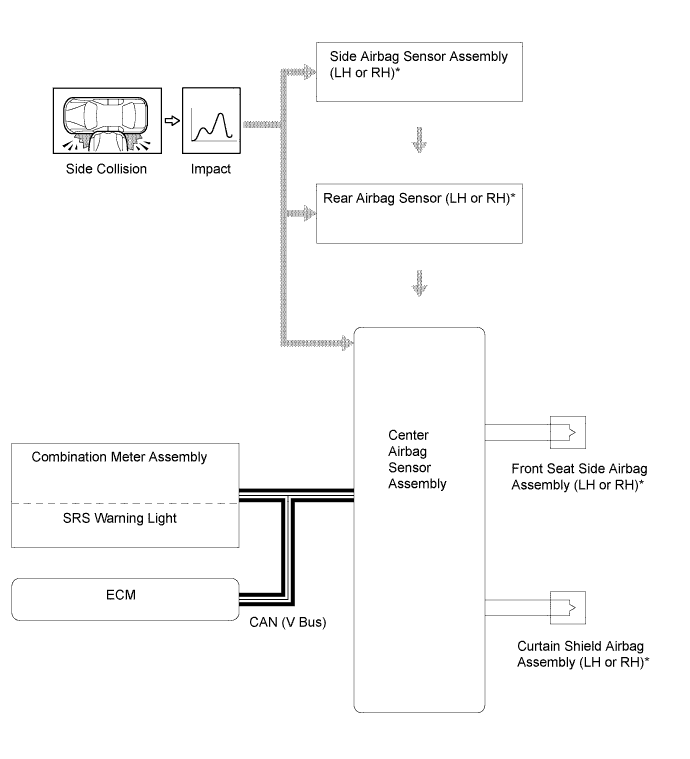
    1. There are 2 airbags which deploy in the event of a severe side collision: the front seat side airbag assembly and curtain shield airbag assembly. These airbags deploy simultaneously.


    2. For a side collision, if the side airbag sensor assembly detects an impact, it informs the center airbag sensor assembly, and the center airbag sensor assembly causes the front seat side and curtain shield airbag assemblies to deploy simultaneously.


      V100410E02

      1. *: The sensor on the collision side detects an impact and causes the airbags on that side to deploy.


    3. For a rear side collision, if the floor side airbag sensor and the rear airbag sensor detect an impact, it informs the center airbag sensor assembly. The center airbag sensor assembly causes the curtain shield airbag assembly to deploy.


      V100411E02

      1. *: The sensor on the collision side detects an impact and causes the airbag on that side to deploy.


  3. Airbag for Roll Over


    1. If the vehicle is tilted and rolls over, the center airbag sensor assembly activates the left and right curtain shield airbags and the seat belt pretensioners for the driver and front passenger based on signals that show the vehicle's roll angle and rotation speed.


      V100412E02


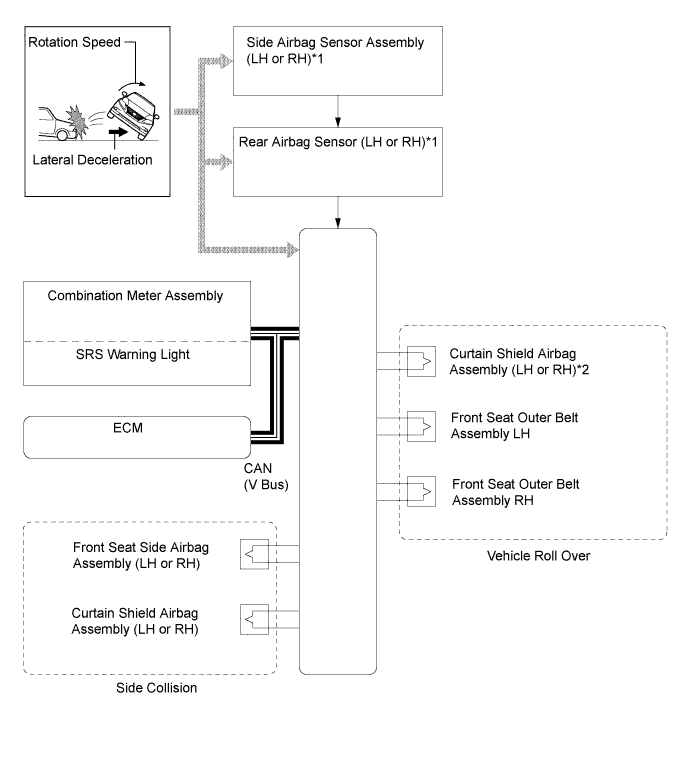
    2. If the vehicle rolls over in a side collision, the center airbag sensor assembly causes the front seat side airbag assembly and curtain shield airbag assembly to deploy based on signals from the rear airbag sensor and side airbag sensor assembly. Meanwhile, it activates the curtain shield airbag on the opposite side of the collision and the belt pretensioners for the driver and front passenger, based on lateral deceleration and rotation speed signals.


      V100413E02

      1. *1: The sensor on the collision side detects an impact and causes the airbag on that side to deploy.
      2. *2: Curtain shield airbag of the opposite side of the collision.


CONSTRUCTION
  1. Center Airbag Sensor Assembly

    1. The center airbag sensor assembly consists of a deceleration sensor, safing sensor, roll rate sensor, ignition control circuit, backup power source, diagnostic circuit and memory circuit.

      Item
      Outline
      Deceleration Sensor
      Deceleration sensors are built into the center airbag sensor assembly, front airbag sensors, side airbag sensor assemblies, rear airbag sensors and floor side airbag sensor. These sensors distort in the event of a collision. The amount of distortion is based on the deceleration rate of the vehicle during a frontal, side or side rear collision and is converted into an electric signal.
      Ignition Control Circuit
      The ignition control circuit performs calculations based on the signal output from the deceleration sensors of the center airbag sensor assembly, front airbag sensors, side airbag sensor assemblies, rear airbag sensors and floor side airbag sensor. If the calculated values are greater than the specified values, the airbags are deployed.
      Safing Sensor
      During a frontal, side or side rear collision, this sensor turns on and outputs an on signal to the center airbag sensor assembly if a deceleration rate of the safing sensor is greater than a specified value.
      Backup Power Circuit
      The backup power circuit consists of a power supply capacitor and a DC-DC converter. When the power supply to the center airbag sensor assembly is disrupted during a collision, the power supply capacitor discharges and supplies electric power to the system. The DC-DC converter operates as a boosting transformer when the battery voltage falls below a predetermined level.
      Roll Rate Sensor
      The roll rate sensor built into the center airbag sensor assembly detects the left to right tilt of the vehicle.
      Diagnostic Circuit
      The diagnostic circuit constantly monitors for system malfunctions. When a malfunction is detected, it turns on the SRS warning light in the combination meter assembly to inform the driver.
      Memory Circuit
      When a malfunction is detected by the diagnostic circuit, a code is stored in memory.


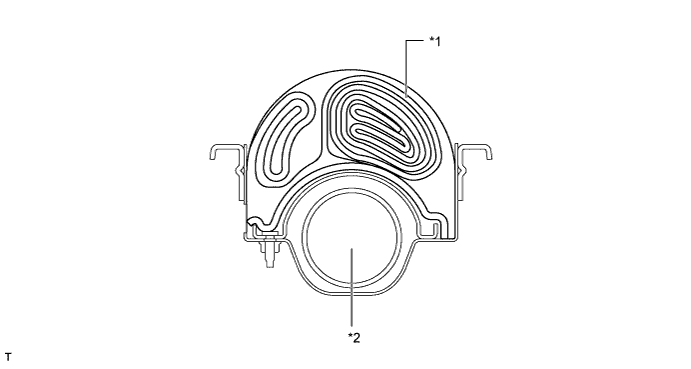
  2. Steering Pad

    1. The steering pad contains the driver airbag assembly.


    2. The driver airbag assembly consists of an inflator and a bag.


      V100414E01


      Text in Illustration 
      *1
      Bag
      *2
      Inflator


  3. Front Passenger Airbag Assembly

    1. The front passenger airbag assembly is located in the upper section of the instrument panel of the front passenger seat.


    2. The front passenger airbag assembly consists of an inflator and a bag.


      V100415E01


      Text in Illustration 
      *1
      Bag
      *2
      Inflator


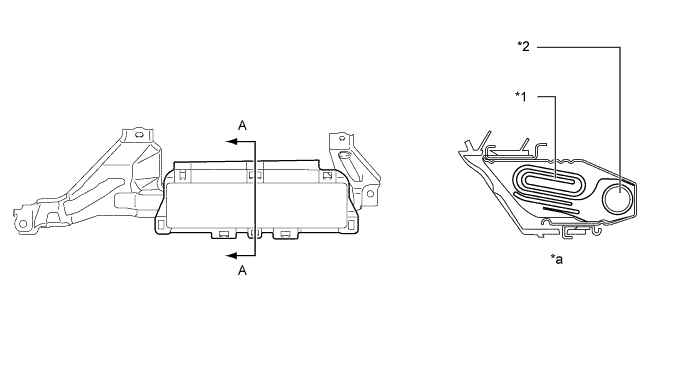
  4. Driver Side Knee Airbag Assembly and Passenger Side Knee Airbag Assembly


    1. The knee airbag assembly consists of an airbag door, inflator and bag.


      V105159E01


      Text in Illustration 
      *1
      Bag
      *2
      Inflator
      *a
      A-A Cross Section
      -
      -


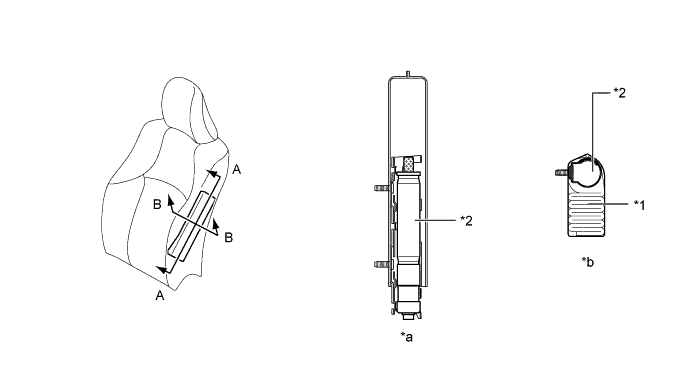
  5. Front Seat Side Airbag Assembly


    1. Each front seat side airbag assembly is a one-piece design, consisting of an inflator and bag.


      V105160E01


      Text in Illustration 
      *1
      Bag
      *2
      Inflator
      *a
      A-A Cross Section
      *b
      B-B Cross Section


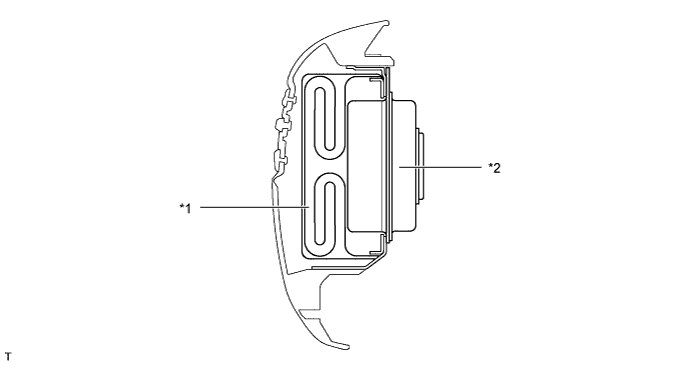
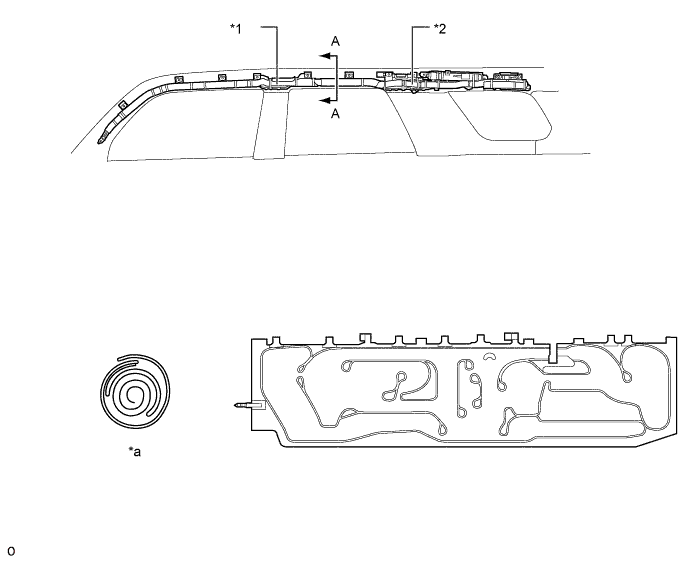
  6. Curtain Shield Airbag Assembly


    1. Each curtain shield airbag assembly is a one-piece design, consisting of an inflator and bag.


      V105153E02


      Text in Illustration 
      *1
      Bag
      *2
      Inflator
      *a
      A-A Cross Section
      -
      -


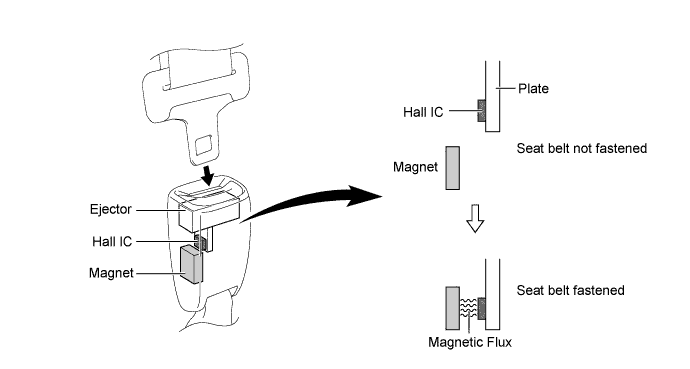
  7. Front Seat Inner Belt Assembly (Seat Belt Buckle Switch)

    1. A non-contact type switch is built into the front seat inner belt assembly (seat belt buckle switch) on the driver and front passenger sides.

    2. The non-contact type switch contains a Hall IC and magnet.

    3. The ejector inside the front seat inner belt assembly (seat belt buckle switch) and the plate installed to the ejector move when the seat belt is removed or inserted. The movement of the plate changes the magnetic flux density of the magnet.


    4. The Hall IC detects changes in the magnetic flux density. These changes indicate that the seat belt is either fastened or unfastened, and the Hall IC outputs a signal to the center airbag sensor assembly (for driver) or occupant classification ECU (for front passenger).


      Y100045E01


DIAGNOSIS
  1. If the center airbag sensor assembly detects a malfunction in the SRS airbag system, the center airbag sensor assembly stores the malfunction data in memory, in addition to illuminating the SRS warning light.

  2. The center airbag sensor assembly outputs the malfunction data, 5-digit Diagnostic Trouble Codes (DTCs), to the Techstream.

  3. The 5-digit DTCs can be read after connecting the Techstream to the DLC3. For details, refer to the Repair Manual.

  4. If the SRS airbag deploys, the center airbag sensor assembly will turn on the SRS warning light. However, different from the ordinary diagnosis function, a DTC will not be stored. The SRS warning light cannot be turned off. It is necessary to replace the center airbag sensor assembly with a new one.