RELATIVE ABSORBER SYSTEM > DETAILS |
| CONSTRUCTION |
Front and Rear Shock Absorbers
Single-cylinder type front and rear shock absorbers are used.
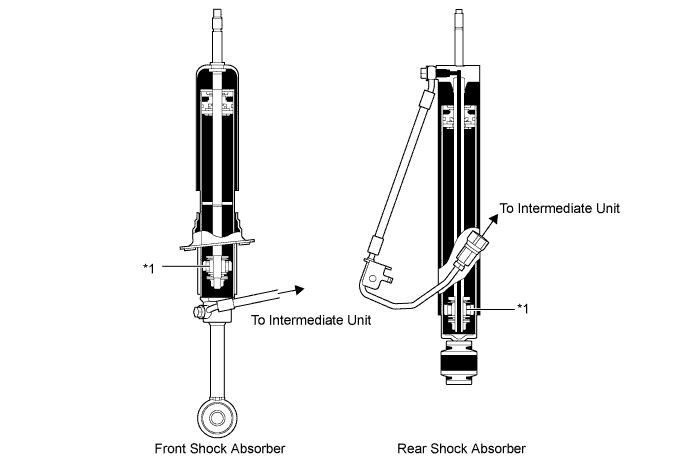
| *1 | Piston Valve | - | - |
Center Control Absorber
In order to apply a damping force to the two shock absorbers that are connected to the center control absorber consists of a valve, free piston, and gas chamber.
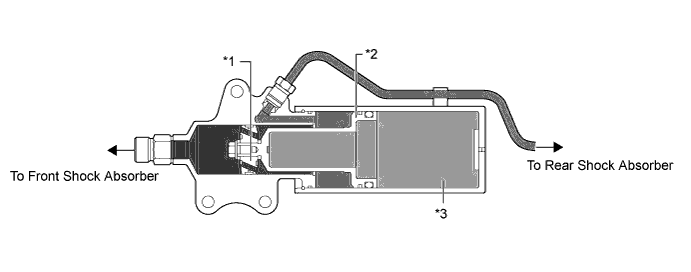
| *1 | Valve | *2 | Free Piston |
| *3 | Gas Room | - | - |
| OPERATION |
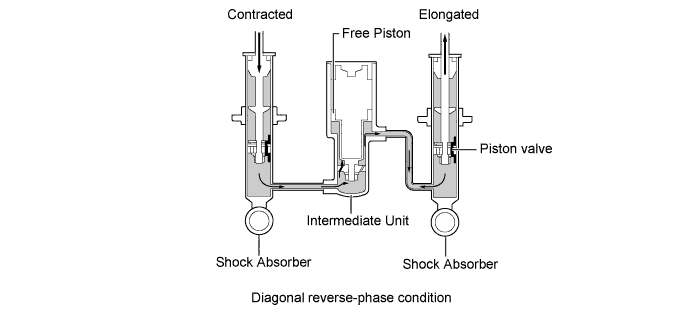
Diagonal Reverse-phase Condition
When the vehicle is leaning, such as when cornering, oil flows to the intermediate unit according to the change in volume in the contracted shock absorber rod, and this oil is then distributed to the elongated shock absorber via the valve in the intermediate unit.
At this time, the damping force generated in the intermediate unit is added to the damping force generated at the piston valves of the connected shock absorbers, optimizing the damping force.

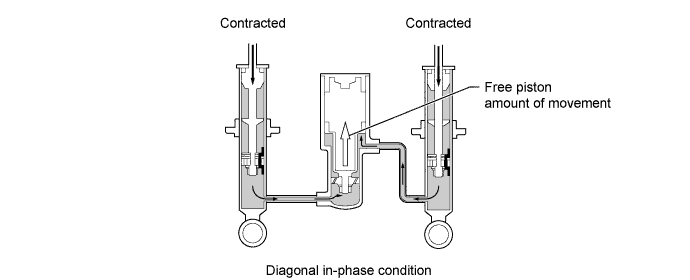
Diagonal In-phase Condition
When the front and rear shock absorbers are compressed on the same level, oil is simultaneously distributed from both sides to the intermediate unit according to the change in volume in the contracted shock absorber rods. Since the oil doesn't flow through the intermediate unit, damping force is not generated.
Since damping force is generated only by the piston valve inside the shock absorber under the above conditions, riding comfort is ensured.

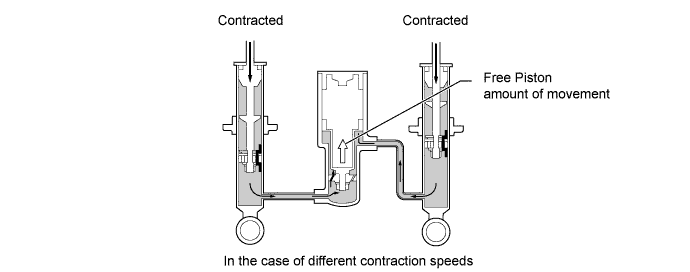
In the Case of Different Contraction Speeds
When there is a difference in the bounding speed of the tires located diagonally opposite, oil flows to the intermediate unit according to the change in volume of the shock absorber rod, moving the free piston.
When the amount of oil flowing into the front and rear shock absorbers varies, the difference in the amount of oil passes through the intermediate unit, at which time the damping force generated is added to the shock absorber, realizing the optimum damping force.