AUDIO / VIDEO AUDIO AND VISUAL SYSTEM(for Radio Receiver Type) SYSTEM DESCRIPTION
DISC PLAYER OUTLINE
A CD player uses a laser pickup to read digital signals recorded on CDs. By converting the digital signals to analog, music and other content can be played.
- CAUTION:
-
Do not look directly at the laser pickup because the CD player uses an invisible laser beam. Be sure to operate the player only as instructed.
- NOTICE:
- ·
Do not disassemble any part of the CD player.
·Do not apply oil to the CD player.
·Do not insert anything but a CD into the CD player.
Usable discs
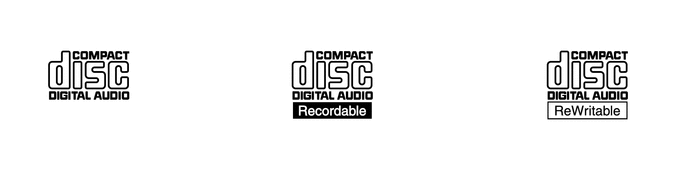
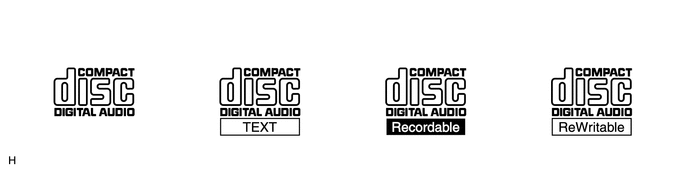
The CD player can only play audio CDs, CD-Rs (CD-Recordable), and CD-RWs (CD-ReWritable) that have any of the following marks:
for 1-DIN Type
for 2-DIN Type
Precautions for use of discs
- NOTICE:
- ·
Copy-protected CDs cannot be played.
·CD-Rs and CD-RWs may not be played depending on the recording conditions or characteristics of the discs, or due to damage, dirt, or deterioration caused by leaving the discs in the cabin for a long time.
·Unfinalized CD-Rs and CD-RWs cannot be played.
·Keep the discs away from dirt. Be careful not to damage the discs or leave your fingerprints on them.
·Hold discs by the outer edge and center hole with the label side up.
·Leaving the disc exposed halfway out of the slot for a long time after pressing the disc eject button may cause deformation of the disc, making the disc unusable.
·If discs have adhesive tape, stickers, CD-R labels, or any traces of such labels attached, the discs may not be ejected or player malfunctions may result.
·Keep the discs away from direct sunlight. (Exposure to direct sunlight may cause deformation of the disc, making the disc unusable.)
·Do not use odd-shaped CDs because these may cause player malfunctions.
·Do not use discs whose recording portion is transparent or translucent because they may not be inserted, ejected, or played normally.
- HINT:
- ·
When it is cold or it is raining, if the windows mist up, mist and condensation may form in the player. In such cases, the CD may skip or stop in the middle of play. Ventilate or dehumidify the cabin for a while before using the player.
·The CD may skip if the player experiences strong vibrations when the vehicle is driven on rough road or similar uneven surface(s).
Cleaning
- NOTICE:
-
Do not use a lens cleaner because it may cause a malfunction in the pickup portion of the player.
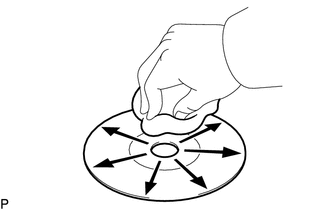
If dirt is on the disc surface, wipe it clean with a soft dry cloth such as an eyeglass cleaner for plastic lenses from the inside to the outside in a radial direction.
- NOTICE:
- ·
Pressing on the disc by hand or rubbing the disc with a hard cloth may scratch the disc surface.
·Use of solvent such as a record spray, antistatic agent, alcohol, benzine, and thinner, or a chemical cloth may cause damage to the disc, making the disc unusable.
MP3/WMA OUTLINE
- HINT:
-
Only MP3 is compatible with the 1-DIN type stereo component tuner assembly.
Playable MP3 file standards
| Compatible standard | MP3 (MPEG1 LAYER3, MPEG2 LSF LAYER3) |
| Compatible sampling frequency | ·
MPEG1 LAYER3: 32, 44.1, 48 (kHz) ·
MPEG2 LSF LAYER3: 16, 22.05, 24 (kHz) |
| Compatible bit rate | ·
MPEG1 LAYER3: 64, 80, 96, 112, 128, 160, 192, 224, 256, 320 (kbps) ·
MPEG2 LSF LAYER3: 64, 80, 96, 112, 128, 144, 160 (kbps) ·
Compatible with VBR |
| Compatible channel mode | Stereo, joint stereo, dual channel, monaural |
| Compatible standard (USB device) | MP3 (MPEG1 AUDIO LAYER2, 3, MPEG2 AUDIO LAYER2, 3, MPEG2.5) |
| Compatible sampling frequency | ·
MPEG1 AUDIO LAYER2, 3: 32, 44.1, 48 (kHz) ·
MPEG2 AUDIO LAYER2, 3: 16, 22.05, 24 (kHz) ·
MPEG2.5: 8, 11.025, 12 (kHz) |
| Compatible bit rate | ·
MPEG1 AUDIO LAYER2, 3: 32-320 (kbps) ·
MPEG1 AUDIO LAYER2, 3: 32-160 (kbps) ·
MPEG2.5: 32-160 (kHz) ·
Compatible with VBR |
| Compatible channel mode | Stereo, joint stereo, dual channel, monaural |
Playable WMA file standards
| Compatible standard | WMA Ver. 7, 8 and 9
(Compatible with DRM) |
| Compatible sampling frequency | 32, 44.1, 48 (kHz) |
| Compatible bit rate | ·
Ver. 7, 8: CBR48, 64, 80, 96, 128, 160, 192 (kbps) ·
Ver. 9: CBR48, 64, 80, 96, 128, 160, 192, 256, 320 (kbps) ·
Compatible with playback of channel 2 only |
| Compatible standard | WMA Ver. 7, 8 and 9
(Compatible with DRM) |
| Compatible sampling frequency | HIGH PROFILE 32, 44.1, 48 (kHz) |
| Compatible bit rate | HIGH PROFILE 32-320 (kbps, VBR) |
ID3 tag and WMA tag
Additional textual information called ID3 tag can be input to MP3 files. Information such as song titles and artist names can be stored.
- HINT:
-
This player is compatible with the ID3 tags of ID3 Ver. 1.0 and 1.1, and ID3 Ver. 2.2 and 2.3. (Number of characters complies with ID3 Ver. 1.0 and 1.1.)
Additional textual information called WMA tag can be input to WMA files. Information such as song titles and artist names can be stored.
Usable media
Only CD-ROMs, CD-Rs (CD-Recordable), and CD-RWs (CD-ReWritable) can be used to play MP3/WMA files.
- NOTICE:
- ·
CD-Rs and CD-RWs are more easily affected by a hot and humid environment than discs used for normal audio CDs. For this reason, some CD-Rs and CD-RWs do not play.
·If there are fingerprints or scratches on the disc, the disc may not play or the CD may skip.
·Some CD-Rs and CD-RWs may deteriorate if they are left in the cabin for a long time.
·Keep CD-Rs and CD-RWs in an opaque case.
Usable media format
Usable media format
| Disc format | CD-ROM Mode 1 and Mode 2, CD-ROM XA Mode 2 Form1 and Form 2 |
| File format | ISO9660 Level 1 and Level 2 (Joliet, Romeo) |
- HINT:
- ·
As for MP3/WMA files written in any unlisted format, the contents of the files may not play normally or the file names or folder names may not display correctly.
·This player is compatible with multi-session discs and can play CD-Rs and CD-RWs on which MP3/WMA files are added. However, only the first session can be played.
·Discs whose first session includes both music data and MP3 or WMA format data cannot be played.
Standard and restrictions
| Maximum directory levels | 8 levels |
| Maximum number of characters for a folder name/file name | 16 characters |
| Maximum number of folders | 192 (Including the root) |
| Maximum number of files in a disc | 255 |
| Maximum directory levels | 8 levels |
| Maximum number of characters for a folder name/file name | 16 characters |
| Maximum number of folders | 255 (Including the root) |
| Maximum number of files in a disc | 512 |
File names
Only files with an extension of ".mp3" or ".wma" can be recognized and played as MP3 or WMA files.
Save MP3 or WMA files with an extension of ".mp3" or ".wma".
- NOTICE:
-
If saving non-MP3 or non-WMA files with an extension of ".mp3" or ".wma", those files are wrongly recognized as MP3 or WMA files and played. A loud noise may occur and damage to the speaker may result.
USB AUDIO SYSTEM FUNCTION OUTLINE (for 2-DIN Type)
The stereo jack adapter assembly is equipped with a USB terminal. Connecting a USB device or "iPod" to the stereo jack adapter assembly allows music files to be played. Not only is it possible to play music from a USB device with audio functions or "iPod", it is also possible to play MP3 or WMA music files that are stored on a USB device or "iPod". In addition, "iPod" control software is installed, allowing file selection from playlists and operation using shuffle mode.
- HINT:
- ·
Visual content of a USB device or "iPod" cannot be played.
·Operation through the controls of a USB device or "iPod" cannot be performed while the USB device or "iPod" is connected.
USB audio system compatible model
USB Device
The following device formats can be used.
| Compatible USB device formats | ·
USB communication format: USB 2.0 FS (12 Mbps) ·
File format: FAT16/32 (Windows) ·
Class: Mass storage class |
USB devices that do not comply with the specifications listed above may not play correctly, and their file names and folder names may not be displayed correctly.
Standards and limitations are as follows:
Maximum number of directory levels: 8 levels
Maximum number of folders in device: 255 (including the root)
Maximum number of files in device: 65025
Maximum number of files per folder: 255
"iPod"
"iPod" is a trademark of Apple Inc., registered in the U.S. and other countries.
| Supported "iPod" Model | Supported Firmware Version |
|---|---|
| "iPod" 5th generation | Ver. 1.3.0 or higher |
| "iPod nano" 1th generation | Ver. 1.3.1 or higher |
| "iPod nano" 2th generation | Ver. 1.1.3 or higher |
| "iPod nano" 3th generation | Ver. 1.1.3 or higher |
| "iPod nano" 4th generation | Ver. 1.0.4 |
| "iPod nano" 5th generation | Ver. 1.0.3 or higher |
| "iPod touch" 1th generation | Ver. 3.1.2 or higher |
| "iPod touch" 2th generation | Ver. 3.1.2 or higher |
| "iPod classic" 1th generation | Ver. 1.1.2 or higher |
| "iPhone" 160GB | Ver. 2.0.3 or higher |
| Unsupported Models | "iPod shuffle" |
| "iPod" 1G, 2G, 3G, 4G | |
| "iPod mini" | |
| "iPod photo" |
- HINT:
- ·
"iPod" models and firmware versions that are not listed in "Supported Models and Firmware Versions" may not function, or may not function correctly.
·Depending on the generation of "iPod" used, response to commands from the vehicle may be delayed.
Items related to standards and limitations are as follows:
Maximum number of lists in device: 9999