A4R AUTOMATIC TRANSMISSION / TRANSAXLE AUTOMATIC TRANSMISSION SYSTEM HYDRAULIC TEST
PERFORM HYDRAULIC TEST
- CAUTION:
-
The line pressure test should always be carried out in pairs. One technician should observe the conditions of the wheels and wheel stoppers from outside the vehicle, while the other is doing the test.
- NOTICE:
- ·
Perform the test at the normal operating ATF (Automatic Transmission Fluid) temperature 70 to 90°C (158 to 194°F).
·Be careful to prevent SST hose from interfering with the exhaust pipe.
·This check must be conducted after checking and adjusting the engine.
·Use a new gasket for SST and measuring instrument.
·Perform under condition that A/C is OFF.
·When conducting a stall test, do not continue more than 5 seconds.
·Test plugs cannot be reused.
Pressure gauge installation procedure.
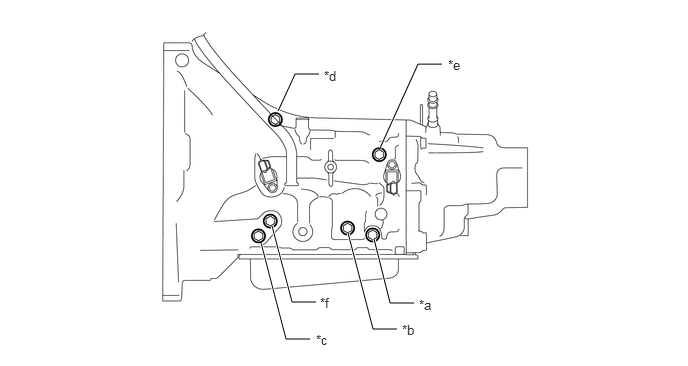
| *a | B1 pressure | *b | C2 pressure |
| *c | C3 pressure | *d | Lock-up ON pressure |
| *e | B2 pressure | *f | Lock-up OFF pressure |
Warm up the ATF.
Remove the transmission oil level tube sub-assembly.
Remove the test plug on the left side of the transmission case and connect SST.
- SST
- 09325-87201 09992-00095 (09992-00271)
Inspect C2 pressure.
Set the parking brake and chock.
Start the engine.
Keep your left foot pressed firmly on the brake pedal and move the shift lever to D.
Depress the accelerator pedal all the way down. Quickly read the highest hydraulic pressure when the engine speed reaches stall speed.
Inspect B2 pressure
Set the parking brake and chocks.
Start the engine.
Keep your left foot pressed firmly on the brake pedal and move the shift lever to R.
Depress the accelerator pedal all the way down. Quickly read the highest hydraulic pressure when the engine speed reaches stall speed.
Inspect B1 pressure
Jack up 4 wheels and support the vehicle with a rigid rack.
Start the engine.
Move the shift lever to D and gradually depress the accelerator pedal to change the gear into 2nd. Measure the hydraulic pressure at 2000 rpm of engine speed.
Inspect C3 pressure
Jack up 4 wheels and support the vehicle with a rigid rack.
Start the engine.
Move the shift lever to D and gradually depress the accelerator pedal to change the gear into 3rd. Measure the hydraulic pressure with the pedal released.
Inspect Lock-up OFF pressure
Jack up 4 wheels and support the vehicle with a rigid rack.
Start the engine.
Move the shift lever to D and measure the hydraulic pressure (hydraulic pressure when lock-up is OFF).
Gradually depress the accelerator pedal to change the gear into 4th. Further accelerate and measure the hydraulic pressure with the gear locked-up. (hydraulic pressure when lock-up is ON)
- HINT:
-
Under the condition that the vehicle speed is approximately 62 to 77 km/h (39 to 48 mph) and throttle angle is 5 to 20%, the 4th lock-up turns ON.
- Specified hydraulic pressure:
Item Shift Position Condition Specified Condition C2 D Stall test 930 to 1130 kPa
(9.5 to 11.5 kgf/cm2, 135 to 164 psi)B2 R Stall test 1770 to 2370 kPa
(18.0 to 24.2 kgf/cm2, 257 to 344 psi)C3 D 3rd gear and accelerator pedal fully released (Lock-up OFF) 250 to 450 kPa
(2.5 to 4.6 kgf/cm2, 36 to 65 psi)B1 D 2nd gear and engine speed 2000 rpm 930 to 1130 kPa
(9.5 to 11.5 kgf/cm2, 135 to 164 psi)Lock up OFF 2 When Lock-up OFF 550 to 710 kPa
(5.6 to 7.2 kgf/cm2, 80 to 103 psi)D When Lock-up ON 20 or less kPa
(0.2 or less kgf/cm2, 2.9 or less psi)
- Evaluation:
Problem Possible Cause Measured values are higher than specified values in all positions Shift solenoid valve defective Measured values are lower than specified values in all positions ·Shift solenoid valve defective
·Oil pump defective
Pressure is low in D only ·D position circuit fluid leak
·Forward clutch (C2) defective
Pressure is low in R only ·R position circuit fluid leak
·Reverse clutch (C1) defective
·1st and reverse brake (B2) defective