P0011 Camshaft Position "A" - Timing Over-Advanced or System Performance (Bank 1)
Diagnostic trouble codes · Vehicles built Oct 2006 – May 2009
Also covers:
- P0012 Camshaft Position "A" - Timing Over-Retarded (Bank 1)
Versions by build date: Jun 2006 – Sep 2006 Oct 2006 – May 2009 from Jun 2009
DESCRIPTION
- HINT:
- If DTC P0011 or P0012 is present, check the VVT (Variable Valve Timing) system.
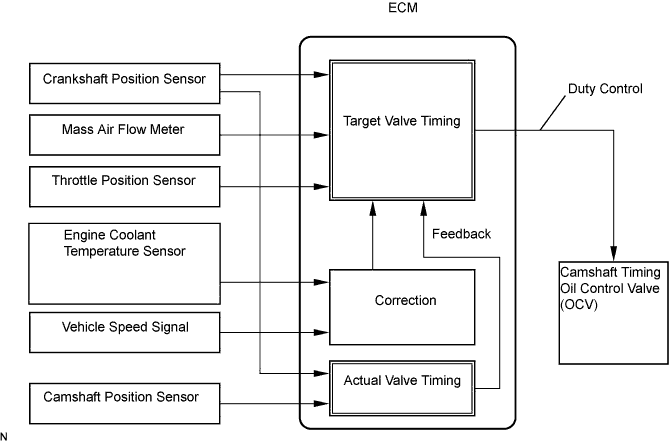

| DTC No. |
DTC Detection Condition |
Trouble Area |
| P0011 |
Advanced camshaft timing: With warm engine and engine speed of between 550 rpm and 4,000 rpm, all conditions (1), (2) and (3) are met (1-trip detection logic): 1. Difference between target and actual intake valve timings is more than 5°CA (Crankshaft Angle) for 4.5 seconds 2. Current intake valve timing is fixed (timing changes less than 5°CA in 5 seconds) 3. Variations in VVT controller timing is more than 19°CA of maximum delayed timing (malfunction in advanced timing) |
|
| P0012 |
Retarded camshaft timing: With warm engine and engine speed of between 550 rpm and 4,000 rpm, all conditions (1), (2) and (3) are met (2-trip detection logic): 1. Difference between target and actual intake valve timings is more than 5°CA (Crankshaft Angle) for 4.5 seconds 2. Current intake valve timing is fixed (timing changes less than 5°CA in 5 seconds) 3. Variations in VVT controller timing is 19°CA or less of maximum delayed timing (malfunction in retarded timing) |
|
WIRING DIAGRAM
Refer to DTC P0010 (Click here).INSPECTION PROCEDURE
- NOTICE:
- DTC P0011 or P0012 may be set when foreign objects in the engine oil are caught in some parts of the system. The DTC will remain set even if the system returns to normal after a short time. Foreign objects are filtered out by the oil filter.
- HINT:
- Read freeze frame data using the intelligent tester. The ECM records vehicle and driving condition information as freeze frame data the moment a DTC is stored. When troubleshooting, freeze frame data can help determine if the vehicle was moving or stationary, if the engine was warmed up or not, if the air-fuel ratio was lean or rich, and other data from the time the malfunction occurred.
| 1. CHECK ANY OTHER DTCS OUTPUT (IN ADDITION TO DTC P0011 OR P0012) |

Connect the intelligent tester to the DLC3.
Turn the ignition switch to the ON position and turn the tester on.
Select the following menu items: Powertrain / Engine and ECT / DTC.
Read the DTCs.
- Result:
Display (DTC Output)
Proceed to
P0011 or P0012
A
P0011 or P0012 and other DTCs
B
- HINT:
- If any DTCs other than P0011 or P0012 are output, troubleshoot those DTCs first.
|
|
||||

| A | |
 |
| 2. PERFORM ACTIVE TEST USING INTELLIGENT TESTER (OPERATE OCV) |
Connect the intelligent tester to the DLC3.
Start the engine and turn the tester on.
Warm up the engine.
Select the following menu items: Powertrain / Engine and ECT / Active Test / Control the VVT System (Bank 1).
Check the engine speed while operating the Oil Control Valve (OCV) using the tester.
- OK:
Tester Operation
Specified Condition
OCV OFF
Normal engine speed
OCV ON
Engine idles roughly or stalls
(soon after OCV switched from OFF to ON)
|
|
||||

| OK | |
|
| 3. CHECK WHETHER DTC OUTPUT RECURS (DTC P0011 OR P0012) |
Connect the intelligent tester to the DLC3.
Turn the ignition switch to the ON position and turn the tester on.
Clear the DTCs (Click here ).
Start the engine and warm it up.
Switch the ECM from normal mode to check mode using the tester.
Drive the vehicle for more than 10 minutes.
Read the DTCs using the tester.
- OK:
- No DTC output.
|
|
||||
| OK | ||
 |
||
| ||
| 4. CHECK VALVE TIMING (CHECK FOR LOOSE AND JUMPED TEETH ON TIMING CHAIN) |
Remove the cylinder head cover.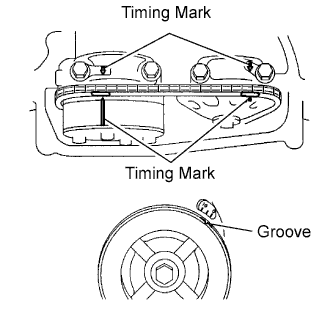
Turn the crankshaft pulley, and align its groove with the timing mark "0" on the timing chain cover.
Check that the timing marks on the camshaft timing sprocket and camshaft timing gear are facing upward as shown in the illustration.
- If not, turn the crankshaft 1 revolution (360°), then align the marks as above.
- OK:
- The timing marks on the camshaft timing gears are aligned as shown in the illustration.
- If not, turn the crankshaft 1 revolution (360°), then align the marks as above.
Reinstall the cylinder head cover.
|
|
||||
| OK | |
|
| 5. INSPECT CAMSHAFT TIMING OIL CONTROL VALVE ASSEMBLY (OCV) |
Disconnect the C32 OCV connector.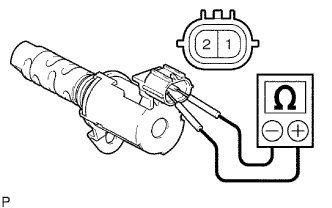
Measure the resistance between the terminals of the OCV.
- Standard resistance:
- 6.9 to 7.9 Ω at 20°C (68°F)
Apply positive battery voltage to terminal 1 and negative battery voltage to terminal 2. Check the valve operation.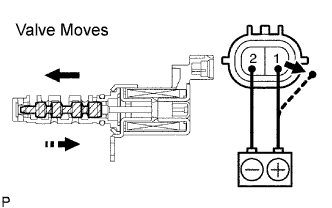
- OK:
- Valve moves quickly.
Reconnect the OCV connector.
|
|
||||
| OK | |
|
| 6. INSPECT OIL CONTROL VALVE FILTER |
Remove the OCV filter.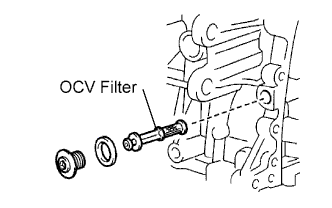
Check that the filter is not clogged.
- OK:
- Filter is not clogged.
Reinstall the OCV filter.
|
|
||||
| OK | |
|
| 7. REPLACE CAMSHAFT TIMING GEAR ASSEMBLY |
| NEXT | |
|
| 8. CHECK WHETHER DTC OUTPUT RECURS (DTC P0011 OR P0012) |
Connect the intelligent tester to the DLC3.
Turn the ignition switch to the ON position and turn the tester on.
Clear the DTCs (Click here).
Start the engine and warm it up.
Switch the ECM from normal mode to check mode using the tester.
Drive the vehicle for more than 10 minutes.
Read the output DTCs using the tester.
- OK:
- No DTC output.
- HINT:
- DTC P0011 or P0012 is output when foreign objects in engine oil are caught in some parts of the system. These codes will stay output for a short time even after the system returns to normal. These foreign objects are then captured by the oil filter, thus eliminating the source of the problem.
|
|
||||
| OK | ||
|
||
| ||