 |
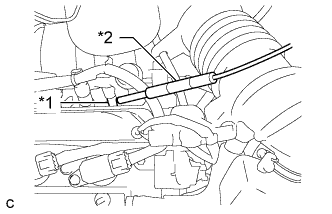
Use a sound scope to check for injector operating sounds.
| *1 | Injector |
| *2 | Sound scope |
EMISSION CONTROL SYSTEM > ON-VEHICLE INSPECTION |
| 1. CHECK FUEL CUT RPM |
Start and warm up the engine.
Increase the engine speed to at least 3000 rpm.
|
Use a sound scope to check for injector operating sounds.
| *1 | Injector |
| *2 | Sound scope |
When the accelerator pedal is released, check that injector operating sounds stop momentarily (at 2500 rpm or higher) and then resume (at 1400 rpm).
| Item | Specified Condition |
| Fuel cut off rpm | 2500 rpm or higher |
| Fuel injection restart rpm | 1400 rpm |
| 2. VISUALLY INSPECT HOSES, CONNECTIONS AND GASKETS |
Visually check that the hoses, connections and gaskets have no cracks, leaks or damage.
| 3. INSPECT EVAPORATIVE EMISSION CONTROL SYSTEM |
Connect the intelligent tester to the DLC3.
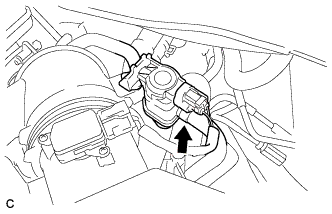 |
Disconnect the fuel vapor feed hose from the purge VSV shown in the illustration.
Start the engine.
Enter the following menus: Powertrain / Engine and ECT / Active Test / Activate the VSV for Evap Control.
Check that vacuum occurs at the purge VSV port.
If vacuum does not occur, check the following items.
Exit Active Test mode and reconnect the fuel vapor feed hose.
Enter the following menus: Powertrain / Engine and ECT / Data List / EVAP Purge VSV.
Warm up the engine and drive the vehicle.
Confirm that the purge VSV opens.
If the result is not as specified, replace the purge VSV, wire harness or ECM.