THEFT DETERRENT / KEYLESS ENTRY SMART ENTRY AND START SYSTEM(for Entry Function) All Door Entry Lock/Unlock Functions do not Operate, but Wireless Functions Operate
DESCRIPTION
When the wireless operation can be used to lock and unlock the doors, communication between the door control receiver and certification ECU (smart key ECU assembly) is normal. If the entry lock and unlock functions do not operate, the entry cancel function may be set through the customize function, there may be communication problems between the electrical key transmitter sub-assembly and vehicle, or there may be wave interference.
CAUTION / NOTICE / HINT
- NOTICE:
- ·
The smart entry and start system (for Entry Function) uses a multiplex communication system (LIN communication system) and the CAN communication system. Inspect the communication function by following How to Proceed with Troubleshooting. Troubleshoot the smart entry and start system (for Entry Function) after confirming that the communication systems are functioning properly.
·When using the intelligent tester with the engine switch off to troubleshoot:
Connect the intelligent tester to the DLC3 and turn a courtesy light switch on and off at 1.5-second intervals until communication between the intelligent tester and vehicle begins.
·Check that there are no electrical key transmitter sub-assemblies in the vehicle.
·Before performing the inspection, check that DTC B1242 (wireless door lock control) is not output (See page Vehicle Interior>DOOR LOCK>WIRELESS DOOR LOCK CONTROL SYSTEM(w/ Smart Entry and Start System)>DTC CHECK / CLEAR).
·Before replacing the certification ECU (smart key ECU assembly) or electrical key transmitter sub-assembly, refer to the smart entry and start system (for Entry Function) precaution (See page Vehicle Interior>THEFT DETERRENT / KEYLESS ENTRY>SMART ENTRY AND START SYSTEM(for Entry Function)>PRECAUTION).
·After repair, confirm that no DTCs are output by performing the "DTC Output Confirmation Operation".
PROCEDURE
Check for DTCs.
- Body Electrical > Entry&Start > Trouble Codes
- 50001 125
- OK:
DTC is not output.
- Result:
Proceed to OK NG
OK
NG
Connect the intelligent tester to the DLC3.
Turn the engine switch on (IG).
Turn the intelligent tester on.
Enter the following menus: Body / Entry&Start / Data List.
Read the Data List according to the display on the intelligent tester.
- Body Electrical > Entry&Start > Data List
-
Tester Display Measurement Item Range Normal Condition Diagnostic Note Auto Entry Cancel SW Entry cancel function setting OFF or ON Mode status displayed
ON: Smart entry and start system canceled
OFF: Smart entry and start system not canceledThe default setting for the entry cancel function is OFF. If the customer requests that the smart entry and start system functions (locking and unlocking the doors while carrying the electrical key transmitter sub-assembly, etc.) be canceled, the setting can be changed through the customize function.*
- Body Electrical > Entry&Start > Data List
-
Tester Display Auto Entry Cancel SW - 50003 125 32
- HINT:
-
If the Data List cannot be read, check the value by performing manual operation of the customize function.
- Result:
Result Proceed to Entry door lock function cancel is OFF A Entry door lock function cancel is ON B
A
B
Move the electrical key transmitter sub-assembly as described below and perform the operation inspection.
- HINT:
- ·
When the electrical key transmitter sub-assembly is brought near the front door outside handle assembly (for driver door) or electrical key antenna, the possibility of wave interference decreases, and it can be determined if wave interference is causing the problem symptom.
·The transmitting wave of the wireless function and entry function are the same, but the wave logic is different. As a result, it is possible that only the wireless function or only the entry function is affected by wave interference.
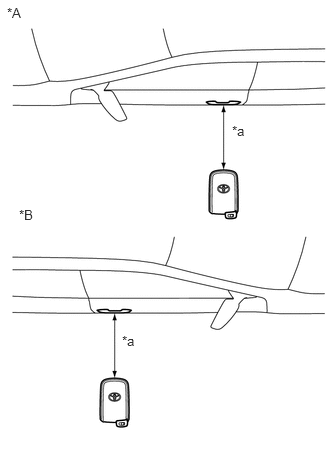
| *A | *for LHD |
| *B | *for RHD |
| *a | Approximately 0.3 m (0.984 ft.) |
Bring the electrical key transmitter sub-assembly approximately 0.3 m (0.984 ft.) from the front door outside handle assembly (for driver door) and perform a driver door entry lock and unlock operation check.
- NOTICE:
-
If the electrical key transmitter sub-assembly is brought within 0.2 m (0.656 ft.) of the door handle, communication may not be possible.
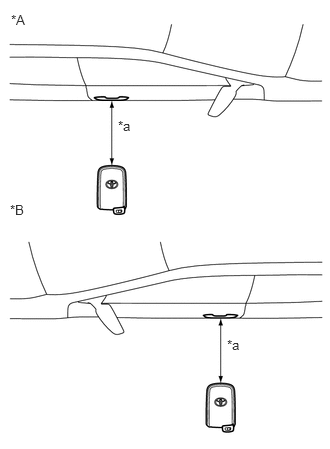
| *A | for LHD |
| *B | for RHD |
| *a | Approximately 0.3 m (0.984 ft.) |
Bring the electrical key transmitter sub-assembly approximately 0.3 m (0.984 ft.) from the front dooroutside handle assembly (for front passenger door)and perform a front passenger door entry lock andunlock operation check.
- NOTICE:
-
If the electrical key transmitter sub-assembly is brought within 0.2 m (0.656 ft.) of the door handle, communication may not be possible.
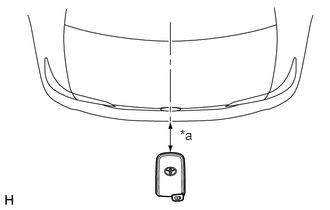
| *a | Approximately 0.3 m (0.984 ft.) |
Bring the electrical key transmitter sub-assembly approximately 0.3 m (0.984 ft.) from the electrical key antenna (outside luggage) and perform a luggage compartment door open function check.
- NOTICE:
-
If the electrical key transmitter sub-assembly is brought within 0.2 m (0.656 ft.) of the rear bumper, communication may not be possible.
- HINT:
- ·
If the inspection result is that the problem only occurs in certain locations or at certain times of day, the possibility of wave interference is high. Also, added vehicle components may cause wave interference. If installed, remove them and perform the operation check.
·If wave interference seems to be the likely cause of the problem, ask the customer if the problem occurs in specific locations.
·Move the vehicle to a different location, perform the following procedure and check if the symptoms can be reproduced.
·If a tool for checking electric waves, such as a signal strength meter, is available, move around the area while observing both the LF band (used by the vehicle antenna to form the detection area) and RF band (used by the electrical key transmitter sub-assembly for transmission) to check for locations where there is wave interference.
- Result:
Result Proceed to All operation checks fail A All operation checks are normal B Some operation checks are normal C
A
B
C
Check the following antennas in the key diagnostic mode.
Select either channel 1 or channel 2 and inspect the key diagnostic mode for each channel.
- HINT:
-
If the buzzer sounds with [CH1] displayed but not with [CH2], the electrical key transmitter sub-assembly cannot be detected by channel 2 due to a malfunction, such as wave interference.
| *A | for LHD |
| *B | for RHD |
| *a | 0.7 to 1 m (2.30 to 3.28 ft.) |
Check the electrical key antenna (for driver door):
When the electrical key transmitter sub-assembly is brought within 0.7 to 1 m (2.30 to 3.28 ft.) of the front door outside handle assembly (for driver door), check that the wireless door lock buzzer sounds.
- Body Electrical > Entry&Start > Utility
-
Tester Display Communication Check(Key Diag Mode) - 50005 125 143
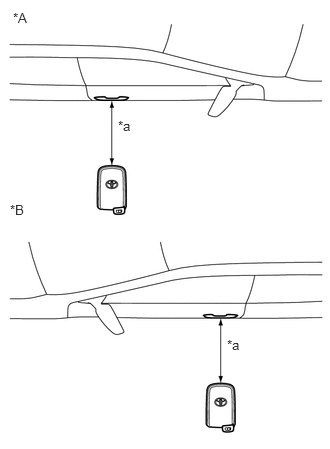
| *A | for LHD |
| *B | for RHD |
| *a | 0.7 to 1 m (2.30 to 3.28 ft.) |
Check the electrical key antenna (for front passenger door):
When the electrical key transmitter sub-assembly is brought within 0.7 to 1 m (2.30 to 3.28 ft.) of the front door outside handle assembly (for front passenger door), check that the wireless door lock buzzer sounds.
- Body Electrical > Entry&Start > Utility
-
Tester Display Communication Check(Key Diag Mode) - 50005 125 143
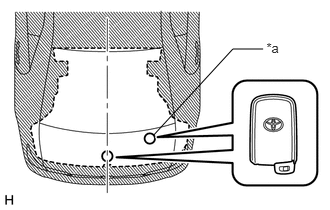
| *a | Inspection Point |
Check the No. 3 indoor electrical key antenna (inside luggage compartment):
When the electrical key transmitter sub-assembly is at the inspection point, check that the wireless door lock buzzer sounds.
- Body Electrical > Entry&Start > Utility
-
Tester Display Communication Check(Key Diag Mode) - 50005 125 143
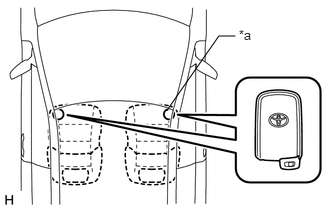
| *a | Inspection Point |
Check the No. 1 indoor electrical key antenna (front floor):
When the electrical key transmitter sub-assembly is at the inspection point, check that the wireless door lock buzzer sounds.
- Body Electrical > Entry&Start > Utility
-
Tester Display Communication Check(Key Diag Mode) - 50005 125 143
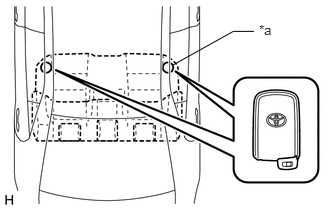
| *a | Inspection Point |
Check the No. 2 indoor electrical key antenna (rear floor):
When the electrical key transmitter sub-assembly is at the inspection point, check that the wireless door lock buzzer sounds.
- Body Electrical > Entry&Start > Utility
-
Tester Display Communication Check(Key Diag Mode) - 50005 125 143
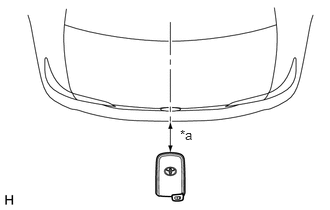
| *a | 0.7 to 1 m (2.30 to 3.28 ft.) |
Check the electrical key antenna (outside luggage):
When the electrical key transmitter sub-assembly is brought within 0.7 to 1 m (2.30 to 3.28 ft.) of the electrical key antenna (outside luggage), check that the wireless door lock buzzer sounds.
- Body Electrical > Entry&Start > Utility
-
Tester Display Communication Check(Key Diag Mode) - 50005 125 143
- OK:
Wireless door lock buzzer sounds.
- Result:
Result Proceed to All diagnostic mode inspections fail A Some diagnostic mode inspections fail (door) B Some diagnostic mode inspections fail (interior) C Some diagnostic mode inspections fail (luggage compartment door) D All diagnostic mode inspections are normal E
A
B
C
D
E
Check if there is another electrical key transmitter sub-assembly available that is already registered to the vehicle.
- Result:
Result Proceed to Another registered electrical key transmitter sub-assembly is not available A Another registered electrical key transmitter sub-assembly is available B
A
B
Register a new electrical key transmitter sub-assembly.
- HINT:
-
Refer to the Service Bulletin.
- Result:
Proceed to NEXT
NEXT
Check the operation of the entry lock function.
- OK:
Entry lock function operates normally.
- Result:
Proceed to OK NG
OK
NG