LIGHTING SYSTEM > GENERAL |
| OUTLINE |
Exterior Lights
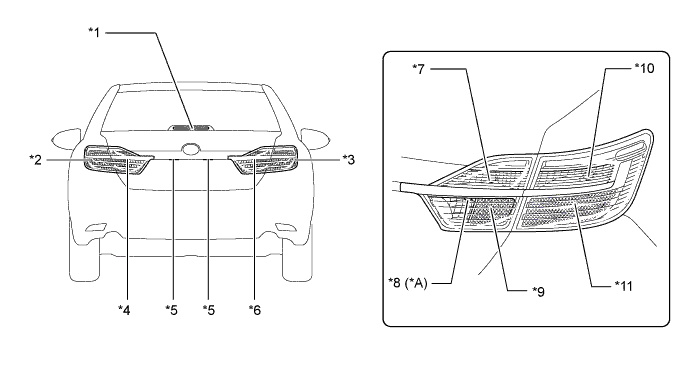
The exterior lights consist of the following:
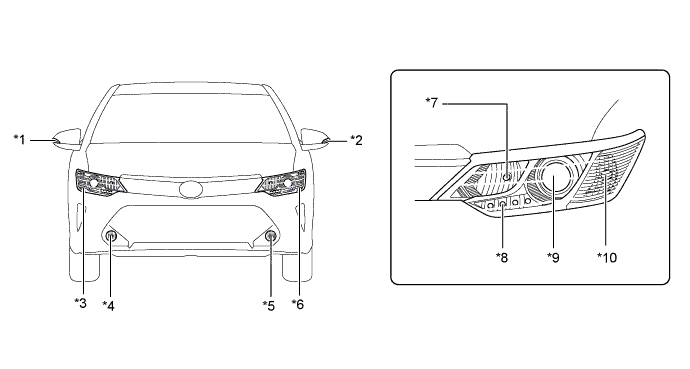
| *1 | Side Turn Signal Light RH | *2 | Side Turn Signal Light LH |
| *3 | Headlight Assembly RH | *4 | Fog Light Assembly RH |
| *5 | Fog Light Assembly LH | *6 | Headlight Assembly LH |
| *7 | High Beam | *8 | Clearance Light/Daytime Running Light |
| *9 | Low Beam | *10 | Front Turn Signal Light |

| *A | Models with Rear Fog Lights | - | - |
| *1 | High Mounted Stop Light (Center Stop Light Set) | *2 | Rear Combination Light Assembly LH |
| *3 | Rear Combination Light Assembly RH | *4 | Rear Light Assembly LH |
| *5 | License Plate Light | *6 | Rear Light Assembly RH |
| *7 | Back-up Light | *8 | Rear Fog Light |
| *9 | Taillight | *10 | Rear Turn Signal Light |
| *11 | Taillight and Stop Light | - | - |
Daytime Running Light System
The daytime running light system is designed to automatically illuminate the daytime running lights during the daytime to keep the vehicle highly visible to other vehicles.
High Intensity Discharge (HID) Headlight System
The HID headlight system uses a metal halide bulb as the light source for each low beam. Discharge bulbs are superior to halogen bulbs.
Automatic Headlight Beam Level Control System
When the headlights are on, the automatic headlight beam level control system operates the headlight leveling motors in accordance with movement of the vehicle.
Automatic Light Control System
When the dimmer switch is in the AUTO position, the light control sensor detects the ambient light level and automatically turns the headlights, taillights, clearance lights and license plate lights on or off accordingly.
This system is controlled by the main body ECU (multiplex network body ECU).
Light Auto Turn-off System
The light auto turn-off system is used to prevent the driver from leaving the vehicle with the headlights, front fog lights, clearance lights, taillights or license plate lights on.
Lane Change Flasher System
The lane change flasher system flashes the turn signal light 3 times when the turn signal switch (headlight dimmer switch assembly) is operated partway up or partway down. By using the lane change flasher system when changing lanes, it is no longer necessary to hold the turn signal switch in the lane change position.
| MAJOR DIFFERENCE |
The new models have been modified from the previous models as shown below:
The exterior light design has been changed.
The combination meter assembly design has been changed.
The LED type clearance lights/daytime running lights have been added.
The taillights and stop lights have been changed to LED type.
| SPECIFICATION |
| Light | Type | Wattage | |
| Headlight Assembly | High Beam | HB3 | 60 |
| Low Beam | DS4 | 35 | |
| Front Turn Signal Light | WY21W | 21 | |
| Clearance Light/Daytime Running Light | LED | 0.4/6.8 | |
| Side Turn Signal Light Assembly (LH, RH) | W5W | 5 | |
| Front Fog Light Assembly | H11 | 55 | |
| Rear Light Assembly | Backup Light | W16W | 16 |
| Taillight | LED | 0.3 | |
| Rear Fog Light* | W21W | 21 | |
| Rear Combination Light Assembly | Taillight/Stop Light | LED | 0.1/2.8 |
| Turn Signal Light | WY21W | 21 | |
| High Mounted Stop Light (Center Stop Light Set) | LED | 0.8 | |
| License Plate Light | W5W | 5 | |
| MAIN FEATURES |
High Intensity Discharge (HID) Headlight System
The light emitted by the bulb is close in color to sunlight. The light shines ahead over a broader area and farther forward, increasing the area visible to the driver.
Less power is consumed compared to halogen headlights.
| PRECAUTION |
High Intensity Discharge (HID) Headlight System
When the HID headlights illuminate, a high voltage (approximately 30000 V) is applied momentarily to the bulb sockets. Never connect a tester to the high voltage socket of an HID headlight for measurement, as this may lead to a serious accident due to high voltage.
Whenever inspecting the HID headlight system, make sure that water or rain is not present, the dimmer switch is off, the battery terminal is disconnected, and the connector of the light control ECU is disconnected in order to prevent electric shock.
Whenever operating the HID headlights, make sure that the headlight assembly is complete and never operate the system without bulbs installed.
Do not operate the HID headlights using a power source other than the vehicle's.
When there is a defect in an HID headlight or any shock has been applied to it, replace the bulb with a new one.
A discharge bulb reaches a high temperature when it is illuminated. For this reason, the life of the bulb could be shortened if any oil comes in contact with the glass portion of the bulb. Do not touch the glass portion of a bulb with bare hands.