1BZ-FPE ENGINE CONTROL ELECTRONIC CONTROLLED CARBURETOR SYSTEM CONTROL AIR FUEL RATIO CONTROL
FUNCTION
Outline
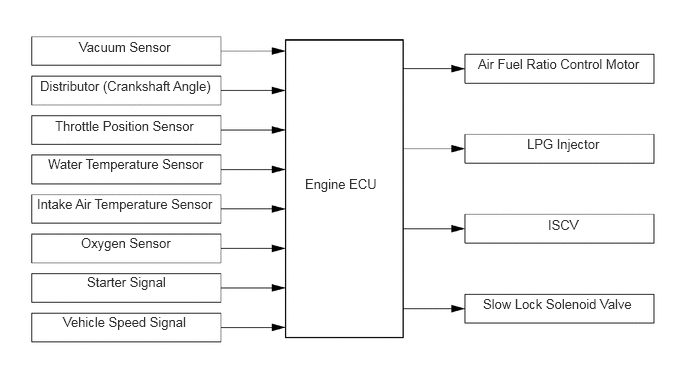
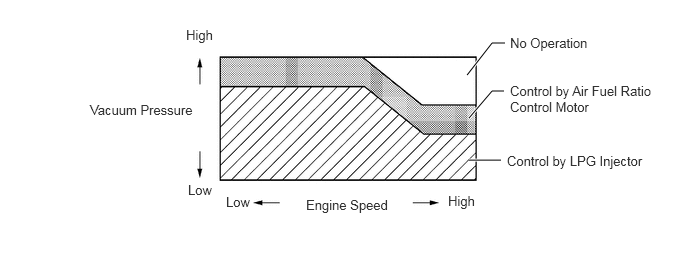
Based on the sensor signal, the engine ECU controls the air fuel ratio by calculating the fuel flow volume that is appropriate for the engine condition. This control realizes an optimal air-fuel ratio at all times by making fuel corrections through the feedback control effected by both the air-fuel ratio control motor and the LPG injector.
Air Fuel Ratio Control Motor Control
The air-fuel ratio control motor provided in the LPG carburetor controls the fuel flow volume in the main passage.
A step motor has been adopted for the air-fuel ratio control motor, which varies in 0 to 100 steps.
Basic Fuel Flow Volume
Determined in accordance with engine speed.
Intake Air Temperature Correction
increases the fuel fiow volume when the intake air temperature is low because the air density becomes high.
Water Temperature Correction
The lower the water temperature, the greater the fuel flow volume becomes in order to ensure drivability immediately following cold-starting.
Learning Correction
Under air-fuel ratio feedback control, this function learns and corrects the deviation from the stoichiometric air-fuel ratio when the water temperature is higher than 70°C.
Heavy Load Correction
When the engine ECU determines a heavy load condition based on the signals from the sensors, this function increases the fuel flow volume.
LPG Injector Control
The LPG injector that is provided in the LPG caburetor injects correction fuel.
Basic Injection Time
Determined in accoordance with the intake pressure and the engine speed.
Injection Time Correction
Intake Air Temperature Correction
Corrects by increasing the fuel flow volume when the intake air temperature is low because the air density becomes high.
Water Temperature Correction
Corrects by decreasing the fuel flow volume when the water temperature is low to prevent the air-fuel ratio from becoming too rich.
Learning Correction
Under air-fuel ratio feedback control, this function learns and corrects the deviation from the stoichiometric air-fuel ratio when the water temperature is higher than 70°C.
Slow Lock Solenoid Valve Control
When the engine speed is higher than the fuel cutoff rpm during deceleration, the slow lock solenoid valve provided in the LPG regulator cuts off the fuel in the flow passage in order to improve fuel economy.
LPG Solenoid Valve Control
When the engine is started, the valve opens in accordance with the signals from the engine ECU, in order to send the fuel to the LPG regulator.
When the engine speed is high (3000 rpm under no-load, or 4100 rpm while driving), the valve closes to prevent the engine from overrunning.