2TR-FE ENGINE MECHANICAL ENGINE UNIT DETAILS BALANCE SHAFT
CONSTRUCTION
For in-line 4-cylinder engines, the main cause of vibration is imbalanced inertial force of reciprocating parts such as the pistons and connecting rods. The engine vibration has been reduced by using 2 balance shafts to cancel the imbalanced inertial force, thereby reducing engine noise (booming noise).
2 balance shafts are built into the cylinder block. Using a chain, crankshaft timing sprocket, balance shaft timing sprocket, balance shaft drive gear and balance shaft timing gear, both balance shafts rotate at twice the speed of the crankshaft with each balance shaft rotating in the opposite direction of the other.
The chain tensioner uses a spring and oil pressure to maintain proper chain tension at all times. A ratchet type non-return mechanism is also included.
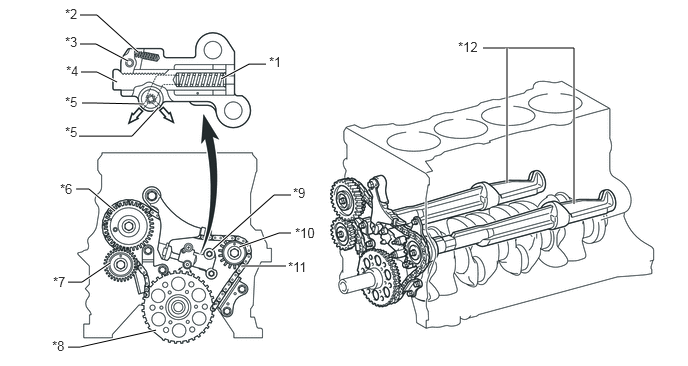
| *1 | Spring | *2 | Cam Spring |
| *3 | Cam | *4 | Plunger |
| *5 | Oil Hole | *6 | Balance Shaft Drive Gear |
| *7 | Balance Shaft Driven Gear | *8 | Crankshaft Timing Sprocket |
| *9 | Chain Tensioner | *10 | Balance Shaft Timing Sprocket |
| *11 | Balance Shaft Chain | *12 | Balance Shaft |

|
Engine Oil | - | - |
OPERATION
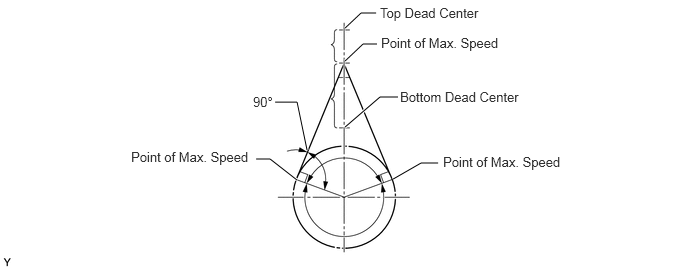
In the in-line 4-cylinder engine, the crankshaft angles for No. 1 and No. 4 cylinders are at the exact opposite (180°) positions of No. 2 and No. 3 cylinders. Therefore, the inertial force of the pistons and the connecting rods of the former 2 cylinders and of the latter 2 cylinders almost cancel each other out. However, because the position at which the piston reaches its maximum speed is located toward the top dead center from the center of the stroke, the upward inertial force is greater than the downward inertial force. This unbalanced secondary inertial force is generated twice for each rotation of the crankshaft.
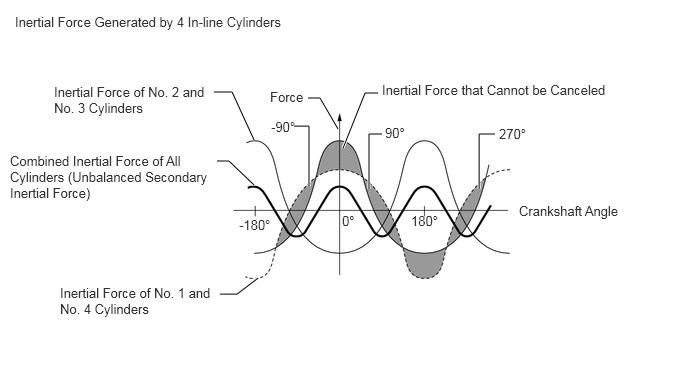
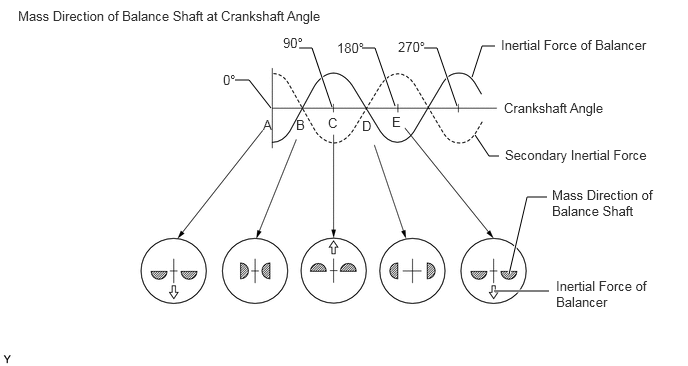
To cancel the unbalanced secondary inertial force, 2 balance shafts are rotated twice for each rotation of the crankshaft and generate inertial force in the opposite direction. Also, in order to cancel the inertial force generated by the balance shaft itself, the balance shaft actually consists of 2 shafts rotating in opposite directions.