1HZ ENGINE MECHANICAL CYLINDER BLOCK CYLINDER BLOCK INSPECTION
PROCEDURE

 1.REMOVE GASKET MATERIAL
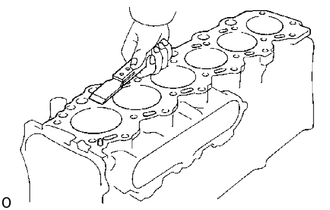
Using a gasket scraper, remove all the gasket material from the cylinder block surface.
11401
2.CLEAN CYLINDER BLOCK
Using a soft brush and solvent, clean the cylinder block.
3.INSPECT TOP OF CYLINDER BLOCK FOR FLATNESS
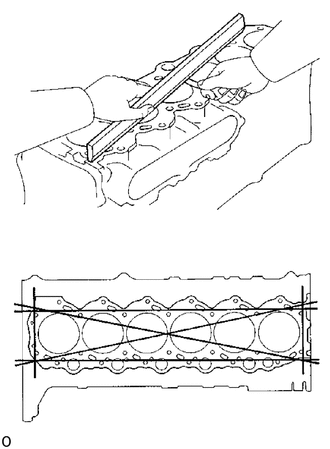
Using a precision straight edge and thickness gauge, measure the surfaces contacting the cylinder head gasket for warpage.
- Maximum warpage:
0.20 mm (0.0079 in,)
If warpage is greater than maximum, replace the cylinder block.
4.INSPECT CYLINDER FOR VERTICAL SCRATCHES
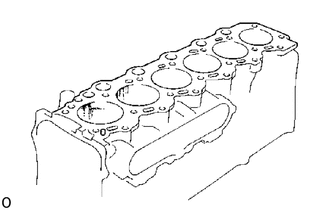
Visually check the cylinder for vertical scratches.
If deep scratches are present, rebore all five (1PZ) or six (1HZ and 1HD-T) cylinders. If necessary, replace the cylinder block.
5.INSPECT CYLINDER BORE DIAMETER
- HINT:
-
-
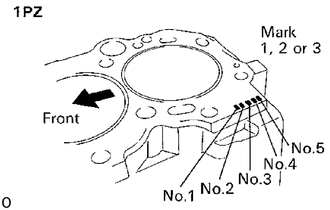
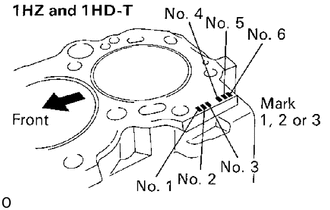
There are three sizes of the standard cylinder bore diameter, marked "1 ", "2" and "3" accordingly. The mark is stamped on the upper left rear of the cylinder block.
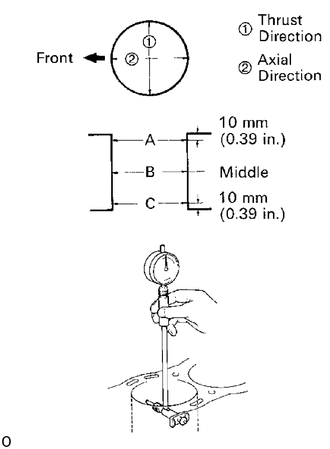
Using a cylinder gauge, measure the cylinder bore diameter at positions A, B and C in the thrust axial directions.
- Standard diameter:
- STD Mark "1":
94.000 - 94.010 mm (3.7008 - 3.7012 in.)
- Mark "2":
94.010 - 94.020 mm (3.7012 - 3.7016 in.)
- Mark "3":
94.020 - 94.030 mm (3.7016 - 3.7020 in.)
- Maximum diameter:
- STD:
94.23 mm (3.7098 in.)
- O/S 0.50:
94.73 mm (3.7295 in.)
If the diameter is greater than maximum, rebore all five (1PZ) or six (1HZ and 1HD-T) cylinders.
If necessary, replace the cylinder block.
6.REMOVE CYLINDER RIDGE
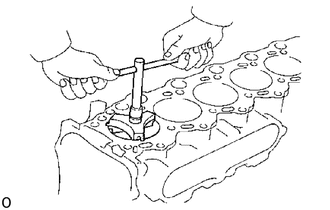
If the wear is less than 0.2 mm (0.008 in.), use a ridge reamer to machine the piston ring ridge at the top of the cylinder.
7.REMOVE MAIN BEARING CAP BOLTS
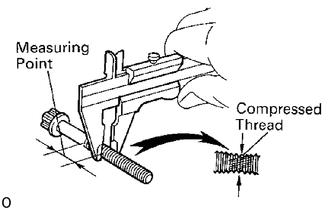
Using vernier calipers, measure the minimum diameter of the compressed thread at the measuring point.
- Standard diameter:
11.800 - 12.000 mm (0.4646 - 0.4724 in.)
- Minimum diameter:
11.50 mm (0.4528 in.)
If the diameter is less than minimum, replace the bolt.
8.INSPECT CYLINDER BLOCK ORIFICE
Check that the oifice is not clogged.