1HZ COOLING COOLING SYSTEM DESCRIPTION
DESCRIPTION
This engine utilizes a pressurized water forced circulation cooling system which includes a thermostat equipped with a by-pass valve mounted on the inlet side.
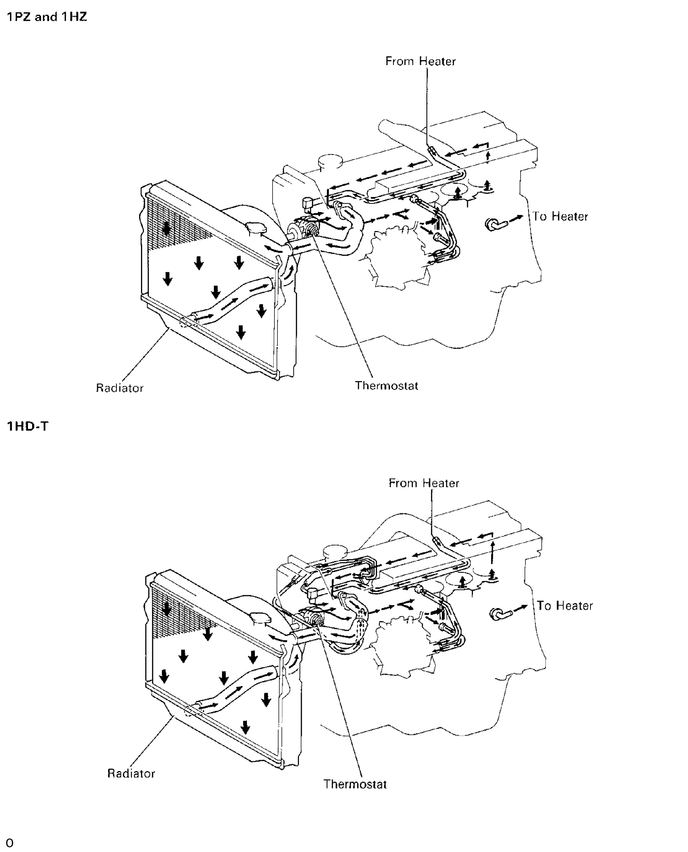
The cooling system is composed of the water jacket (inside the cylinder block and cylinder head), radiator, water pump, thermostat, cooling fan, hoses and other components. Coolant which is heated in the water jacket is pumped to the radiator, where it is cooled by the cooling fan and the vehicle windstream. Coolant which has been cooled is then sent back to the engine by the water pump, where it cools the engine. The water jacket is a network of channels in the shell of the cylinder block and cylinder head through which coolant passes. It is designed to provide adequate cooling of the cylinders and combustion chambers which become the hottest during engine operation.
RADIATOR
The radiator performs the function of cooling the coolant which has passed through the water jacket and become hot, and it is mounted in the front of the vehicle. The radiator consists of an upper tank and lower tank, and a core which connects the two tanks. The upper tank contains an inlet for coolant from the water jacket and a filler inlet. It also has a hose through which excess coolant or steam can flow. The lower tank has an outlet and drain cock for the coolant. The core contains many tubes and cooling fins through which coolant flows from the upper tank to the lower tank so that coolant has been heated up as it passes through the water jacket is cooled heae by the air sucked through the radiator by the cooling fan, as well as by the wind generated by the vehicle's travel. Models with an automatic transmission include an automatic transmissions fluid cooler built into the lower tank of the radiator.
RADIATOR CAP
The radiator cap is a pressure type cap which seals the radiator, resulting in pressurization of the radiator as the coolant expands. The pressurization prevents the coolant from boiling even when the coolant temperature exceeds 100 °C (212 °F). A relief valve (pressurization valve) and a vacuum valve (negative pressure valve) are built into the radiator cap. When the pressure generated inside the cooling system exceeds the limit (coolant temperature: 110 - 120 °C, 230 - 248 °F, pressure; 0.3 - 1.0 kg/cm2, 4.3 - 14.2 psi, 29.4 - 98.1 kPa) the relief valve is opened by the pressure and lets steam escape through the overflow pipe. The vacuum valve opens to allow atmospheric air to enter to alleviated the vacuum which develops in the cooling system after the engine is stopped and the coolant temperature drops. The valve's opening allows the pressure in the cooling system to return to the reservoir tank.
RESERVOIR TANK
The reservoir tank is used to catch coolant which overflows the cooling system as a result of volumetric expansion when the coolant is heated. When the coolant temperature drops the coolant in the reservoir tank returns to the radiator, thus keeping the radiator full at all times and avoiding needless coolant loss. To find out if the coolant needs to be replenished, check the reservoir tank level.
WATER PUMP
The water pump is used for forced circulation of coolant through the cooling system. It is mounted on the front of the cylinder block and driven by a drive belt.
THERMOSTAT
The thermostat has a wax type by-pass valve and is mounted in the cylinder block. The thermostat includes a type of automatic valve operated by fluctuations in the coolant temperature. This valve closes when the coolant temperature drops, preventing the circulation of coolant through the radiator and thus permitting the engine to warm up rapidly. The valve opens when the coolant temperature has risen, allowing the circulation of coolant. Wax inside the thermostat expands when heated and contracts when cooled. Heating the wax thus generates pressure which overpowers the force of the spring which keeps the valve closed, thus opening the valve. When the wax cools, its contraction causes the force of the spring to take effect once more, closing the valve. The thermostat in this engine operates at a temperature of 76 °C (169 °F).