POWER ASSIST SYSTEMS POWER STEERING SYSTEM DESCRIPTION
POWER STEERING PRINCIPLES
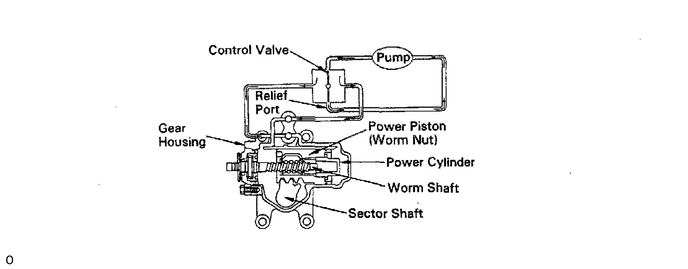
Power steering is a hydraulic device which utilizies engine power to reduce steering effort. The engine is used to drive a pump to develop fluid pressure, and this pressure acts on a piston within the power cylinder so that the piston assists the rack or sector shaft effort. The amount of this assistance depends on the extent of pressure acting on the piston. Therefore, if more steering force is required, the pressure must be raised. The variation in the fluid pressure is accomplished by a control valve which is linked to the steering main shaft.
NEUTRAL (STRAIGHT-AHEAD) POSITION
Fluid from the pump is sent to the control valve. If the control valve is in the neutral position, all the fluid will flow through the control valve into the relief port and back to the pump. At this time, hardly any pressure is created and because the pressure on the cylinder or power piston is equal on both sides, the piston will not move in either direction.
WHEN TURNING
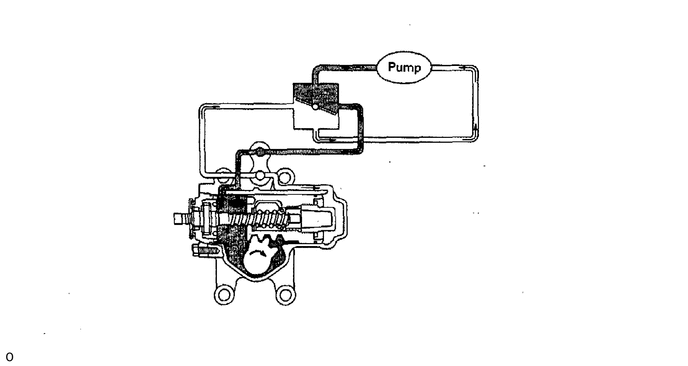
When the steering main shaft is turned in either direction, the control valve also moves, closing one of the fluid passages. The other passage then opens wider, causing a change in fluid flow volume and, at the same time, pressure is created. Consequently, a pressure difference occurs between both sides of the piston and the piston moves in the direction of the lower pressure so that the fluid in the cylinder is forced back to the pump through the control valve.
SERVICE HINT
Trouble with the power steering system usually involves hard steering resulting from a lack of assistance. In such cases, before attempting to make repairs, you should determine whether the trouble lies with the pump or with the gear housing. To do this, use a pressure gauge to perform an on-vehicle inspection.
ON-VEHICLE INSPECTION
Power steering is a hydraulic device and problems are normally due to insufficient fluid pressure acting on the piston. This could be caused by either the pump not producing the specified fluid pressure or the control valve in the gear housing not functioning properly so that the proper fluid pressure can not be obtained.
If the fault lies with the pump, the same symptoms will generally occur whether the steering wheel is turned fully to the right or left. On the other hand, if the fault lies with the control valve, there will generally be a difference between the amount of assistance when the steering wheel is turned to the left and right, causing harder steering. However, if the piston seal of the power cylinder is worn, there will be a loss of fluid pressure whether the steering wheel is turned to the right or left and the symptoms will be the same for both.
Before performing an on-vehicle inspection, a check must first be made to confirm that thepower steering system is completely free of any air. If there is any air in the system, the volume of this air will change when the fluid pressure is raised, causing a fluctuation in the fluid pressure so that the power steering will not function properly. To determine if there is any air in the system, check if there is a change of fluid level in the reservoir tank when the steering wheel is turned fully to the right or left.
If there is air in the system, it will be compressed to a smaller volume when the steering wheel is turned, causing a considerable drop in the fluid level. If the system is free of air, there will be very little change in the level even when the fluid pressure is raised. This is because the fluid, being a liquid, does not change volume when compressed. The small change in the fluid level is due to expansion of the hoses between the pump and gear housing when pressure rises.
Also, air in the system sometimes causes abnormal noise in the pump or gear housing when the steering wheel is fully turned in either direction.
This on-vehicle inspection must be performed every time after overhauling or repairing the pump or gear housing to ensure that the power steering system is working properly.

VANE PUMP
The main component parts of the vane pump, such as the cam ring, rotor, vanes and flow control valve are high precision parts and must be handled carefully. Also, because this pump produces a very high fluid pressure, O-rings are used for sealing each part. When reassembling the pump, always use new O-rings.
In the flow control valve, there is a relief valve which controls the maximum pressure of the pump. The amount of this maximum pressure is very important; if it is too low, there will be insufficient steering assistance and if too high, it will have an adverse effect on the pressure hoses, oil seals, etc. If the maximum pressure is either too high or too low due to a faulty relief valve, do not disassemble or adjust the relief valve, but replace the flow control valve as an assembly.
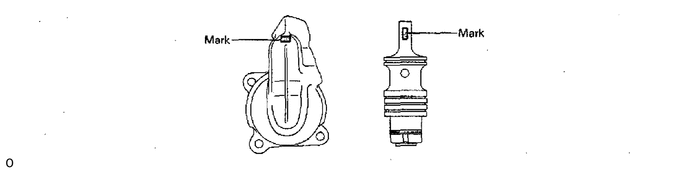
The clearance between the flow control valve and pump body installation hole is very important. After manufacture, the factory measures the size of the installation hole and outer circumference of the flow control valve, and punches a mark accordingly. Therefore, when replacing the flow control valve, be sure to do so with one having the same mark in order to ensure the proper clearance.
Check the cam ring for wear or scratches, if necessary, replace the cam ring, the rotor and the vane plates in a set.
GEAR HOUSING
Because of the high pressure, even the slightest scratch will cause fluid leakage, resulting in an inoperative power steering system.
Teflon rings are used for the piston, cross shaft and control valve. These teflon rings are highly durable against wear, but if it is necessary to replace them, be careful not so stretch the new ones. After installing a teflon ring into its groove, snug it down into the groove before assembly of the cylinder or housing to prevent possible damage.
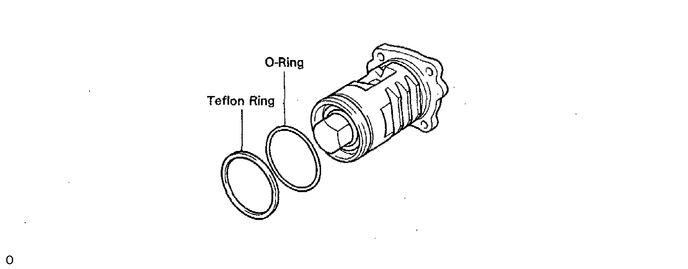
As with the rack and pinion type and recirculating ball type steering, preload is very important. If the preload is not correct, it could result in trouble such as steering wheel play or shimmy or lack of durability, so always make sure that it is correct.
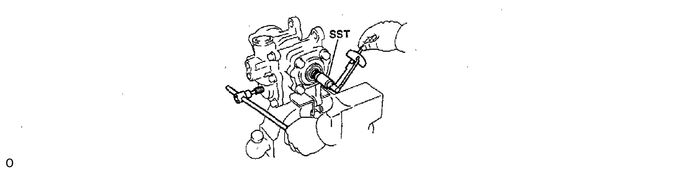
IDLE-UP DEVICE
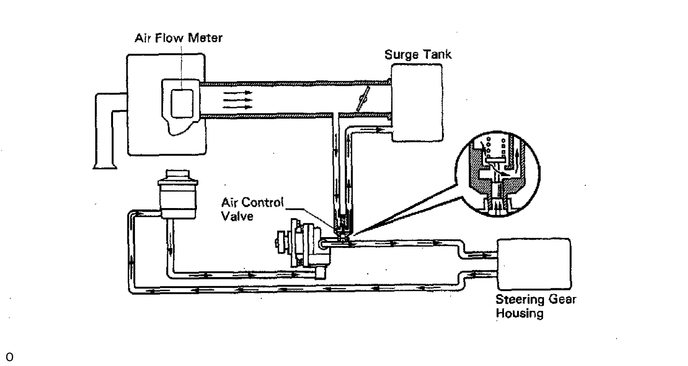
The pump produces the maximum fluid pressure when the steering wheel is turned fully to the right or left and, at this time, there is a maximum load on the pump which causes a decrease in engine idle rpm. To solve this problem, vehicles are equipped with an idle-up device which acts to raise the engine idle rpm whenever there is a heavy load on the pump.
On EFl engines, when the piston of the air control valve is pushed by fluid pressure, the air valve opens and the volume of air by-passing the throttle valve is increased to regulate engine rpm.