POWER ASSIST SYSTEMS POWER STEERING SYSTEM ON-VEHICLE INSPECTION
PROCEDURE

 1. DRIVE BELT TENSION CHECK
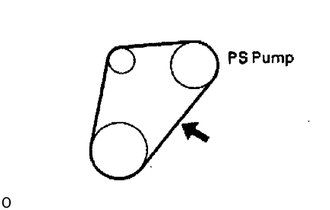
Measure the drive belt deflection.
- Drive belt tension:
at 98 N (10 kgf, 22 lbf)
- New belt:
10.0-12.0 mm (0.39-0.47 in.)
- Used belt:
13.0-15.0 mm (0.51-0.59 in.)
- HINT:
-
- ·
"New belt" refers to a belt which has been less than 5 minutes on a running engine.
·"Used belt" refers to a belt which has been used on a running engine for 5 minutes or more.
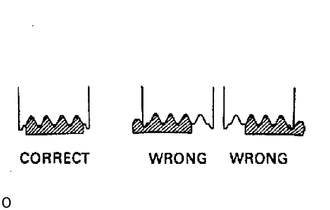
·After installing the drive belt, check that it fits properly in the ribbed grooves.
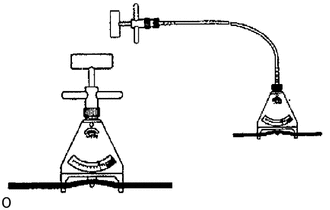
Reference:
Using a belt tension gauge, check the drive belt tension.
- Drive belt tension:
- New belt:
539-637 N (55-65 kgf, 121-143 lbf)
- Used belt:
245-392 N (25-40 kgf, 55-88 lbf)
2. FLUID LEVEL CHECK
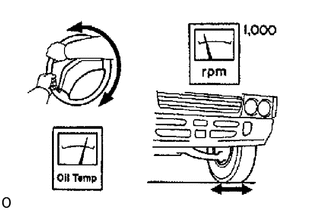
KEEP VEHICLE LEVEL
BOOST FLUID TEMPERATURE
With the engine idling at 1,000 rpm or less, turn the steering wheel from lock to lock several times to boost fluid temperature.
- Fluid temperature:
80°C (176°F)
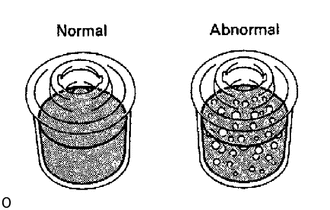
CHECK FOR FOAMING OR EMULSIFICATION
- HINT:
-
Foaming and emulsification indicate either the existence of air in the system or that the fluid level is too low.
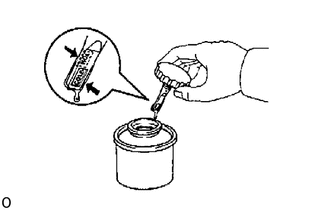
CHECK FLUID LEVEL IN RESERVOIIR
Check the fluid level and add fluid if necessary.
- Fluid:
ATF DEXRON II
- HINT:
-
When the fluid temperature is hot (60 - 80°C), check that the fluid level is within the HOT LEVEL of the dipstick of the reservoir.
-
If the fluid is cold (0 - 20° C), check that it is within the COLD LEVEL of the dipstick.
3. POWER STEERING FLUID REPLACEMENT
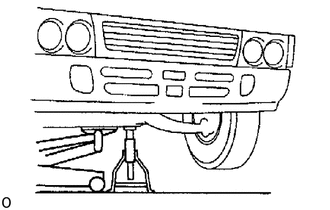
JACK UP FRONT OF VEHICLE AND SUPPORT IT WITH STANDS
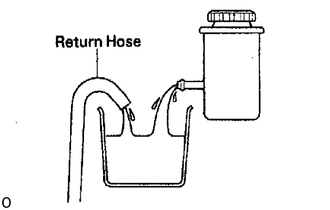
REMOVE FLUID RETURN HOSE FROM OIL RESERVOIR AND DRAIN FLUID INTO CONTAINER
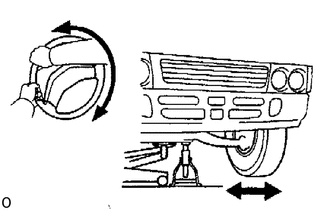
TURN STEERING WHEEL FROM LOCK TO LOCK WHILE DRAINING FLUID
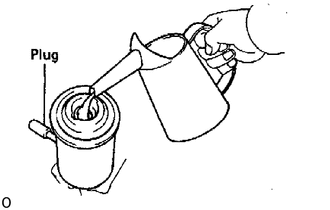
FILL OIL RESERVOIR WITH FRESH FLUID
- Fluid:
ATF DEXRON II
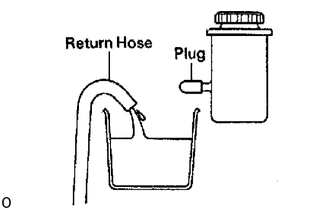
START ENGINE AND RUN IT AT 1,000 RPM
After 1 or 2 seconds, fluid will begin to discharge from the return hose. Stop the engine immediately at this time.
- NOTICE:
-
Take care that some fluid remains left in the oil reservoir.
REPEAT STEPS 4 AND 5 FOUR OR FIVE TIMES UNTIL THERE IS NO MORE AIR IN FLUID
CONNECT RETURN HOSE TO OIL RESERVOIR
BLEED POWER STEERING SYSTEM
4. POWER STEERING SYSTEM BLEEDING
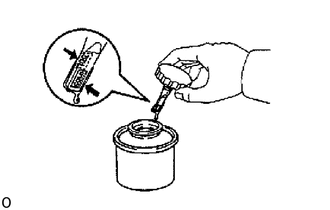
CHECK FLUID LEVEL IN OIL RESERVOIR
Check the fluid level and add fluid if necessary.
- Fluid:
ATF DEXRON II
- HINT:
-
When the fluid temperature is hot (60-80°C), check that the fluid level is within the HOT LEVEL of the dipstick of the reservoir.
-
If the fluid is cold (0-20° C), check that it is within the COLD LEVEL of the dipstick.
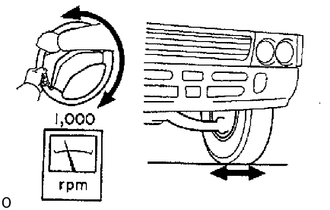
START ENGINE AND TURN STEERING WHEEL FROM LOCK TO LOCK 3 OR 4 TIMES
With the engine speed below 1,000 rpm, turn the steering wheel to left or right full lock and keep it there for 2-3 seconds, then turn the wheel to the opposite full lock and keep it there for 2-3 seconds.
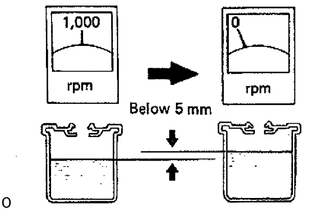
CHECK THAT FLUID IN OIL RESERVOIR IS NOT FOAMY OR CLOUDY AND DOES NOT RISE OVER MAXIMUM WHEN ENGINE IS STOPPED
Measure the fluid level with the engine running. Stop the engine and measure the fluid level.
- Maximum rise:
5 mm (0.20 in.)
If a problem is found, repeat "POWER STEERING FLUID REPLACEMENT" on page SR-5 and 6. Repair the PS if the problem persists.
5. OIL PRESSURE CHECK
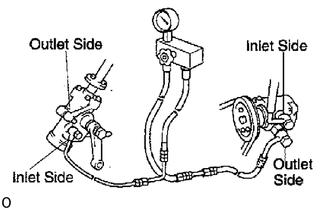
CONNECT OIL PRESSURE GAUGE
Drain fluid.
Disconnect the pressure line from the PS pump.
Connect the valve side of the pressure gauge to the pressure line, and the gauge side to the PS pump.
BLEED POWER STEERING SYSTEM
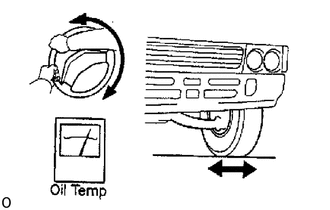
START ENGINE AND RUN IT AT IDLE
BOOST FLUID TEMPERATURE
With the engine idling at 1.000 rpm or less, turn the steering wheel from lock to lock several times to boost fluid temperature.
- Fluid temperature:
80° (176 °F)
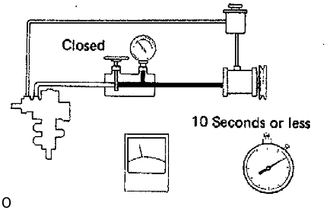
CHECK FLUID PRESSURE READING WITH VALVECLOSED
Close the pressure gauge valve and observe the reading on the gauge.
- Minimum pressure:
7,845 kPa (80 kgf/cm2, 1,138 psi)
- NOTICE:
- ·
Do not keep the valve closed for more than 10 seconds.
·Do not let the fluid temperature become too high.
If pressure is low, repair or replace the PS pump.
OPEN VALVE FULLY
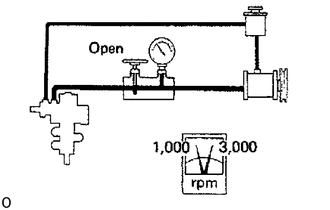
CHECK AND RECORD PRESSURE READING AT 1,000 RPM
CHECK AND RECORD PRESSURE READING AT 3,000 RPM
Check that the difference in pressure is less than 490 kPa (5 kgf/cm2, 71 psi) between the 1,000 rpm and 3,000 rpm checks.
If the difference is excessive, repair or replace the flow control valve of the PS pump.
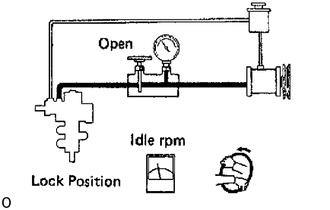
CHECK PRESSURE READING WITH STEERING WHEEL TURNED TO FULL LOCK
Be sure the pressure gauge valve is fully opened and the engine idling.
- Minimum pressure:
7,845 kPa (80 kgf/cm2, 1,138 psi)
- NOTICE:
- ·
Do not maintain lock position for more than 10 seconds.
·Do not let the fluid temperature become too high.
If pressure is low, the gear housing has an internal leak and must be repaired or replaced.
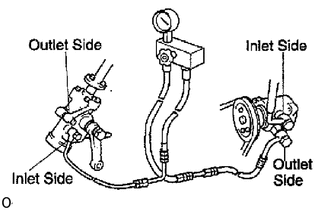
DISCONNECT OIL PRESSURE GAUGE
Drain fluid.
Disconnect the oil pressure gauge.
Install the union bolt with a new gasket.
- Torque:
47 N*m (475 kgf*cm. 34 ft.*lbf)
BLEED POWER STEERING SYSTEM
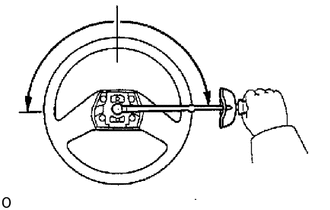
MEASURE STEERING EFFORT
Center the steering wheel and run the engine at idle.
Using a torque meter, measure the steering effort in both directions.
- Maximum steering effort:
8.3 N*m (85 kgf*cm, 73 in.*lbf)
If steering effort is excessive, repair the PS unit.
- HINT:
-
Be sure to consider the tire type, pressure and contact surface before making your diagnosis.