1BZ-FPE COOLING RADIATOR INSPECTION
PROCEDURE

 16520A
1.REMOVE RADIATOR CAP FROM WATER FILLER
- CAUTION:
-
To avoid the danger of being burned, do not remove the radiator cap while the engine and radiator are still hot, as fluid and steam can be blown out under pressure.
16520A
2.INSPECT RADIATOR CAP
- NOTICE:
- ·
If the radiator cap contains water or foreign substances, always rinse it with water.
·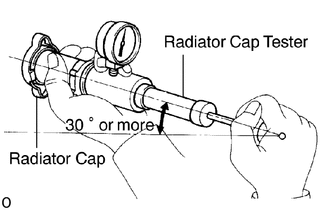
When performing steps (a) and (b) below, keep the radiator pump tester at an angle of over 30 ° above the horizontal.
Using a radiator cap tester, slowly pump the tester and check that air is coming from the relief valve.
- Pump speed:
1 push / 3 seconds or more
- NOTICE:
-
Push the pump at a constant speed.
If air is not coming from the relief valve, replace the radiator cap.
Pump the tester several times and measure the relief valve opening pressure.
- Standard opening pressure:
93 - 123 kPa (0.95 - 1.25 kgf/cm2, 13.5 - 17.8 psi)
- Minimum opening pressure:
78 kPa (0.8 kgf/cm2, 11.4 psi)
- HINT:
-
Use the tester's maximum reading as the opening pressure.
-
If the opening pressure is less than minimum, replace the radiator cap.
3.INSPECT COOLING SYSTEM FOR LEAKS
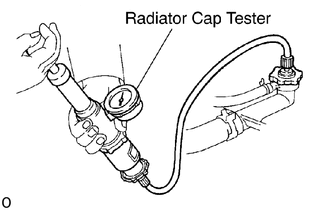
Fill the radiator with coolant, and attach a radiator cap tester to the water filler.
Warm up the engine.
Pump it to 118 kPa (1.2 kgf/cm2, 17.1 psi), and check that the pressure does not drop.
If the pressure drops, check the hoses, radiator or water pump for leaks. If no external leaks are found, check the heater core, cylinder block and head.