1BZ-FPE ENGINE CONTROL ELECTRONIC CONTROLLED CARBURETOR SYSTEM CHECK MODE PROCEDURE
- HINT:
-
Hand-held tester only:
-
Compared to the normal mode, the check mode has an increased sensitivity to detect malfunctions.
-
Furthermore, the same diagnostic items which are detected in the normal mode can also be detected in the check (test) mode.
CHECK THE DTC
Initial conditions
Battery positive voltage 11V or more.
Throttle valve fully closed.
Transmission in "P" or "N" position.
Air conditioning switched OFF.
Turn ignition switch OFF.
Prepare the hand-held tester.
Connect the hand-held tester to DLC3 on the at the lower right of the instrument panel.
Turn the ignition switch ON and switch the push the hand-held tester ON.
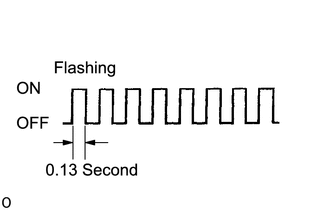
Switch the hand-held tester normal mode to check (test) mode. (Check that the check engine warning light (CHK ENG) flashes.)
Start the engine. (The check engine warning (CHK ENG) light goes out after the engine start.)
Simulate the conditions of the malfunction described by the customer.
- NOTICE:
-
Leave the ignition switch ON until you have checked the DTC, etc.
After simulating the malfunction conditions, use the hand-held tester diagnosis selector to check the DTCs and freezed frame data, etc.
- HINT:
-
Take care not to turn the ignition switch OFF. Turning the ignition switch OFF switches the diagnosis system from check (test) mode to normal mode. so all DTCs, etc. are erased.
After checking the DTCs, inspect the applicable circuit.
CLEAR THE DTC
The following actions will erase the DTCs and freezed frame data.
Operating the hand-held tester to erase the codes. (See the hand-held tester's instruction book for operating in structions.)
Disconnecting the battery terminals or EFI fuse.
- NOTICE:
-
If the hand-held tester switches the engine ECU from normal mode to check mode or vice-versa, or if the ignition switch is turned from ON to ACC or OFF during check mode, the DTCs and freezed frame data will be erased.