1BZ-FPE ENGINE CONTROL ELECTRONIC CONTROLLED CARBURETOR SYSTEM BASIC INSPECTION
CAUTION / NOTICE / HINT
When the malfunction code is not confirmed in the DTC check, troubleshooting should be carried out in the order for all possible circuits to be considered as the causes of the problems. In many cases, by carrying out the basic engine check shown in the following flow chart, the location causing the problem can be found quickly and efficiently. Therefore, use of this check is essential in engine troubleshooting.
PROCEDURE
- Result:
Proceed to YES NO
YES
NO
- Result:
Proceed to YES NO
YES
NO
- Result:
Proceed to YES NO
YES
NO
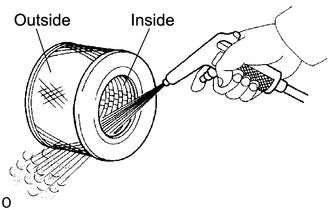
PREPARATION:
Remove the air filter.
CHECK:
Visually check that the air filter is not excessively dirty or oily.
- HINT:
-
If necessary, clean the filter with compressed air. First blow from inside thoroughly, then blow from outside of filter.
- Result:
Proceed to OK NG
OK
NG
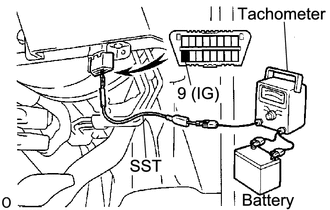
PREPARATION:
Warm up engine to normal operating temperature.
Switch off all accessories.
Switch off air conditioning.
Connect the hand-held tester to DLC3 on the vehicle.
If you have no hand-held tester, connect tachometer test prove to terminal 9 (IG-) of DLC3.
- SST
- 09843-18030
- NOTICE:
-
As some tachometer are not compatible with this ignition system, we recommend that you confirm the compatibility of your until before use.
CHECK:
Check the idle speed.
- OK:
Idle speed: 650 - 750 rpm
- Result:
Proceed to OK NG
OK
NG
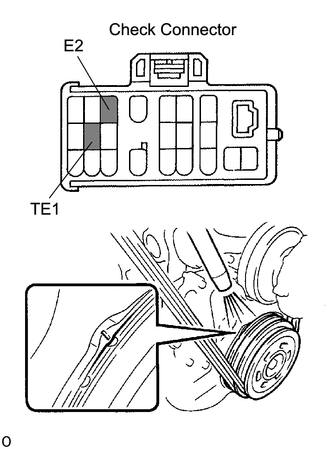
PREPARATION:
Warm up the engine to normal operating temperature.
Keep the engine speed at idle.
Using SST, connect terminals TE1 and E2 of the check connector.
- SST
- 09843-18020
Connect a timing light probe to the No.1 high-tensioncord.
CHECK:
Check the ignition timing.
- OK:
Ignition timing: 10 - 14° BTDC at idle
- Result:
Proceed to OK NG
OK
NG
- Result:
Proceed to OK NG
OK
NG
CHECK:
Disconnect the high-tension cord from the distributor and hold the end about 12.5 mm (1/2") from the ground. See if spark occurs while the engine is being cranked.
- NOTICE:
-
To prevent excessive fuel being injected from the injectors during this check, don't crank the engine for more than 1 - 2 seconds at a time.
- Result:
Proceed to OK NG
OK
NG