INSTALLATION
Removal / installation · Vehicles built from Jan 2017
Versions by build date: Oct 2014 – Dec 2014 Jan 2015 – Dec 2016 from Jan 2017
| 1. INSTALL REAR BRAKE TUBE FLEXIBLE HOSE |

Using a union nut wrench, install the rear brake tube flexible hose.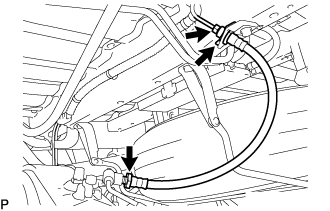

- Torque:
- 23 N*m{ 235 kgf*cm , 17 ft.*lbf }
- NOTICE:
- Use the formula to calculate special torque values for situations where a union nut wrench is combined with a torque wrench (Click here).
Install the flexible hose with a new clip.
- NOTICE:
- When installing the rear brake flexible hose, face the identification mark to the exterior of the vehicle and minimize twisting of the hose.
- Install the clip as far as it will go.
- When installing the rear brake flexible hose, face the identification mark to the exterior of the vehicle and minimize twisting of the hose.
Connect the brake tube to rear brake flexible hose with a union nut wrench while holding the rear brake flexible hose with a wrench.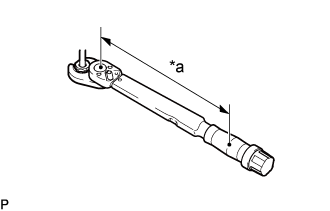
- Torque:
- Specified tightening torque:
- 15 N*m{ 155 kgf*cm , 11 ft.*lbf }
Text in Illustration *a
Torque Wrench Fulcrum Length
- HINT:
- Calculate the torque wrench reading when changing the fulcrum length of the torque wrench (Click here).
- When using a union nut wrench (fulcrum length of 22 mm (0.8661 in.)) + torque wrench (fulcrum length of 162 mm (6.3779 in.)): 13 N*m (137 kgf*cm, 10 ft.*lbf)
- Calculate the torque wrench reading when changing the fulcrum length of the torque wrench (Click here).
- NOTICE:
- Do not bend or damage the brake tube.
- Do not allow any foreign matter such as dirt and dust to enter the brake tube from the connecting points.
- Do not bend or damage the brake tube.
| 2. ADD BRAKE FLUID |
- Fluid:
- SAE J1703 or FMVSS No. 116 DOT3 or equivalent
- NOTICE:
- Do not remove the filter from the brake master cylinder reservoir and be sure to fill with new brake fluid to avoid any potential contamination of the brake system. Contamination, for example by dirt particles or mineral oil, could lead to functional brake problems.
| 3. BLEED BRAKE LINE |
Connect the vinyl tube to the bleeder plug.
Depress the brake pedal several times and loosen the bleeder plug with the pedal held down.
At the point where the fluid stops coming out, tighten the bleeder plug and release the brake pedal.
Repeat this procedure until the air in the brake fluid is completely bled out.
Tighten the bleeder plug.
Front bleeder plug:
- Torque:
- 11 N*m{ 110 kgf*cm , 8 ft.*lbf }
Rear bleeder plug:
- Torque:
- 11 N*m{ 112 kgf*cm , 8 ft.*lbf }
Repeat the above procedure to bleed the air out of the brake line for each wheel.
| 4. INSPECT BRAKE FLUID LEVEL IN RESERVOIR |
Check the fluid level and add fluid if necessary.
- Fluid:
- SAE J1703 or FMVSS No.116 DOT3 or equivalent
- NOTICE:
- Do not remove the filter from the brake master cylinder reservoir and be sure to fill with new brake fluid to avoid any potential contamination of the brake system. Contamination, for example by dirt particles or mineral oil, could lead to functional brake problems.
| 5. CHECK BRAKE FLUID LEAKAGE |
| 6. INSTALL REAR WHEEL |
- Torque:
- 100 N*m{ 1020 kgf*cm , 74 ft.*lbf }