ON-VEHICLE INSPECTION
Inspection · Vehicles built from Oct 2014
| CHECK FUEL PRESSURE |

Check that the battery positive voltage is above 12 V.
Discharge the fuel system pressure (Click here).
Disconnect the negative terminal cable from the battery.
Pinch and pull the No. 1 fuel hose (fuel tube connector) to disconnect it from the fuel pressure pulsation damper assembly.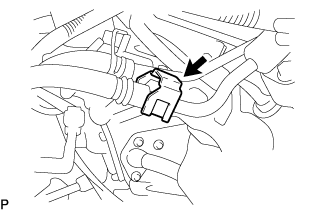

- CAUTION:
- Always read the precautions (Click here) before disconnecting the fuel tube connector (quick type).
- The fuel tube may spray fuel as a result of pressure that remains in it. Do not allow fuel to be sprayed in the engine compartment.
- Always read the precautions (Click here) before disconnecting the fuel tube connector (quick type).
Install SST (pressure gauge) as shown in the illustration.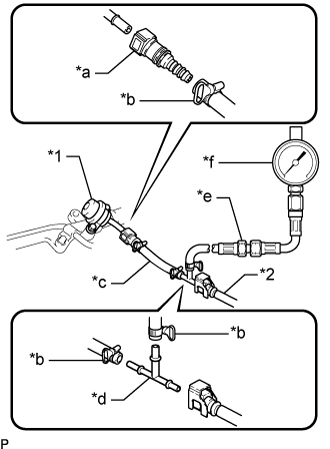
- SST
- 09268-45101
(09268-41250, 09268-41260, 09268-41280, 09268-41500, 09268-41700, 95336-08070)
Text in Illustration *1
Fuel Pressure Pulsation Damper Assembly
*2
No. 1 Fuel Hose
*a
SST (Fuel Tube Connector)
*b
SST (Hose Band)
*c
SST (Hose)
*d
SST (T-Joint)
*e
SST (Hose Joint)
*f
SST (Pressure Gauge)
Wipe off any gasoline.
Reconnect the negative terminal cable.
Operate the fuel pump.
Connect the intelligent tester to the DLC3.
Turn the ignition switch to ON.
- NOTICE:
- Do not start the engine.
Turn the intelligent tester on.
Enter the following menus: Powertrain / Engine and ECT / Active Test / Control the Fuel Pump / Speed.
Measure the fuel pressure.
- Standard fuel pressure:
- 281 to 287 kPa (2.87 to 2.93 kgf/cm2, 40.8 to 41.7 psi)
If the pressure is lower than the specification, check the fuel hoses and connections, fuel pump, fuel filter assembly and fuel pressure regulator assembly.
Start the engine.
Measure the fuel pressure.
- Standard fuel pressure:
- 281 to 287 kPa (2.87 to 2.93 kgf/cm2, 40.8 to 41.7 psi)
Stop the engine.
Check that the fuel pressure remains as specified for 5 minutes after the engine has stopped.
- Standard fuel pressure:
- 147 kPa (1.5 kgf/cm2, 21 psi) or more
After checking the fuel pressure, disconnect the negative terminal cable and carefully remove SST and the fuel tube connector to prevent gasoline from spraying.
Reconnect the No. 1 fuel hose (fuel tube connector) to the fuel pressure pulsation damper assembly.
| CHECK FUEL PUMP OPERATION AND FUEL LEAK |
When using the intelligent tester
Connect the intelligent tester to the DLC3.
Turn the ignition switch to the on position and intelligent tester main switch ON.
- NOTICE:
- Do not start the engine.
Select the Active Test mode on the intelligent tester.
- HINT:
- Please refer to the intelligent tester operator's manual for further details.
When not using the intelligent tester.
Disconnect the fuel pump connector.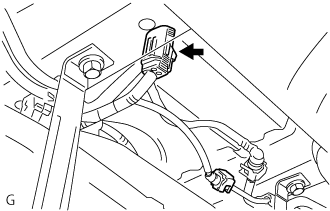
Using a service wire, connect terminals FP and +B of the relay block.
- NOTICE:
- Pay attention to the terminal connecting position to avoid a malfunction.
Turn the ignition switch to the ON position, and check that the fuel pump operates.
- NOTICE:
- Do not start the engine.
Check that there are no fuel leaks anywhere on the fuel system after doing maintenance.
Check that the pulsation damper screw rises up when the fuel pump operates.
If operation is not as specified, check the following parts:- Fusible link
- Fuel pump
- Wiring connections
- ECM
- Fuses
- Fusible link
Turn the ignition switch off.
Disconnect the intelligent tester from the DLC3.