POWER ASSIST SYSTEMS POWER STEERING SYSTEM CONTROL VARIABLE FLOW CONTROL (VFC) POWER STEERING
FUNCTION OF MAIN COMPONENTS
| Component | Function | |
|---|---|---|
| Rack and Pinion Power Steering Gear Assembly | Increases operation force of the steering wheel and transmits operation force to the front wheel. | |
| Vane Pump Assembly | VFC Solenoid Valve | Controls the discharge flow rate and is controlled by the power steering ECU assembly. |
| Vane Pump Oil Reservoir | Stores the power steering fluid. | |
| Combination Meter Assembly | Power Steering Warning Light | Lights up to alert the driver that the power steering ECU assembly has detected a malfunction in the power steering system. |
| Steering Sensor | Detects the steering direction and the angle of the steering wheel. | |
| Power Steering ECU Assembly | Calculates the optimum discharge flow rate in accordance with the vehicle condition, and controls the VFC solenoid valve. | |
| Brake Actuator Assembly | Skid Control ECU | Sends the vehicle speed signal. |
| ECM | Sends the engine speed signal. | |
SYSTEM CONTROL
The Variable Flow Control (VFC) power steering optimizes the discharge rate of the power steering fluid sent from the vane pump based on the vehicle speed, steering speed, steering angle and engine speed.
Discharge rate control has a basic control, which includes standby control and assist control. When the steering wheel is not operated such as while driving straight, standby control is performed. The moment the steering wheel is operated, standby control switches to assist control. Also, steering angle correction is performed to gradually reduce the discharge rate based on the vehicle speed and steering angle.
Under standby control, the discharge rate is maintained in order to suppress the drive torque of the vane pump and help improve fuel efficiency.
Under assist control, the discharge rate is increased when the steering wheel is operated at low speeds in order to reduce steering force. On the other hand, the discharge rate is reduced when the steering wheel is operated at high speeds in order to maintain a solid steering force.
Basic Control
The power steering ECU assembly switches between standby control and assist control depending on the vehicle speed, steering speed and steering angle.
Under assist control, the discharge rate is determined based on the vehicle speed and steering speed.
The discharge rate is then adjusted in response to the steering angle.
| Control | Function | Outline |
|---|---|---|
| Standby Control
(Assist Control → Standby Control) |
The steering speed is 0 deg/sec for 0.01 seconds or more when the vehicle speed is 0 km/h. | The discharge rate decreases at a rate of 0.5 l/min.
(The discharge rate may increase depending on the steering conditions.) |
| The steering angle is less than 4.5° for 0.01 seconds or more except when the vehicle speed is 0 km/h. | ||
| Assist Control
(Standby Control → Assist Control) |
The steering speed is 0 deg/sec or more when the vehicle speed is 0 km/h. | This control increases the discharge rate according to the steering speed when the time constant reaches a certain value.
(The discharge rate may also be reduced depending on the steering conditions when the time constant reaches a certain value.) |
| The steering angle is 4.5° or more except when the vehicle speed is 0 km/h. |
- HINT:
-
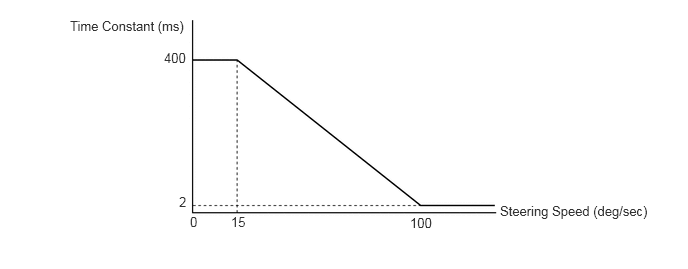
*: The time constant is the amount of time required for the power steering fluid to reach a target discharge rate of 63.2%.