CRUISE CONTROL DYNAMIC RADAR CRUISE CONTROL SYSTEM CONTROL DYNAMIC RADAR CRUISE CONTROL
FUNCTION OF MAIN COMPONENTS
The main components in the dynamic radar cruise control system have the following functions:
| Component | Function | |
|---|---|---|
|
*1: Models with RSA system *2: Models with diesel engine *3: Models with gasoline engine |
||
| Millimeter Wave Radar Sensor Assembly | Radiates millimeter radar waves forward, uses the reflected waves to detect the presence of a vehicle traveling ahead, the vehicle-to-vehicle distance, and the relative speed, and then sends this information to the forward recognition camera. | |
| Forward Recognition Camera | ·
Detects lane markers and objects on the road ahead using the image captured by the forward recognition camera. ·
While the system is in vehicle-to-vehicle distance control mode, the forward recognition camera detects the vehicle ahead based on signals from the millimeter wave radar sensor assembly and forward recognition camera. Then, the forward recognition camera calculates the acceleration or deceleration rate required in order to attain the target vehicle-to-vehicle distance, and outputs a request signal to the ECM. ·
Controls the supply of electric current to the camera heater when the ambient temperature is low. ·
If the detects a malfunction in the dynamic radar cruise control system, it will store Diagnostic Trouble Codes (DTCs). |
|
| Camera Heater (Forward Recognition Hood with Heater Sub-assembly) | Uses electricity from the forward recognition camera to generate heat, removing fog and preventing the windshield glass in front of the forward recognition camera from fogging up. | |
| Steering Pad Switch Assembly | Cruise Control Main Switch | ·
Turns the dynamic radar cruise control system on and off. ·
Vehicle-to-vehicle distance control mode becomes be activated immediately after the switch is turned on. The mode shifts to constant speed control mode by pressing and holding the switch more than 1.5 seconds. |
| CANCEL Switch | A cancel signal is output to the ECM when this switch is operated. | |
| +RES Switch | ·
The acceleration function and resuming of a preset speed can be performed by operating this switch. A signal is output to the ECM when this switch is operated. ·
The dynamic radar cruise control with road sign assist operation signals are sent to the ECM.*1 |
|
| -SET Switch | ·
The deceleration function and vehicle speed setting resume signals are output to the ECM when this switch is operated. ·
The dynamic radar cruise control with road sign assist operation signals are sent to the ECM.*1 |
|
| Vehicle-to-vehicle Distance Control Switch | While the system is in vehicle-to-vehicle distance control mode, the driver can operate the vehicle-to-vehicle distance control switch to select the vehicle-to-vehicle distance in 3 levels: long, middle and short. | |
| Stop Light Switch Assembly | Detects brake pedal depression and transmits its signal to the ECM. | |
| Park/Neutral Position Switch Assembly | Detects the shift lever position and transmits signals to the ECM. | |
| Transmission Control Switch | ·
Detects the shift lever position and transmits signals to the ECM. ·
Informs the ECM of driver upshift or downshift operations while the shift lever is in S. |
|
| Turn Signal Switch | Sends a turn signal command to the steering sensor. | |
| Accelerator Pedal Sensor Assembly | Detects the accelerator pedal depression angle and transmits it to the ECM. | |
| Steering Sensor | ·
Detects the angle and direction of steering and sends signals to the ECM. ·
Sends a turn signal command to the ECM. |
|
| Airbag ECU (Airbag Sensor Assembly) | Yawrate Sensor | Detects the yaw rate of the vehicle and sends signals to the ECM. |
| Injector*2 | Adjusts the fuel injection volume based on the signals. | |
| Throttle Body with Motor Assembly*3 | Throttle Control Motor | Adjusts the throttle valve opening angle in accordance with signals from the ECM. |
| Throttle Position Sensor | Detects the throttle valve opening angle and outputs it to the ECM. | |
| Combination Meter Assembly | Cruise Control Indicator (Constant Speed Control Mode) | ·
Based on a cruise control indicator (constant speed control mode) operation signal sent by the ECM, the combination meter assembly illuminates the cruise control indicator (constant speed control mode) when the dynamic radar cruise control system in constant speed control mode has been turned on using the cruise control main switch on the steering pad switch assembly. ·
Based on a cruise control indicator (constant speed control mode) operation signal sent by the ECM, the combination meter assembly turns off the cruise control indicator light if a malfunction occurs in the dynamic radar cruise control system. |
| Cruise Control Indicator (Vehicle-to-vehicle Distance Control Mode) | ·
Based on a cruise control indicator (vehicle-to-vehicle distance control mode) operation signal sent by the ECM, the combination meter assembly illuminates the cruise control indicator (vehicle-to-vehicle distance control mode) when the dynamic radar cruise control system in vehicle-to-vehicle distance control mode has been turned on using the cruise control main switch on the steering pad switch assembly. ·
Based on a cruise control indicator (vehicle-to-vehicle distance control mode) operation signal sent by the ECM, the combination meter assembly turns off the cruise control indicator (vehicle-to-vehicle distance control mode) if a malfunction occurs in the dynamic radar cruise control system. |
|
| Cruise Control SET Indicator | Cruise control SET indicator illuminates when the vehicle speed is set. | |
| Multi-information Display | ·
Displays a warning message to alert the driver in accordance with a signal provided by the ECM. ·
During dynamic radar cruise control operation, the multi-information display receives signals from the ECM in order to display the system conditions. |
|
| Meter Buzzer | ·
Sounds a buzzer when it receives a signal from the ECM to alert the driver that the distance between vehicles is short. ·
If the ECM detects automatic cancel or warning signals while the vehicle is operating under cruise control, this buzzer sounds to inform the driver. |
|
| ECM | ·
Controls the dynamic radar cruise control system in accordance with signals from switches, sensors. ·
If the ECM detects a malfunction in the dynamic radar cruise control system, it will store Diagnostic Trouble Codes (DTCs). |
|
| Brake Actuator Assembly | Brake Actuator | Performs brake control according to brake request signals from the skid control ECU. |
| Skid Control ECU | ·
Sends a vehicle speed signal to the ECM. ·
Sends the VSC, TRC and AUTO LSD control status to the ECM. ·
While the system is operating in vehicle-to-vehicle distance control mode, the skid control ECU operates the brake actuator in accordance with the brake request signal received from the ECM. ·
Applies the brakes in accordance with signals from the ECM. |
|
| Central Gateway ECU (Network Gateway ECU) | Sends the signal between the CAN communication buses. | |
| DLC3 | The Global TechStream (GTS) can be connected to read the Diagnostic Trouble Codes (DTCs) of malfunctions. | |
SYSTEM CONTROL
The control of the dynamic radar cruise control system varies depending on the mode:
A: Constant Speed Control Mode
B: Vehicle-to-vehicle Distance Control Mode
| Function | Outline | Mode | |
|---|---|---|---|
| A | B | ||
|
*1: Models with diesel engine *2: Models with gasoline engine *3: Models with RSA system *4: Models with downhill brake control |
|||
| Constant Speed Control | The ECM compares the actual vehicle speed and the set speed and if the vehicle speed is lower than the set speed, it uses the throttle motor to increase the throttle valve opening angle. | ○ | ○ |
| Deceleration Control | Performs injector*1 or throttle*2 control and brake control in order to decelerate the vehicle so that the vehicle-to-vehicle distance between the driver's own vehicle and the vehicle ahead equals the set distance. | - | ○ |
| Follow-up Control | After performing deceleration control, the driver's own vehicle follows the vehicle ahead in order to maintain the proper vehicle-to-vehicle distance. The actual distance maintained for each distance level (long, medium and short) varies in accordance with the vehicle speed. | - | ○ |
| Acceleration Control | Accelerates the vehicle in order to attain the set vehicle speed if the vehicle ahead or the driver's own vehicle has changed lanes. | - | ○ |
| Turn signal-linked Control | If the turn signal switch is operated when changing lanes to the passing lane at a vehicle speed of approximately 70 km/h (43 mph) during follow-up control, the vehicle will begin preliminary acceleration; once the vehicle has changed lanes it will first maintain this preliminary acceleration, and then slowly accelerate to the set vehicle speed. | - | ○ |
| Dynamic Radar Cruise Control with Road Sign Assist*3 | This function is turned on and while RSA system speed limit information is displayed, the speed limit can be set by holding down the +RES switch to increase the set vehicle speed to the speed limit, or by holding down the -SET switch to reduce the set vehicle speed to the speed limit. | - | ○ |
| Set Control | When the dynamic radar cruise control system has been turned on using the cruise control main switch on the steering pad switch assembly, either of the relevant vehicle speed conditions shown below is met, and the -SET switch on the steering pad switch assembly is pressed, the ECM stores the vehicle speed and maintains the vehicle constantly at that speed. | ○ | ○ |
| The vehicle is being driven at a speed of approximately 30 km/h (20 mph) or more. | ○ | ○ | |
| Low Speed Limit Control | The low speed limit is the lowest speed that cruise control can be set at and it is designed to be approximately 25 km/h (16 mph). The cruise control cannot be set below that speed. If the vehicle speed drops below that speed while driving using cruise control, the cruise control will be canceled automatically. The set vehicle speed is kept in memory. | ○ | ○ |
| Coast Control | While the -SET switch on the steering pad switch assembly is pushed continuously, the vehicle speed and the set vehicle speed change as follows, according to the mode: | ○ | ○ |
·
The vehicle decelerates constantly. ·
The set vehicle speed changes to the speed at which the -SET switch is released. |
○ | - | |
·
The set vehicle speed decreases in increments of 5 km/h or 5 mph. [Example: 103 →100 → 95 → 90 → 85 km/h (mph)] ·
The vehicle decelerates rapidly. The vehicle will remain at the speed that the vehicle is traveling at when the -SET switch is released. |
- | ○ | |
| Tap Down Control | When the -SET switch on the steering pad switch assembly is pushed momentarily (approximately 0.6 seconds or less), the vehicle speed and the set vehicle speed change as follows, according to the mode: | ○ | ○ |
·
The vehicle will decelerate in increments of approximately 1 km/h or 1 mph each time the -SET switch is pushed. ·
However, if the difference between the actual vehicle speed and the set vehicle speed is greater than 5 km/h (3 mph), the set vehicle speed will change to the speed at which the vehicle was being driven at the time the -SET switch was operated. |
○ | - | |
| The vehicle will decelerate in increments of approximately 1 km/h or 1 mph for each time the -SET switch is pushed. | - | ○ | |
| Accelerator Control | While the +RES switch on the steering pad switch assembly is pushed continuously, the vehicle speed and the set vehicle speed change as follows, according to the mode: | ○ | ○ |
·
The vehicle will accelerate constantly. ·
The set vehicle speed changes to the speed at which the +RES switch is released. |
○ | - | |
·
The set vehicle speed increases in increments of 5 km/h or 5 mph. [Example: 83 → 85 → 90 → 95 → 100 km/h (mph)] ·
The vehicle will accelerate to the speed that is set at the time the +RES switch is released. However, only the set vehicle speed will change during follow-up control. |
- | ○ | |
| Tap Up Control | When the +RES switch on the steering pad switch assembly is pushed momentarily (approximately 0.6 seconds or less), the vehicle speed and the set vehicle speed change as follows: | ○ | ○ |
·
The vehicle will accelerate in increments of approximately 1 km/h or 1 mph for each time the +RES switch was pushed. ·
However, if the difference between the actual vehicle speed and the set vehicle speed is greater than 5 km/h (3 mph), the set vehicle speed will not change. |
○ | - | |
| The vehicle will accelerate in increments of approximately 1 km/h or 1 mph for each time the +RES switch is pushed. | - | ○ | |
| Resume Control | If the vehicle speed is above the low speed limit, the +RES switch on the steering pad switch assembly can be pushed to resume cruise control operation and reach the vehicle speed that was set at the time the driver canceled cruise control. | ○ | ○ |
| If the vehicle ahead changes driving lanes during follow-up control, the vehicle speed is gradually increased to the set vehicle speed. At this time, the vehicle speed can be increased promptly by pushing the +RES switch on the steering pad switch assembly. | - | ○ | |
| Shift-down Control | When the vehicle is traveling uphill using cruise control, automatic transmission control may cause the transmission to shift down. During shift down control, when the end of uphill travel is determined based on the throttle valve angle, the transmission will shift up after a certain period of time. When the transmission shifts down during accelerator control or resume control, the transmission will shift up after accelerator control or resume control ends. | ○ | ○ |
| Downhill Brake Control*4 | Operates the brakes to suppress vehicle speed increases on downhill slopes during cruise control operation. | ○ | ○ |
| Manual Cancel Control | If any of the following signals are sent to the ECM, the cruise control is canceled accordingly:
·
Stop light switch on signal. (The brake pedal is depressed) ·
Shift position is changed from D or S to any other position. ·
Signal to select the S1, S2 and S3 ranges. ·
CANCEL switch on signal. (CANCEL switch on the steering pad switch assembly is pushed) ·
Cruise control main switch off signal. (Cruise control main switch on the steering pad switch assembly is pushed) |
○ | ○ |
| Automatic Cancel Control | When an automatic cancel signal is sent to the ECM, cruise control operation is canceled. At this time, the type of warning sent to the driver and the control resumption condition varies according to the cancel signal. | ○ | ○ |
| Mode Switching Control | The following operations switch modes:
·
Vehicle-to-vehicle distance control mode is activated immediately after the switch is turned on. The mode is changed to constant speed control mode by pressing and holding the switch for more than 1.5 seconds while the dynamic radar cruise control system is turned off. |
○ | ○ |
| Other Cancel Conditions | ·
VSC operates during cruise control driving. ·
TRC operates for a certain period of time while the cruise control. ·
AUTO LSD is turned to on. ·
VSC is off. ·
Engine switch off. ·
Pre-collision system operates during cruise control driving. |
○ | ○ |
| Diagnosis | If a malfunction occurs in the dynamic radar cruise control system during cruise control operation, the ECM cancels cruise control and memorizes information related to the malfunction. | ○ | ○ |
- HINT:
-
○: Available
-
-: Not available
Constant Speed Control Mode
The ECM compares the set vehicle speed and the actual vehicle speed, and performs constant speed control in order to attain the set vehicle speed.
Vehicle-to-vehicle Distance Control Mode
In vehicle-to-vehicle distance control mode, the ECM performs constant speed control function, deceleration control function, follow-up control function, acceleration control function, turn signal-linked control function or dynamic radar cruise control with road sign assist function* based on the information about the vehicle ahead transmitted from the millimeter wave radar sensor assembly and forward recognition camera.
*: Models with RSA system
Constant Speed Control Function
The ECM compares the set vehicle speed and the actual vehicle speed, and performs constant speed control by regulating the injector*1 or throttle control motor*2 in order to attain the set vehicle speed. The forward recognition camera uses the millimeter wave radar sensor signal and information from the forward recognition camera to determine the condition in front of the vehicle and sends acceleration/deceleration requests to the ECM.
*1: Models with diesel engine
*2: Models with gasoline engine
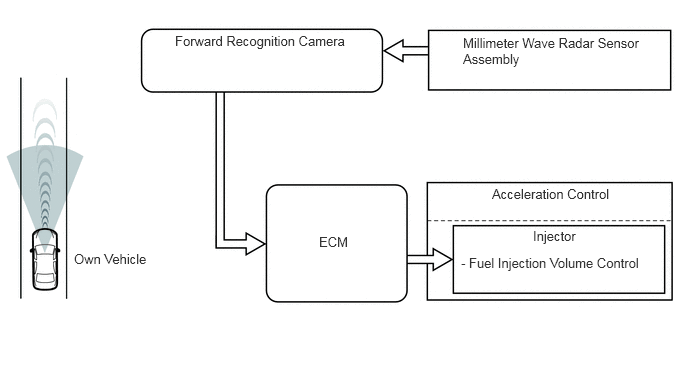
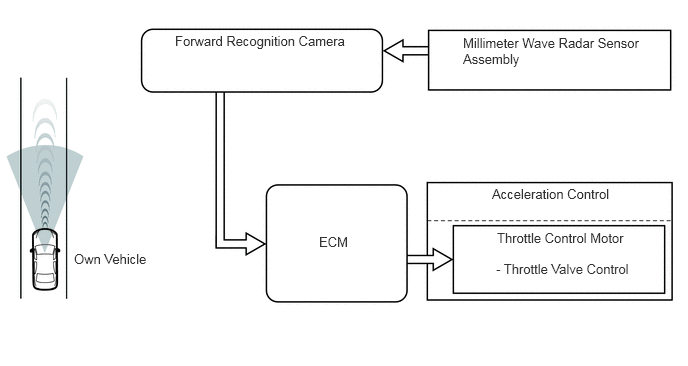
Deceleration Control Function
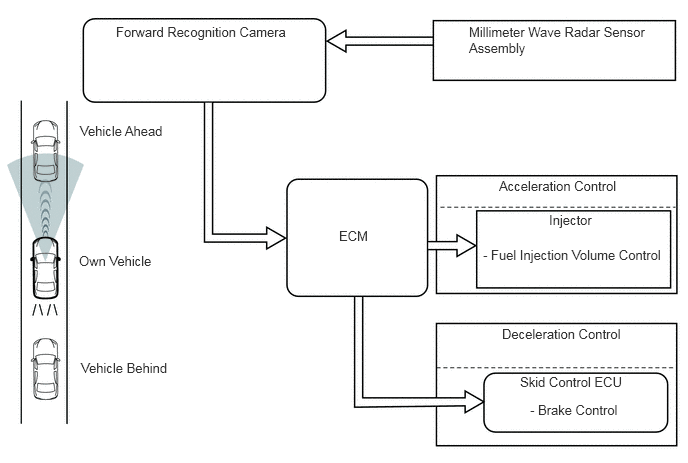
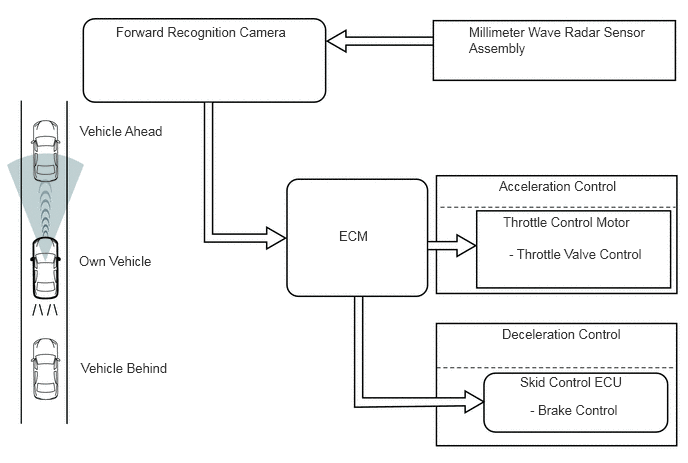
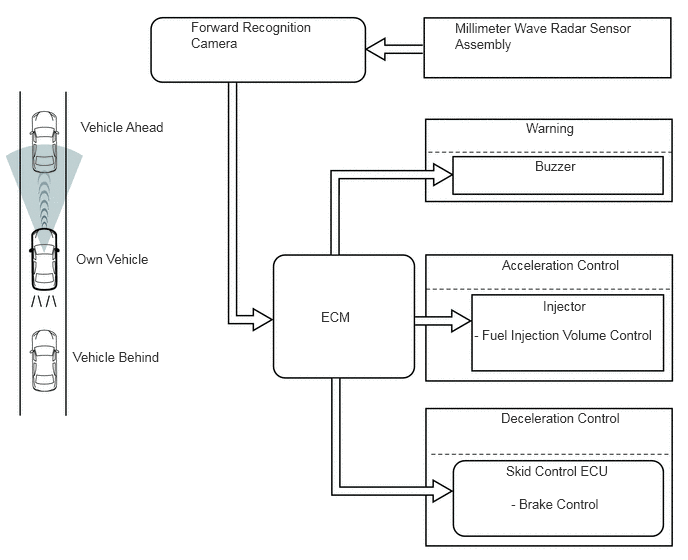
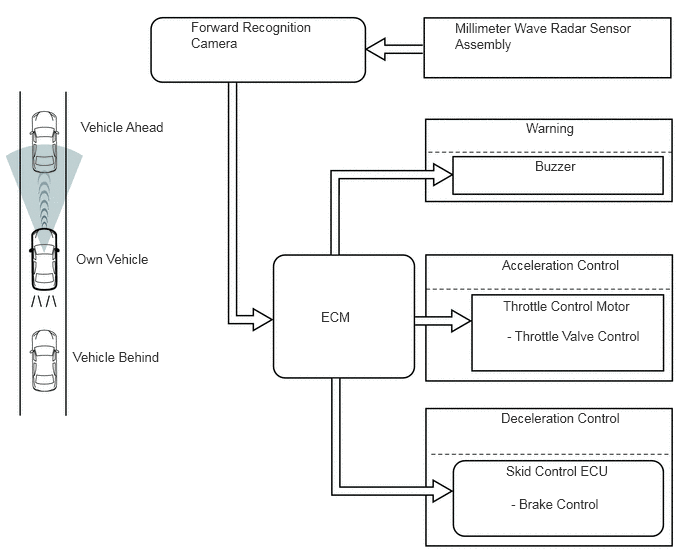
The forward recognition camera calculates the target deceleration rate in accordance with signals from the millimeter wave radar sensor assembly, forward recognition camera and transmits a deceleration request signal to the ECM. Upon receiving this signal, the ECM decreases the fuel injection volume*1 or closes the throttle valve*2 in order to cause the vehicle to decelerate.
*1: Models with diesel engine
*2: Models with gasoline engine
This control is not performed in the presence of a parked vehicle or object or below the settable vehicle speed range.
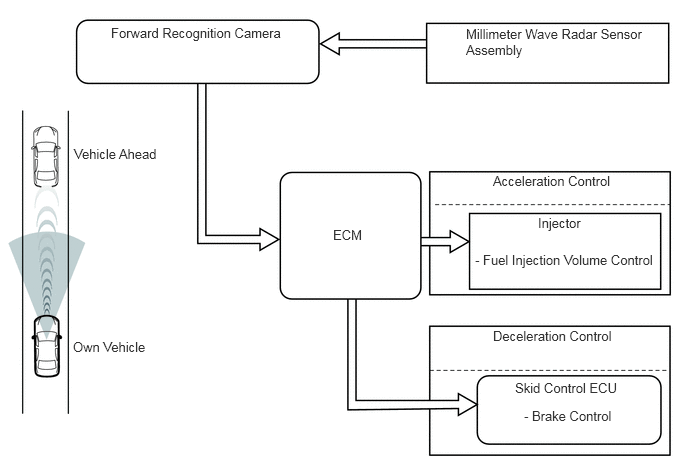
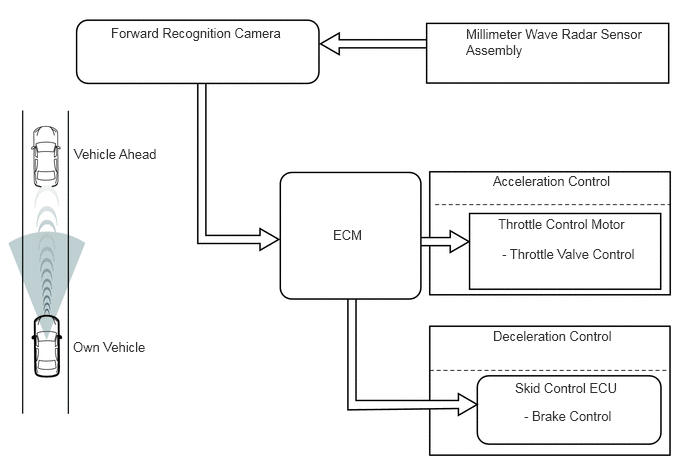
If the forward recognition camera determines that further deceleration is necessary, it transmits a brake request signal to the ECM. Upon receiving this signal, the ECM transmits a brake request signal to the skid control ECU. The skid control ECU then controls the brake actuator to apply the brakes.
At this time, if the deceleration rate is higher than a predetermined value, the skid control ECU outputs a stop light illumination request signal to the stop lights in order to warn any vehicles behind.
If the vehicle is not decelerating adequately, ECM sounds a buzzer. The buzzer is sounded to urge the driver to depress the brake pedal.
Follow-up Control Function
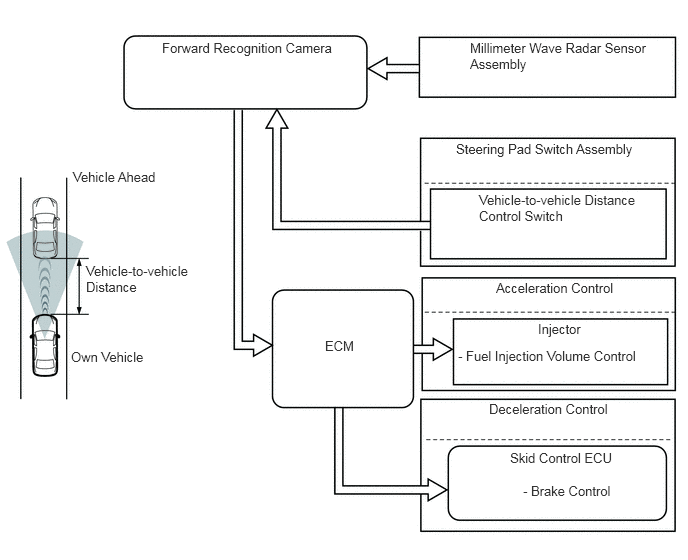
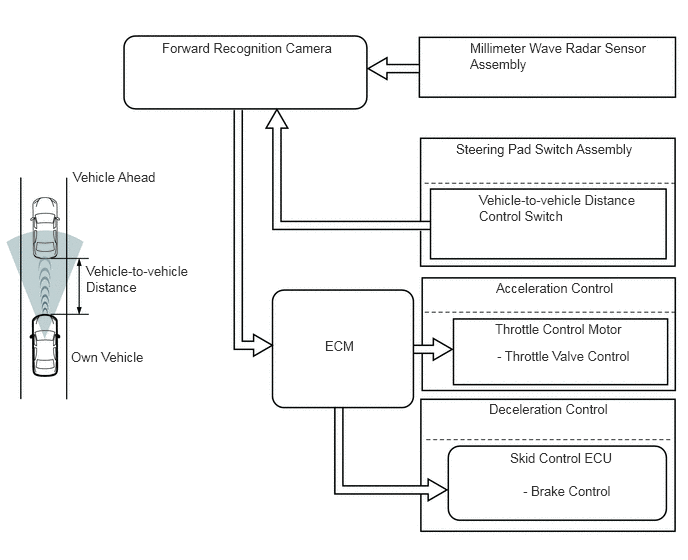
After performing deceleration control, the forward recognition camera transmits a request signal to the ECM so that the vehicle can follow the vehicle ahead while maintaining the proper vehicle-to-vehicle distance according to the vehicle speed. Upon receiving this signal, the ECM regulates the injector*1 or throttle control motor*2 in order to perform follow-up control.
*1: Models with diesel engine
*2: Models with gasoline engine
3 stages (long, middle and short) of vehicle-to-vehicle distance can be selected by operating the vehicle-to-vehicle distance control switch.
Acceleration Control Function
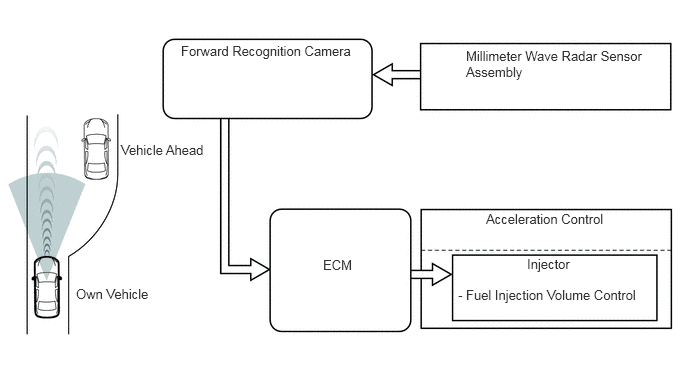
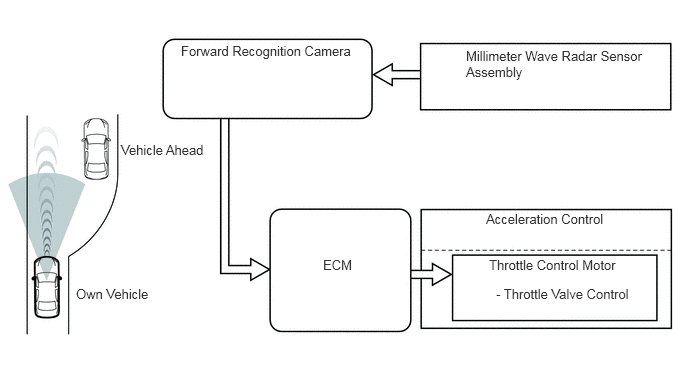
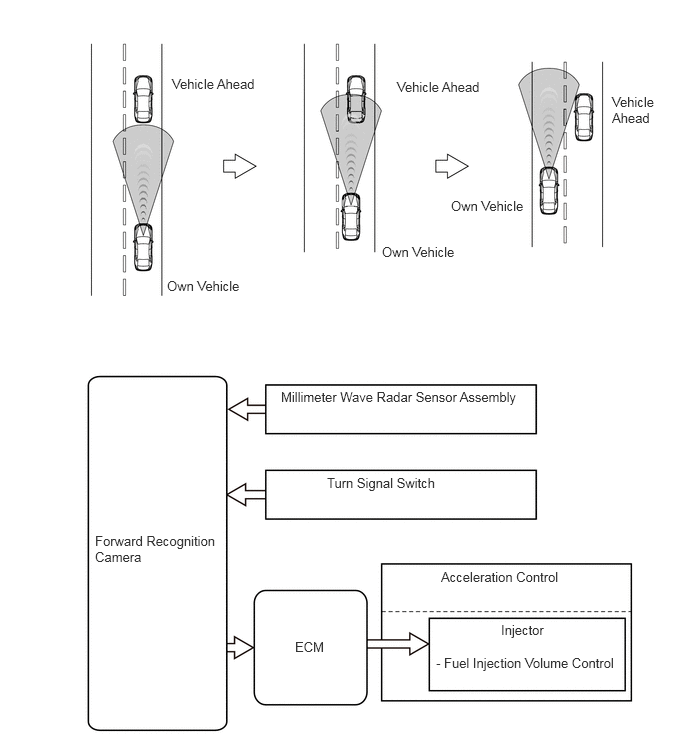
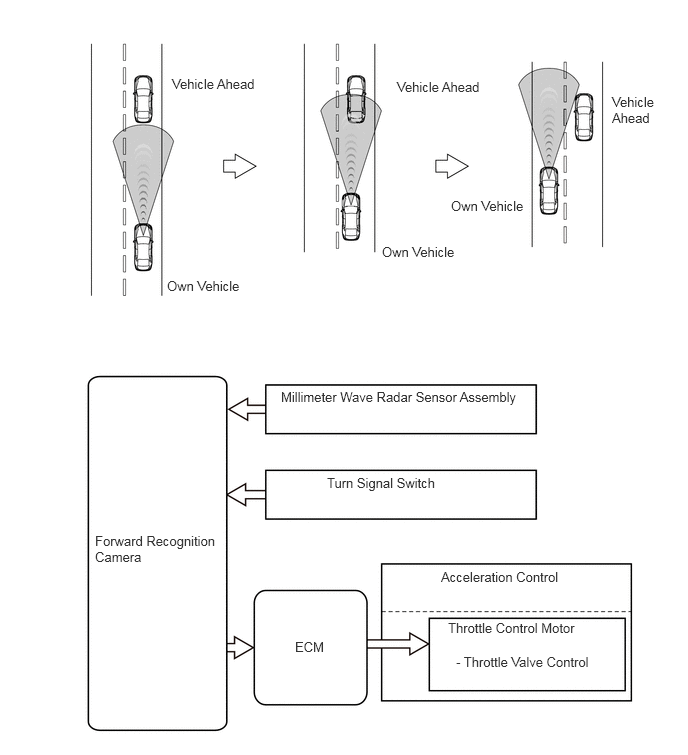
If the forward recognition camera detects (based on the millimeter wave radar sensor assembly and forward recognition camera) that either the vehicle ahead or the driver has changed lanes, an acceleration request signal is transmitted to the ECM in order to attain the set vehicle speed. Upon receiving this signal, the ECM regulates the injector*1 or throttle control motor*2 in order to perform acceleration control.
*1: Models with diesel engine
*2: Models with gasoline engine
Turn signal-linked Control Function
If the turn signal switch is operated when changing lanes to the passing lane at a vehicle speed of approximately 70 km/h (43 mph) during follow-up control, the vehicle will begin preliminary acceleration; once the vehicle has changed lanes it will first maintain this preliminary acceleration, and then slowly accelerate to the set vehicle speed.
Dynamic Radar Cruise Control with Road Sign Assist (Models with RSA System)
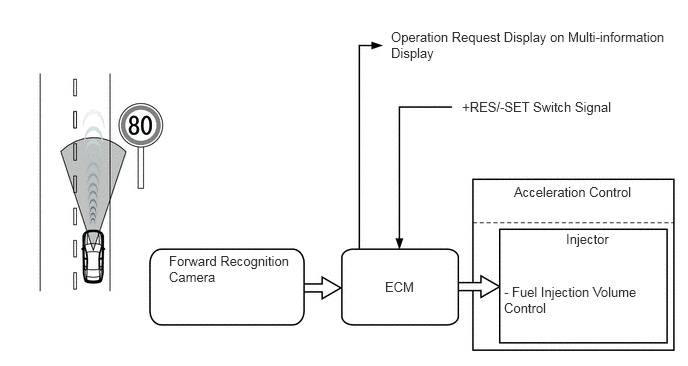
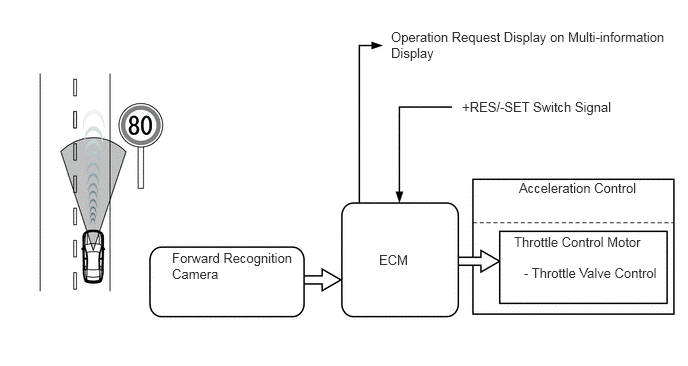
This function is turned on and while RSA system speed limit information is displayed, the speed limit can be set by holding down the +RES switch to increase the set vehicle speed to the speed limit, or by holding down the -SET switch to reduce the set vehicle speed to the speed limit.
Automatic Cancel Control
If one of the conditions listed below occurs while the vehicle is being driven using cruise control, speed control by the dynamic radar cruise control system will be canceled. Then, the following warning items will appear for the driver.
| Situation | Warning | |
|---|---|---|
| Multi-information Display | Buzzer | |
| If the following condition occurs, the ECM clears the set vehicle speed and cancels the cruise control.
·
An open or short circuit in the stop light switch assembly. The dynamic radar cruise control system is disabled until the engine switch is turned on (IG) again. |
Cruise Control
Malfunction Visit Your Dealer |
Sounds |
| If the following condition occurs, the ECM clears the set vehicle speed and cancels the cruise control.
·
The vehicle speed drops more than 16 km/h (10 mph) below the set vehicle speed. |
- | - |
| If the following condition occurs, the ECM cancels the cruise control while retaining the set vehicle speed in its memory.
·
The vehicle speed drops below the low speed limit [approximately 25 km/h (16 mph)]. |
- | - |
| If the following condition occurs, the ECM clears the set vehicle speed and cancels the cruise control.
·
Malfunction in the engine control system. The dynamic radar cruise control system is disabled until the engine switch is turned on (IG) again. |
- | - |
| If either of the conditions listed below occurs, the ECM clears the set vehicle speed and cancels the cruise control.
·
Stop light switch assembly input signal is abnormal. ·
Cancel circuit malfunction. ·
Brake control system malfunction. ·
Communication malfunction between the skid control ECU and ECM. |
Cruise Control
Malfunction Visit Your Dealer |
Sounds |
| Situation | Warning | |
|---|---|---|
| Multi-information Display | Buzzer | |
| If either of the conditions listed below occurs, the ECM clears the set vehicle speed and cancels the cruise control.
·
An open or short circuit in the stop light switch assembly. ·
Malfunction of the millimeter wave radar sensor assembly. ·
Malfunction in the dynamic radar cruise control system other than those given above. The dynamic radar cruise control system is disabled until the engine switch is turned on (IG) again. |
Cruise Control
Malfunction Visit Your Dealer |
Sounds |
| If the following condition occurs, the ECM clears the set vehicle speed and cancels the cruise control.
·
Malfunction in the engine control system. The dynamic radar cruise control system is disabled until the engine switch is turned on (IG) again. |
- | - |
| If the following condition occurs, the ECM cancels the cruise control while retaining the set vehicle speed in its memory.
·
The millimeter wave radar sensor assembly or the grille cover are dirty. The dynamic radar cruise control system is prohibited until the condition is corrected or the dynamic radar cruise control system is turned off and back on again using the cruise control main switch on the steering pad switch assembly. |
Radar Cruise
Control Unavailable See Owner's Manual |
Sounds |
| If either of the following conditions occurs, the ECM cancels the cruise control while retaining the set vehicle speed in its memory.
·
The measurement becomes extremely unstable due to poor weather conditions. ·
Brake control by the dynamic radar cruise control system is temporarily unavailable. ·
Misalignment of the axis of the millimeter wave radar sensor assembly. ·
A Malfunction in the forward recognition camera. ·
Forward recognition camera temporarily not available. The dynamic radar cruise control system is prohibited until the condition is corrected or the dynamic radar cruise control system is turned off and back on again using the cruise control main switch on the steering pad switch assembly. |
Radar Cruise
Control Unavailable |
Sounds |
FUNCTION
The operation switches of the dynamic radar cruise control system (cruise control main switch, -SET switch, +RES switch, CANCEL switch and vehicle-to-vehicle distance control switch) are positioned in the steering pad switch assembly.
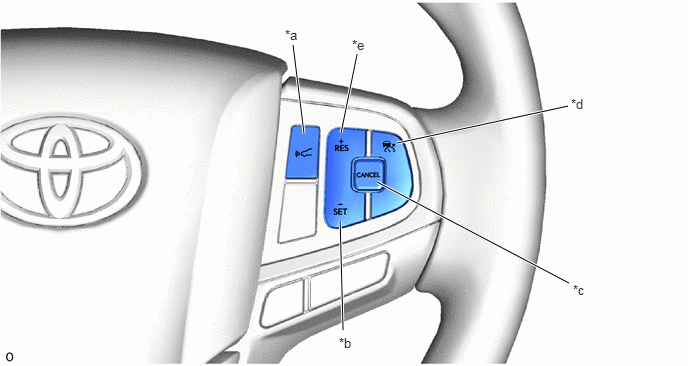
| *a | Vehicle-to-vehicle Distance Control Switch | *b | -SET Switch |
| *c | CANCEL Switch | *d | Cruise Control Main Switch |
| *e | +RES Switch | - | - |
Cruise Control Main Switch
When the dynamic radar cruise control system is turned on using the cruise control main switch, the system starts in vehicle-to-vehicle distance control mode. When the cruise control main switch is pushed and held for 1.5 seconds or more from the dynamic radar cruise control system off, the system changes to constant control mode.
Vehicle-to-vehicle Distance Control Switch
While the vehicle is being driven in vehicle-to-vehicle distance control mode, the vehicle-to-vehicle distance setting can be changed as follows each time the distance control switch is pressed; long → middle → short → long.
If the engine switch is turned off and back on (IG), the system will default to "long".
The vehicle-to-vehicle distance is as follows:
| Mode | Vehicle-to-vehicle Distance* |
|---|---|
|
*: While driving at a speed of 80 km/h (50 mph). |
|
| Long | Approximately 50 m (160 ft.) |
| Middle | Approximately 40 m (130 ft.) |
| Short | Approximately 30 m (100 ft.) |
Dynamic Radar Cruise Control with Road Sign Assist Operation (Models with RSA System)
The combination meter assembly customization setting can be used to turn the dynamic radar cruise control with road sign assist on and off.
DIAGNOSIS
In order to make system inspections easier to perform, a diagnosis function is used in consideration of serviceability. The DTCs of malfunctioning parts can be read by connecting the Global TechStream (GTS). For details, refer to the Repair Manual.