Check the entry unlock function.
Use the wireless lock operation to lock the doors. With the electrical key in your possession, touch a door's outside handle (touch sensor) and check that the door unlocks.
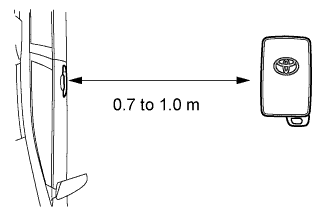 |
Check the entry unlock operation's detection area.
Step 1: Hold the electrical key at the same height as the door's outside handle (approximately 0.8 m (2.62 ft.)). Make sure that the direction and position of the electrical key are as shown in the illustration.
Step 2: When the electrical key is brought within 0.7 to 1.0 m (2.30 to 3.28 ft.) of the vehicle, check that the system enters unlock standby mode.
- HINT:
- Unlock standby mode is signified by the electrical key's red LED illuminating.
Step 3: After the system enters unlock standby mode, touch the door outside handle's sensor within 3 seconds. Check that the door unlocks.
- NOTICE:
- The electrical key cannot communicate with the system within a 0.2 m (0.656 ft.) radius of each door outside handle.
Step 4: Repeat steps 2 and 3 for the remaining doors.
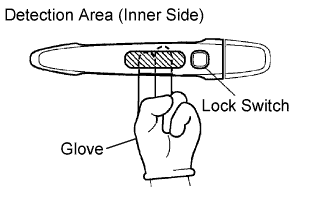
Step 5: Inspect the door electrical key oscillator's response sensitivity. Wear protective gloves, set the system to unlock standby mode, and check that touching the inner side of the door outside handle (the highlighted area in the illustration) with your fingers causes the door to unlock.
- NOTICE:
- When touching the highlighted area, tapping too quickly or having extended contact may not trigger the sensor. In such a case, the door will not unlock.
Step 6: Repeat step 5 for the remaining doors.
 |
 |
Check the entry lock function.
Step 1: Close all of the vehicle's doors. With the electrical key in your possession outside the vehicle, check that pressing the lock switch locks the doors.
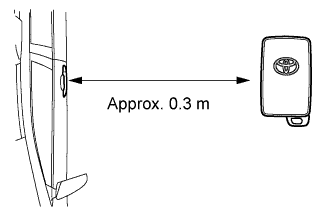
Step 2: Inspect the entry lock operation's detection area and the indoor electrical key antenna for wave leaks. Hold the electrical key at a height of 1 m (3.28 ft.) above the lower edge of the window frame. Make sure that the direction and position of the electrical key are as shown in the illustration. When the electrical key is approximately 0.3 m (0.984 ft.) from the vehicle and the lock switch is pressed, check that all the doors lock and the warning buzzer (for when the electrical key is forgotten) does not sound. If the warning buzzer sounds, the indoor electrical key antenna may have a wave leak.
- HINT:
- Do not press the lock switch with the same hand that is holding the electrical key because the electrical key cannot communicate with the system within a 0.2 m (0.656 ft.) radius of the door outside handle. The doors will not lock.
Step 3: Repeat steps 1 and 2 for the remaining doors.
 |
Check the entry back door open function.
Close the back door. With the electrical key in your possession, check that pressing the back door opener switch opens the back door.
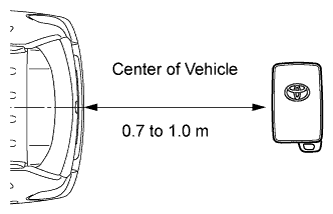
Inspect the entry back door open operation's detection area. Hold the electrical key at the same height as the back door opener switch (approximately 0.8 m (2.62 ft.)) and align the key with the center of the rear of the vehicle. Make sure that the direction and position of the electrical key are as shown in the illustration. When the electrical key is brought within 0.7 to 1.0 m (2.30 to 3.28 ft.) of the vehicle, check that pressing the back door opener switch opens the back door.
|
Check the entry glass hatch open function.
Close the back door. With the electrical key in your possession, check that pressing the glass hatch opener switch opens the glass hatch.
Inspect the entry glass hatch open operation's detection area. Hold the electrical key at the same height as the glass hatch opener switch (approximately 0.8 m (2.62 ft.)) and align the key with the center of the rear of the vehicle. Make sure that the direction and position of the electrical key are as shown in the illustration. When the electrical key is brought within 0.7 to 1.0 m (2.30 to 3.28 ft.) of the vehicle, check that pressing the glass hatch opener switch opens the glass hatch.
Check the entry ignition function.
When the engine is off:
With the electrical key in your possession and the brake pedal depressed, check that pressing the engine switch releases the steering wheel lock and starts the engine.- HINT:
- The engine can be started only when the engine switch indicator illuminates in green.
When the engine is running:
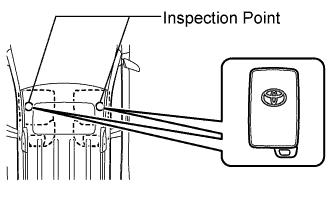
With the electrical key in your possession, check that pressing the engine switch stops the engine.Inspect the entry ignition operation's detection area (front). Make sure that the direction of the electrical key is as shown in the illustration. When the electrical key is in either of the 2 inspection points in the illustration, check that the engine can start.
- NOTICE:
- The engine cannot be started when the electrical key is on the instrument panel or in the glove box.
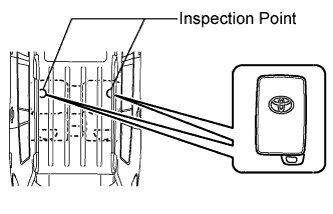
Inspect the entry ignition operation's detection area (center). Make sure that the direction of the electrical key is as shown in the illustration. When the electrical key is in either of the 2 inspection points in the illustration, check that the engine can start.
- NOTICE:
- The engine cannot be started when the electrical key is on the instrument panel or in the glove box.
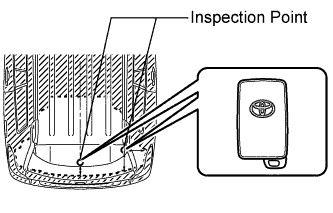
Inspect the entry ignition operation's detection area (rear). Make sure that the direction of the electrical key is as shown in the illustration. When the electrical key is in either of the 2 inspection points in the illustration, check that the engine can start.
- NOTICE:
- The engine cannot be started when the electrical key is on the instrument panel or in the glove box.
 |
 |
 |
Check the electrical key lock-in prevention function (Glass hatch).
Place the electrical key in the cabin with all doors locked. Check that: 1) closing the glass hatch triggers the electrical key's wireless buzzer (which lasts approximately 2 seconds), and 2) pressing the glass hatch opener switch opens the glass hatch.
Place the electrical key lock-in prevention function (Cabin).
Place the electrical key in the cabin with all doors locked. Check that: 1) closing all doors triggers the electrical key's wireless buzzer (which lasts approximately 2 seconds), and 2) unlocking the doors opens the doors.
Check the electrical key cancel function.
Proceed to the electrical key cancel operation (Click here).
The electrical key cancel operation disables the following functions:- Entry Unlock/Lock
- Entry Back Door Open
- Entry Glass Hatch Open
- Electrical Key Lock-in Prevention
- Warning
- Entry Unlock/Lock
While the electrical key cancel function is ON, check that all functions in the smart key system cannot be operated.
Check the answer-back function (hazard warning light flashing and buzzer sounding).
| Entry Operation | Hazard Warning Light | Buzzer |
| Entry Door Lock | Flashes once | Sounds once |
| Entry Door Unlock | Flashes twice | Sounds twice |
| Entry Back Door Open | Does not flash | Does not sound |
| Entry Glass Hatch Open | Does not flash | Does not sound |
Check that the electrical key reminder warning buzzer sounds.
Carry the electrical key in the vehicle and close the driver side door. Then turn the engine switch off or on (ACC). The steering lock is released.
Open the driver side door and check that the buzzer sounds intermittently.
Check that the electrical key reminder warning buzzer stops.
When the buzzer is sounding, check that the buzzer stops sounding if either of the following is performed:
- Close the driver side door (front door courtesy light switch is off).
- Turn the engine switch on (IG or ACC) and lock the steering wheel.
- Close the driver side door (front door courtesy light switch is off).