SHIFT LEVER > ADJUSTMENT |
| 1. INSPECT SHIFT LEVER POSITION |
Apply the parking brake.
Lock the wheels with chocks to secure the vehicle.
Turn the power switch on (READY).
Move the shift lever to the D position and release the brake pedal.
Slowly move the shift lever to the N position and measure moving distance (a) of the shift lever from the original point to the gear activation point.
Move the shift lever to the R position and release the brake pedal.
Slowly move the shift lever to the N position and measure moving distance (b) of the shift lever from the original point to the vehicle activation point.
Check that moving distances (a) and (b) shown in the illustration are almost the same.
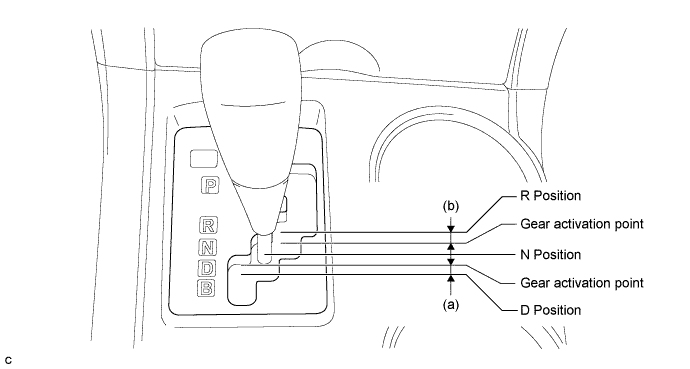
| 2. ADJUST SHIFT LEVER POSITION |
If moving distance (a) is shorter than (b) [*1]:

Move the shift lever to the N position.
![]() |
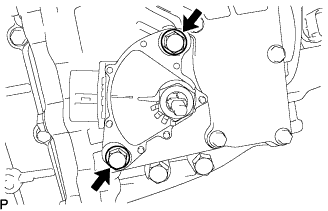
Loosen the 2 bolts.
![]() |
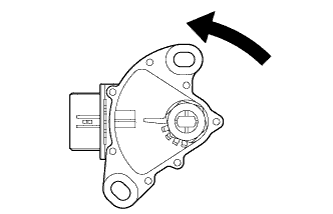
Slightly turn the shift lever position sensor counterclockwise.
![]() |
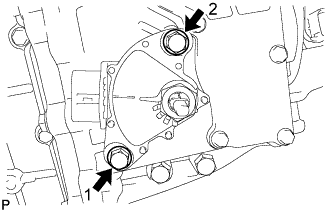
Tighten the 2 bolts in the order shown in the illustration.
Recheck the shift lever position.
If moving distance (b) is shorter than (a) [*2]:

Move the shift lever to the N position.
![]() |
Loosen the 2 bolts.
![]() |
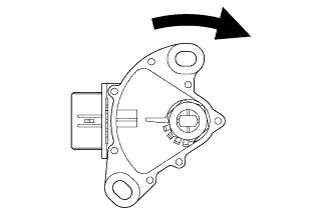
Slightly turn the shift lever position sensor clockwise.
![]() |
Tighten the 2 bolts in the order shown in the illustration.
Recheck the shift lever position.
| 3. INSPECT SHIFT LEVER OPERATION |
While moving the shift lever from the N to each position, check that the lever moves smoothly and that the shift position indicator comes on properly according to the shift lever position.
Turn the power switch on (READY), and check the following:
When the shift lever is moved to the D position, the vehicle moves forward.
When the shift lever is moved to the R position, the buzzer sounds and the vehicle moves in reverse.