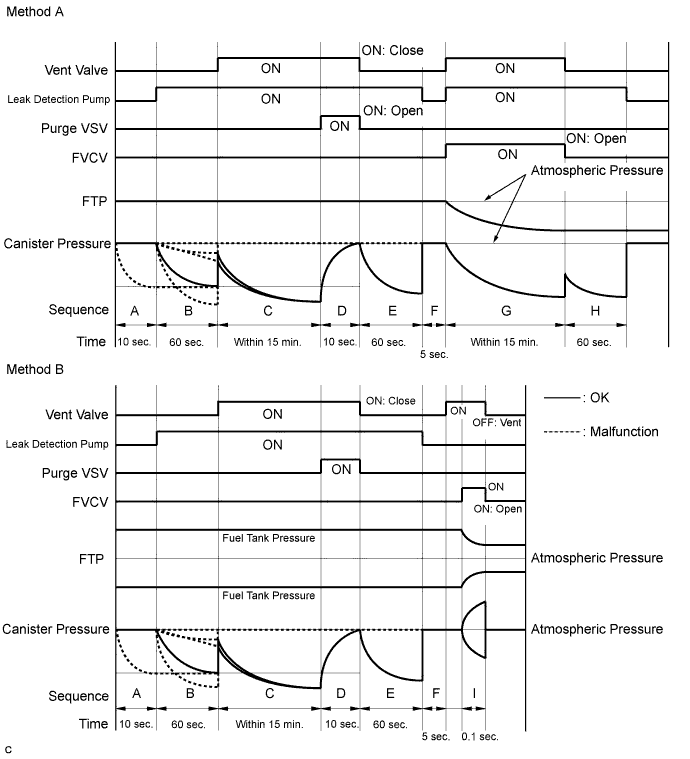
DTC P043E Evaporative Emission System Reference Orifice Clog Up |
DTC P043F Evaporative Emission System Reference Orifice High Flow |
DTC P2401 Evaporative Emission Leak Detection Pump Stuck OFF |
DTC P2402 Evaporative Emission Leak Detection Pump Stuck ON |
DTC P2419 Evaporative Emission System Switching Valve Control Circuit Low |
| DTC No. | Monitoring Item | DTC Detection Condition | Trouble Area | Detection Timing | Detection Logic |
| P043E | Reference orifice clogged | P043E, P043F, P2401, P2402 and P2419 present when one of following conditions met during key-off EVAP monitor:
|
| Power switch OFF | 2-trip |
| P043F | Reference orifice high-flow | ||||
| P2401 | Leak detection pump stuck OFF | ||||
| P2402 | Leak detection pump stuck ON | ||||
| P2419 | Vent valve stuck closed |
| Required Sensors/Components (Main) | Canister pump module |
| Required Sensors/Components (Related) | Air fuel ratio sensor, Rear heated oxygen, Intake air temperature sensor, Mass air flow meter, Crankshaft position sensor, engine coolant temperature sensor |
| Frequency of Operation | Once per driving cycle |
| Duration | Within 2 minutes |
| MIL Operation | 2 driving cycles |
| Sequence of Operation | None |
| Monitor runs whenever following DTCs are not present | None |
| EVAP key-off monitor is run when all of the following conditions are met: | - |
| Atmospheric pressure | 70 to 110 kPa (525 to 825 mmHg) |
| Battery voltage | 10.5 V or more |
| Vehicle speed | Below 4 km/h (2.5 mph) |
| Power switch | OFF |
| Pressure sensor (built in canister pump module) malfunction (P0450, P0451, P0452 and P0453) | Not detected |
| FTP sensor malfunction (P1451, P1452 and P1453) | Not detected |
| Purge VSV | Not operated by scan tool |
| Vent valve | Not operated by scan tool |
| Leak detection pump | Not operated by scan tool |
| Both of the following conditions are met before power switch off | Conditions 1 and 2 |
| 1. Duration that vehicle is being driven | 5 minutes or more |
| 2. EVAP purge operation | Performed |
| Engine coolant temperature | 4.4 to 35°C (40 to 95°F) |
| Intake air temperature | 4.4 to 35°C (40 to 95°F) |
| Time after engine stop | 5 hours |
| First time | 7 hours |
| Second time | 9 hours and 30 minutes |
| Next sequence is run if the following condition is met: | - |
| Atmospheric pressure change for 10 seconds | Less than 0.3 kPa (2.25 mmHg) for 1 second |
| Next sequence is run if all of the following conditions are met: | Conditions 1, 2 and 3 |
| 1. EVAP pressure 1.9 seconds after reference pressure measurement | -1 kPa (-7.5 mmHg) or less |
| 2. Reference pressure | -4.85 to -1.057 kPa (-36.4 to -7.93 mmHg) |
| 3. Reference pressure | Saturated |
| Next sequence is run if the following condition is met: | - |
| EVAP pressure change for 10 seconds after vent valve ON (Closed) | 0.3 kPa (2.25 mmHg) or more |
| Next sequence is run if both of the following conditions are met: | Conditions 1 and 2 |
| 1. Vacuum introduction time | 15 minutes or less |
| 2. FTP | Saturated |
| Next sequence is run if the following condition is met: | - |
| EVAP pressure change for 10 seconds after purge VSV ON (Open). | 0.3 kPa (2.25 mmHg) or more |
| Next sequence is run if all of the following conditions are met: | Conditions 1, 2, 3 and 4 |
| 1. EVAP pressure 1.9 seconds after reference pressure measurement | -1 kPa (-7.5 mmHg) or less |
| 2. Reference pressure | -4.85 to -1.057 kPa (-36.4 to -7.93 mmHg) |
| 3. Reference pressure | Saturated within 55 seconds |
| 4. Reference pressure difference between the first and second | Less than 0.7 kPa (5.25 mmHg) |
| Next sequence is run if the following condition is met: | - |
| Canister leak when vacuum introduction was complete | Second reference pressure or less |
| Sequence 14 is run if both of the following conditions are met: | Conditions 1 and 2 |
| 1. FTP when EVAP monitor started | -2 kPa (-15 mmHg) or less, or 3 kPa (22.5 mmHg) or more |
| 2. FTP change while FVCV and vent valve are open | 0.5 kPa (3.75 mmHg) or more |
| Next sequence is run if both of the following conditions are met: | Conditions 1 and 2 |
| 1. FTP when EVAP monitor started | -2 to 3 kPa (-15 to 22.5 mmHg) |
| 2. Vacuum introduction time | 15 minutes or less |
| Next sequence is run if the following condition is met: | - |
| FTP change when vacuum introduction for fuel tank | 0.5 kPa (3.75 mmHg) |
| Next sequence is run if the following condition is met: | - |
| FTP change when FVCV closed | 0.35 kPa (2.6 mmHg) or less |
| Next sequence is run if all of the following conditions are met: | Conditions 1, 2, 3, and 4 |
| 1. FTP 1.9 seconds after reference pressure measurement | -1 kPa (-7.5 mmHg) or more |
| 2. Reference pressure | -4.85 to -1.057 kPa (-36.4 to -7.93 mmHg) |
| 3. Reference pressure | Saturated |
| 4. Reference pressure difference between the second and third measurement | Less than 0.7 kPa (5.25 mmHg) |
| Sequence is run if the following condition is met: | - |
| FTP when vacuum introduction for fuel tank was complete | Less than third reference pressure |
| Next sequence is run if the following condition is met: | - |
| FTP change while FVCV and vent valve are open | Less than 0.3 kPa (2.25 mmHg) |
| Monitor is complete if the following condition is met: | - |
| Atmospheric pressure difference between sequences 1 and 8 | 0.3 kPa (2.5 mmHg) or less |
| One of the following condition is met: | - |
| EVAP pressure just after reference pressure measurement start | More than -1 kPa (-7.5 mmHg) |
| Reference pressure | Less than -4.85 kPa (-36.4 mmHg) |
| Reference pressure | -1.057 kPa (-7.93 mmHg) or more |
| Reference pressure | Not saturated within 1 minute |
| Difference between first reference pressure and second reference pressure | 0.7 kPa (5.25 mmHg) or more |