Home › ENGINE › 3MZ-FE ENGINE CONTROL SYSTEM › SFI SYSTEM

DTC    P1422    Fuel Tank Small Leak

DTC    P1423    Fuel Tank Gross Leak

for Preparation Click here


DTC SUMMARY


DTC No.
Monitoring Item
DTC Detection Condition
Trouble Area
Detection Timing
Detection Logic
P1422
Fuel tank small leak
Vacuum pump creates negative pressure (vacuum) in fuel tank and fuel tank pressure is measured. 0.02 inch leak pressure standard is measured at the start and at the end of leak check.
If stabilized pressure is higher than third 0.02 inch leak pressure standard, ECM (included in the hybrid vehicle control ECU) determines that fuel tank has a small leak.
  1. Leak in EVAP line
    (Canister - Fuel vapor-containment valve)
  2. Leak in EVAP line
    (Purge VSV - Canister)
  3. Canister pump module
  4. Leak in canister
Power switch off
2 trip
P1423
Fuel tank gross leak
Vacuum pump creates negative pressure (vacuum) in fuel tank and fuel tank pressure is measured. 0.02 inch leak pressure standard is measured at the start and at the end of leak check.
If stabilized pressure is higher than [third 0.02 inch leak pressure standard x 0.2], ECM (included in the hybrid vehicle control ECU) determines that fuel tank has large leak.
Same as above
Power switch off
2 trip

DESCRIPTION

Refer to the EVAP system .

MONITOR DESCRIPTION

  1. P1422: Fuel tank small leak
    In operation G, the vacuum pump creates negative pressure (vacuum) in the fuel tank and the fuel tank pressure is measured. If the stabilized system pressure is higher than the third 0.02 inch leak pressure standard, the ECM (included in the hybrid vehicle control ECU) determines that the fuel tank has a large leak. The ECM illuminates the MIL and sets the DTC (2 trip detection logic).
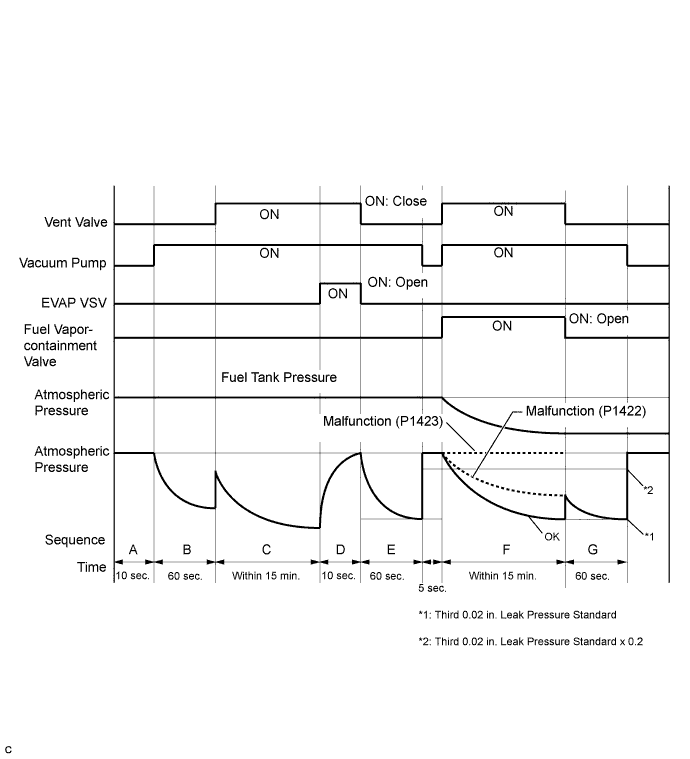
  2. P1423: Fuel tank gross leak
    In operation G, the vacuum pump creates negative pressure (vacuum) in the fuel tank and the fuel tank pressure is measured. If the stabilized system pressure is higher than [third 0.02 inch leak pressure standard x 0.2] (near atmospheric pressure), the ECM (included in the hybrid vehicle control ECU) determines that the fuel tank has a large leak. The ECM illuminates the MIL and sets the DTC (2 trip detection logic).


    A109166E06


MONITOR STRATEGY


Required Sensors/Components
Fuel tank and canister pump module
Frequency of Operation
Once per driving cycle
Duration
Within 15 minutes (varies with the amount of fuel in tank)
MIL Operation
2 driving cycles
Sequence of Operation
None

TYPICAL ENABLING CONDITIONS


Monitor runs whenever following DTCs are not present
None
EVAP key-off monitor runs when all of the following conditions are met:
-
Atmospheric pressure
70 to 110 kPa (525 to 825 mmHg)
Battery voltage
10.5 V or more
Vehicle speed
Below 4 km/h (2.5 mph)
Power switch
OFF
Engine condition
Not running
FTP sensor malfunction (P1450, P1452 and/or P1453)
Not detected
Purge VSV
Not operated by scan tool
Vent valve
Not operated by scan tool
Leak detection pump
Not operated by scan tool
Both of the following conditions are met before power switch OFF:
Conditions 1 and 2
1. Duration that vehicle is being driven
5 minutes or more
2. Purge flow
Executed
Engine coolant temperature
4.4 to 35°C (40 to 95°F)
Intake air temperature
4.4 to 35°C (40 to 95°F)
Time after engine stopped
5 hours

Example of restart time 
First time
7 hours
Second time
9 hours and 30 minutes
  1. Key-off monitor sequence 1 to 15

    1. Atmospheric pressure measurement 
    Next sequence is run if the following condition is met:
    -
    Atmospheric pressure change for 10 seconds
    Less than 0.3 kPa (2.25 mmHg) for 1 second

    2. First reference pressure measurement 
    Next sequence is run if all of the following conditions are met:
    Conditions 1, 2, and 3
    1. EVAP pressure 1.9 seconds after reference pressure measurement
    -1 kPa (-7.5 mmHg) or less
    2. Reference pressure
    -4.85 to -1.057 kPa (-36.4 to -7.93 mmHg)
    3. Reference pressure
    Saturated within 55 seconds

    3. Vent valve stuck closed check 
    Next sequence is run if the following condition is met:
    -
    EVAP pressure change for 10 seconds after vent valve ON (Closed)
    0.3 kPa (2.25 mmHg) or more

    4. Vacuum introduction for canister 
    Next sequence is run if both of the following conditions are met:
    Conditions 1 and 2
    1. Vacuum introduction time
    15 minutes or less
    2. FTP
    Saturated

    5. Purge VSV stuck closed check 
    Next sequence is run if the following condition is met:
    -
    EVAP pressure change for 10 seconds after Purge VSV ON (Open)
    0.3 kPa (2.25 mmHg) or more

    6. Second reference pressure measurement 
    Next sequence is run if all of the following conditions are met:
    Conditions 1, 2, 3 and 4
    1. EVAP pressure 1.9 seconds after reference pressure measurement
    -1 kPa (-7.5 mmHg) or less
    2. Reference pressure
    -4.85 to -1.057 kPa (-36.4 to -7.93 mmHg)
    3. Reference pressure
    Saturated within 55 seconds
    4. Reference pressure difference between the first and second
    0.7 kPa (5.25 mmHg) or less

    7. Canister leak 
    Next sequence is run if the following condition is met:
    -
    Canister leak when vacuum introduction was complete
    Less than second reference pressure

    8. Fuel vapor-containment valve (FVCV stuck closed check) 
    Sequence 14 is run if both of the following conditions are met:
    Conditions 1 and 2
    1. FTP when EVAP monitor started
    -2 kPa (-15 mmHg) or less, or 3 kPa (22.5 mmHg) or more
    2. FTP change while FVCV and vent valve are open
    0.5 kPa (3.75 mmHg) or more

    9. Vacuum introduction for fuel tank 
    Next sequence is run if both of the following conditions are met:
    Conditions 1 and 2
    1. FTP when EVAP monitor started
    -2 to 3 kPa (-15 to 22.5 mmHg)
    2. Vacuum introduction time
    15 minutes or less

    10. FVCV stuck closed check 
    Next sequence is run if the following condition is met:
    -
    FTP change when vacuum introduction for fuel tank
    0.5 kPa (3.75 mmHg)

    11. FTP sensor stuck check 
    Next sequence is run if the following condition is met:
    -
    FTP change when FVCV closed
    0.35 kPa (2.6 mmHg) or less

    12 Third reference pressure measurement 
    Next sequence is run if all of the following conditions are met:
    Conditions 1, 2, 3, and 4
    1. FTP 1.9 seconds after reference pressure measurement began
    -1 kPa (-7.5 mmHg) or more
    2. Reference pressure
    -4.85 to -1.057 kPa (-36.4 to -7.93 mmHg)
    3. Reference pressure
    Saturated
    4. Reference pressure difference between the second and third
    Less than 0.7 kPa (5.25 mmHg)

    13. Fuel tank leak check 
    Sequence is run if the following condition is met:
    -
    FTP when vacuum introduction for fuel tank was complete
    Less than third reference pressure

    14. FTP sensor stuck check 
    Next sequence is run if the following condition is met:
    -
    FTP change while FVCV and vent valve are open
    Less than 0.3 kPa (2.25 mmHg)

    15. Atmospheric pressure measurement 
    Monitor is complete if the following condition is met:
    -
    Atmospheric pressure difference between sequences 1 and 8
    0.35 kPa (2.6 mmHg) or less

TYPICAL MALFUNCTION THRESHOLDS

"Saturated" indicates that the fuel tank pressure change is less than 0.1 kPa (0.75 mmHg) in 30 seconds.

P1423: Fuel tank gross leak:  
FTP when vacuum introduction complete
Higher than reference pressure x 0.2

P1422: Fuel tank small leak: 
FTP when vacuum introduction is complete
Between conditions 1 and 2
Condition 1
Higher than second reference pressure
Condition 2
Lower than reference pressure x 0.2
Atmospheric pressure (absolute pressure)
70 kPa (525 mmHg) or more, and less than 110 kPa (825 mmHg)

MONITOR RESULT

Refer to EVAP System .

INSPECTION PROCEDURE

Refer to EVAP System .