Home › ENGINE › 3MZ-FE COOLING › COOLANT (for Engine)

COOLANT (for Engine) > REPLACEMENT

for Preparation Click here


1. DRAIN ENGINE COOLANT (for Engine)
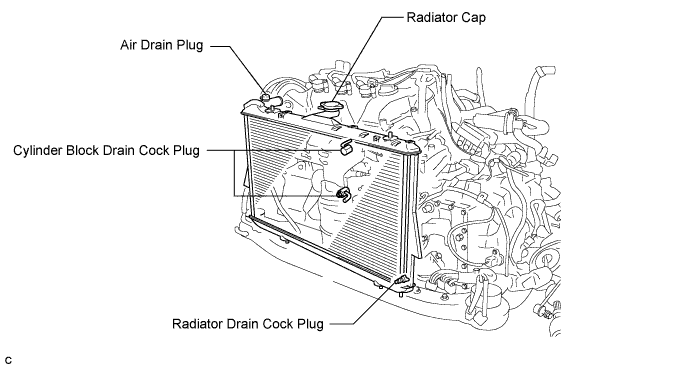
  1. Loosen the radiator drain cock plug.

    CAUTION:
    To avoid the danger of being burned, do not remove the radiator cap and drain plugs while the engine and radiator are still hot. Thermal expansion will cause hot engine coolant and steam to blow out from the radiator.

    NOTICE:
    Collect the coolant in a container and dispose of it according to the regulations in your area.

  1. Loosen the cylinder block drain cock plugs.


  1. Remove the radiator cap.

    A176029E01


2. ADD ENGINE COOLANT (for Engine)
  1. Tighten the radiator drain cock plug.

  1. Tighten the cylinder block drain cock plugs.

    Torque:
    13 N*m{ 133 kgf*cm , 9 ft.*lbf }

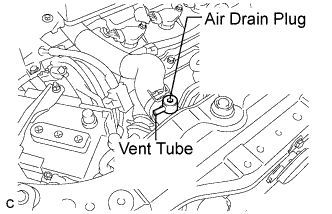
  1. Loosen the air drain plug.


    A176032E01
  1. Install a vinyl tube to the vent tube located on the air drain plug.

  1. Fill the radiator with engine coolant until the vinyl tube is filled with the coolant.

  1. Tighten the air drain plug.

    Torque:
    1.5 N*m{ 15 kgf*cm , 13 in.*lbf }

    CAUTION:
    1. Do not use an alcohol type coolant or plain water alone.
    2. The coolant must be mixed with plain water (preferably demineralized water).


    Coolant capacity:

    Condition
    Capacity
    w/ rear heater
    12.8 liters (13.5 US qts, 11.2 lmp.qts)
    w/o rear heater
    10.6 liters (11.2 US qts, 9.3 lmp.qts)

    HINT:
    1. Improper coolants may damage the engine cooling system.
    2. TOYOTA vehicles are filled with TOYOTA SLLC at the factory. In order to avoid damage to the engine cooling system and other technical problems, only use TOYOTA SLLC or similar high quality ethylene glycol based non-silicate, non-amine, non-nitrite, non-borate coolant with long-life hybrid organic acid technology (coolant with long-life hybrid organic acid technology consists of a combination of low phosphates and organic acids).
    3. Use of coolant which includes more than 50% (freezing protection down to -35°C (-31°F)) or 60% (freezing protection down to -50°C (-58°F)) of ethylene-glycol is recommended but not more than 70%.
    4. Observe the coolant level inside the radiator by pressing the inlet and outlet radiator hoses several times by hand. If the coolant level goes down, add the coolant.

    NOTICE:
    Never use water as a substitute for engine coolant.

  1. Install the radiator cap securely.

  1. Fill the radiator reservoir tank with coolant.

  1. Warm up the engine until the thermostat opens. While the thermostat is open, allow the coolant to circulate for several minutes.

    HINT:
    The thermostat opening timing can be confirmed by squeezing the inlet radiator hose by hand, and sensing vibrations when the engine coolant starts to flow inside the hose.

  1. Stop the engine and wait until the coolant cools down.

  1. Remove the radiator cap and check the coolant level inside the radiator.

  1. If the coolant level is below the full level, perform the steps from (C) through (K) and repeat the operation until the coolant level stays at the full level.

  1. Recheck the coolant level inside the radiator reservoir tank. If it is below the full level, add the coolant.


3. INSPECT FOR COOLANT LEAK (for Engine)

CAUTION:
Do not remove the radiator cap while the engine and radiator are still hot. Pressurized, hot engine coolant and steam may be released and cause serious burns.


    A176028
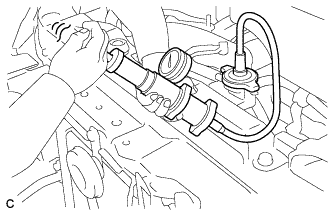
  1. Fill the radiator with coolant and attach a radiator cap tester.

  1. Pump the tester to 118 kPa (1.2 kgf/cm2, 17.1 psi), then check that the pressure does not drop.
    If the pressure drops, check the hoses, radiator assembly and water pump assembly for leakage. If there are no signs or traces of external engine coolant leakage, check the heater core, cylinder block and cylinder head.