UA80F AUTOMATIC TRANSMISSION / TRANSAXLE AUTOMATIC TRANSAXLE SYSTEM P071000 Transmission Fluid Temperature Sensor "A" Circuit Range/Performance
DESCRIPTION
The ATF temperature sensor converts the automatic transaxle fluid (ATF) temperature into a resistance value for use by the ECM.
The ECM applies a voltage to the temperature sensor through terminal THO1 of the ECM.
The sensor resistance changes with the ATF temperature. As the temperature rises, the sensor resistance decreases.
One terminal of the sensor is grounded so that the sensor resistance and voltage decrease as the temperature rises.
The ECM calculates the ATF temperature based on the voltage signal.
| DTC No. | Detection Item | DTC Detection Condition | Trouble Area | MIL | Memory | Note |
|---|---|---|---|---|---|---|
| P071000 | Transmission Fluid Temperature Sensor "A" Circuit Range/Performance | 1. Diagnosis Condition, 2. Malfunction Status, 3. Malfunction Time, 4. Other
DTC Detection Condition 1
1.
Certain monitor enabling conditions are met. 2.
ATF temperature is less than 20°C (68°F). 3.
3 seconds 4.
2-trip detection logic DTC Detection Condition 2
1.
Certain monitor enabling conditions are met. 2.
ATF temperature is 110°C (230°F) or higher 3.
3 seconds 4.
2-trip detection logic |
·
Transmission wire (ATF temperature sensor) ·
ATF temperature sensor circuit ·
ECM |
Comes on | DTC stored | SAE Code:
P0711 |
MONITOR DESCRIPTION
This DTC indicates that there is a problem with the output signals from the ATF temperature sensor and that the sensor itself is defective. The ATF temperature sensor converts the ATF temperature into an electrical resistance value. Based on the resistance, the ECM determines the ATF temperature and detects an open or short in the ATF temperature circuit or a malfunction of the ATF temperature sensor.
After driving the vehicle for a certain period of time, the ATF temperature should increase. If the ATF temperature is below 20°C (68°F) after driving the vehicle for a certain period, the ECM interprets this as a malfunction, illuminates the MIL and stores this DTC.
If the ATF temperature is 110°C (230°F) or higher and the engine coolant temperature takes 10 seconds or more to reach 60°C (140°F) after a cold start, the ECM also interprets this as a malfunction, illuminates the MIL and stores this DTC.
WIRING DIAGRAM
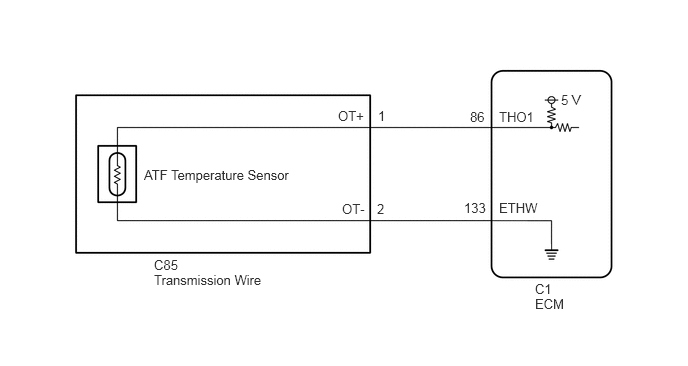
CAUTION / NOTICE / HINT
- NOTICE:
- ·
Perform registration and/or initialization when parts related to the automatic transaxle are replaced.
Click hereDrivetrain>UA80F (AUTOMATIC TRANSMISSION / TRANSAXLE)>AUTOMATIC TRANSAXLE SYSTEM>PRECAUTION
·If DTCs P071000, P261029 and/or P261093 are output simultaneously, using the GTS, check if the ATF temperature is as specified under the "Normal Condition" column of the Data List. If the ATF temperature is as specified under the "Normal Condition" column, perform troubleshooting for DTC P261029.
Click hereEngine / Hybrid System>2GR-FKS (ENGINE CONTROL)>SFI SYSTEM>P261029
- HINT:
-
After performing repair, clear the DTCs and perform the following procedure to check that DTCs are not output.
- 1.
Start the engine.
2.Drive the vehicle 20 km (12 mile) or more over a period of 11 minutes and 10 seconds or more.
3.After 40 minutes or more have elapsed since performing step (2), turn the ignition switch off.
4.Perform steps (1) through (4) again.
5.Check for DTCs again.
Click hereDrivetrain>UA80F (AUTOMATIC TRANSMISSION / TRANSAXLE)>AUTOMATIC TRANSAXLE SYSTEM>DTC CHECK / CLEAR
DATA LIST
- NOTICE:
-
In the table below, the values listed under "Normal Condition" are reference values. Do not depend solely on these reference values when deciding whether a part is faulty or not.
- HINT:
-
Using the GTS to read the Data List allows the values or states of switches, sensors, actuators and other items to be read without removing any parts. This non-intrusive inspection can be very useful because intermittent conditions or signals may be discovered before parts or wiring is disturbed. Reading the Data List information early in troubleshooting is one way to save diagnostic time.
Warm up the engine.
Turn the ignition switch off.
Connect the GTS to the DLC3.
Turn the ignition switch to ON.
Turn the GTS on.
Enter the following menus: Powertrain / Transmission / Data List / A/T Oil Temperature No.1.
Read the Data List according to the display on the GTS.
- Powertrain > Transmission > Data List
-
Tester Display Measurement Item Range Normal Condition Diagnostic Note A/T Oil Temperature No.1 ATF temperature sensor value Min.: -40°C (-40°F)
Max.: 150°C (302°F)·Approximately 80°C (176°F): After stall speed test
·Equal to ambient temperature: When engine is cold
If value is -40°C (-40°F) or 150°C (302°F), ATF temperature sensor circuit is open or shorted
- Powertrain > Transmission > Data List
-
Tester Display A/T Oil Temperature No.1 - 50003 373 180
- HINT:
- ·
If DTC P071011 is output and the GTS indicates 150°C (302°F) or higher, there is a short in the circuit.
·If DTC P071015 is output and the GTS indicates -40°C (-40°F), the circuit is open.
Check the temperature displayed on the GTS in order to check if a malfunction exists.
Temperature Displayed Malfunction -40°C (-40°F) Open circuit 150°C (302°F) or higher Short circuit
·If a circuit related to the ATF temperature sensor becomes open, P071015 will be stored in approximately 0.5 seconds. If DTC P071015 is stored, DTC P071000 cannot be detected. It is not necessary to inspect the circuit when P071000 is output.
PROCEDURE
Connect the GTS to the DLC3.
Turn the ignition switch to ON.
Turn the GTS on.
Enter the following menus: Powertrain / Transmission / Trouble Codes.
- Powertrain > Transmission > Trouble Codes
- 50001 373
Read the DTCs using the GTS.
- Result:
Result Proceed to Only DTC P071000 is output A DTC P071000 and P071015 are output B DTC P071000 and other DTCs are output C
- HINT:
-
If any DTCs other than DTC P071000 are output, perform troubleshooting for those DTCs first.
A
B
C
Check the automatic transaxle fluid level.
Click hereDrivetrain>UA80F (AUTOMATIC TRANSMISSION / TRANSAXLE)>AUTOMATIC TRANSAXLE FLUID>ADJUSTMENT
- OK:
Automatic transaxle fluid level is correct.
- Result:
Proceed to OK NG
OK
NG
Click hereDrivetrain>UA80F (AUTOMATIC TRANSMISSION / TRANSAXLE)>AUTOMATIC TRANSAXLE FLUID>ADJUSTMENT
Disconnect the C1 ECM connector.
Measure the resistance according to the value(s) in the table below.
- Standard Resistance:
Tester Connection Condition Specified Condition C1-86 (THO1) - C1-133 (ETHW) ATF temperature 10°C (50°F) 5 to 8 kΩ C1-86 (THO1) - C1-133 (ETHW) ATF temperature 110°C (230°F) 0.22 to 0.28 kΩ C1-133 (ETHW) - Body ground Always 10 kΩ or higher C1-86 (THO1) - Body ground Always 10 kΩ or higher
- HINT:
-
If the resistance is out of the specified range at the ATF temperature shown in the table below, the driveability of the vehicle may decrease.
ATF Temperature Specified Condition 25°C (77°F) 2.5 to 4.5 kΩ
- Result:
Proceed to OK NG
OK
NG
Replace the ECM.
Click hereEngine / Hybrid System>2GR-FKS (ENGINE CONTROL)>ECM>COMPONENTS
- Result:
Proceed to NEXT
NEXT
Click hereDrivetrain>UA80F (AUTOMATIC TRANSMISSION / TRANSAXLE)>AUTOMATIC TRANSAXLE SYSTEM>REGISTRATION
Disconnect the C85 transmission wire connector.
Disconnect the C1 ECM connector.
Measure the resistance according to the value(s) in the table below.
- Standard Resistance:
Tester Connection Condition Specified Condition C85-1 (OT+) - C1-86 (THO1) Always Below 1 Ω C85-2 (OT-) - C1-133 (ETHW) Always Below 1 Ω C85-1 (OT+) or C1-86 (THO1) - Body ground Always 10 kΩ or higher C85-2 (OT-) or C1-133 (ETHW) - Body ground Always 10 kΩ or higher
- Result:
Proceed to OK NG
OK
When Not Using the Engine Support Bridge: Click hereDrivetrain>UA80F (AUTOMATIC TRANSMISSION / TRANSAXLE)>TRANSMISSION WIRE(When Not Using the Engine Support Bridge)>COMPONENTS
When Using the Engine Support Bridge: Click hereDrivetrain>UA80F (AUTOMATIC TRANSMISSION / TRANSAXLE)>TRANSMISSION WIRE(When Using the Engine Support Bridge)>COMPONENTS
NG