INTRODUCTION WORK NOTICES AND PRECAUTIONS NOTICE FOR HYBRID SYSTEM
Refer to the TOYOTA Repair Manual for each work procedure.
PRECAUTIONS FOR HIGH-VOLTAGE CIRCUIT INSPECTION AND SERVICE (for HV Model)
- CAUTION:
- for Nickel Metal Hydride Battery:
This vehicle has a hybrid system that operates at high voltages. The hybrid system uses an HV battery that contains an electrolyte which is a strong alkali solution that includes potassium hydroxide. Be sure to follow the instructions in this manual to handle the system correctly. Failure to do so may result in serious injury or electrocution.
- for Lithium-ion Battery:
This vehicle has a hybrid system that operates at high voltages. The hybrid system uses an HV battery which contains a carbonic acid ester based organic electrolyte. Be sure to follow the instructions in this manual to handle the system correctly. Failure to do so may result in serious injury or electrocution.
Technicians must undergo special training to be able to service and inspect the high-voltage system.
All high-voltage wire harnesses and connectors are colored orange. The HV battery and other high-voltage components have "High Voltage" caution labels. Do not carelessly touch these wires or components.
When there is a problem with a wire harness or connector of a high-voltage circuit, repairs to the harness or connector should not be attempted. Replace damaged or malfunctioning high-voltage wire or connector.
Before inspecting or servicing the high-voltage system, be sure to follow all safety measures, such as wearing insulated gloves and removing the service plug grip, to prevent electrocution. Carry the removed service plug grip in your pocket to prevent other technicians from accidentally installing it while you are servicing the vehicle.
- NOTICE:
- ·
After removing the service plug grip, do not turn the ignition switch ON (READY), unless instructed by the repair manual, as this may cause a malfunction.
·After turning the ignition switch off, waiting time may be required before disconnecting the cable from the negative (-) auxiliary battery terminal. Therefore, make sure to read the disconnecting the cable from the negative (-) auxiliary battery terminal notices before proceeding with work.
Before using insulated gloves, be sure to check them for cracks, tears and other types of damage by performing the following procedure.
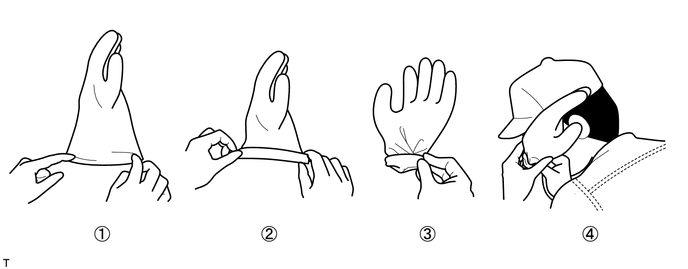
Place the glove on its side.
Roll the opening up 2 or 3 times.
Fold the opening in half to close it.
Confirm that there are no air leaks.
When servicing the vehicle, do not carry metal objects like mechanical pencils or rulers that can be dropped accidentally and cause a short circuit.
Before touching a bare high-voltage terminal, put on insulated gloves and use an electrical tester to make sure that the terminal voltage is 0 V.
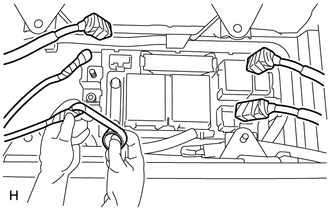
After disconnecting or exposing a high-voltage connector or terminal, insulate it immediately using insulating tape.
Bolts and nuts for high-voltage terminals should be tightened to the specified torque. Both insufficient and excessive torque can cause a malfunction.
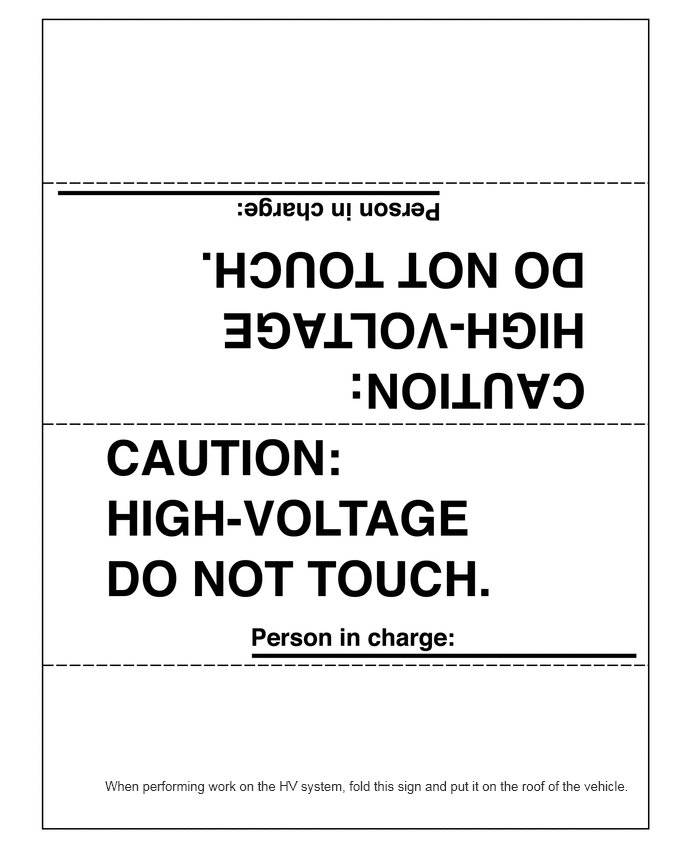
Use the "CAUTION: HIGH VOLTAGE DO NOT TOUCH" sign to notify other technicians that the high-voltage system is being inspected and/or repaired.
After servicing the high-voltage system and before reinstalling the service plug grip, make sure that you have not left any parts or tools inside the vehicle, that the high-voltage terminals are firmly tightened, and that the connectors are correctly connected.
When performing work involving a high-voltage circuit, use either a tool wrapped with vinyl insulation tape or an insulated tool.
When installing hybrid system components such as the HV battery, make sure that the polarity of all connections is correct.
PRECAUTIONS TO BE OBSERVED WHEN PERFORMING INSPECTION OR SERVICE IN ENGINE COMPARTMENT (for HV Model)
The vehicle automatically starts and stops the engine on and off when the READY light in the combination meter assembly is illuminated. To avoid injury, make sure that both the indicator on the ignition switch and the READY light in the combination meter assembly are off.
ACTIONS TO BE TAKEN FOR VEHICLES DAMAGED BY IMPACT (for HV Model)
- CAUTION:
- for Nickel Metal Hydride Battery:
This vehicle has a hybrid system that operates at high voltages. The hybrid system uses an HV battery that contains an electrolyte which is a strong alkali solution that includes potassium hydroxide. Be sure to follow the instructions in this manual to handle the system correctly. Failure to do so may result in serious injury or electrocution.
- for Lithium-ion Battery:
This vehicle has a hybrid system that operates at high voltages. The hybrid system uses an HV battery which contains a carbonic acid ester based organic electrolyte. Be sure to follow the instructions in this manual to handle the system correctly. Failure to do so may result in serious injury or electrocution.
Items to be prepared for the accident site
Protective clothing (insulated gloves, rubber gloves, goggles and safety shoes)
20 liters (21.1 US qts, 17.6 Imp. qts) saturated boric acid solution (obtain 800 g (1.76 lb) of boric acid powder, put it into a container, and dissolve it in water)
Red litmus paper
ABC fire extinguisher (effective against both oil flames and electrical flames)
A shop rag or piece of cloth (for wiping up the neutralized electrolyte)
Insulating tape (for insulating cables)
Electrical tester
Protective clothing (insulated gloves, rubber gloves, goggles, organic solvent mask, safety shoes and solvent resistant apron (for organic solvent))
Soap
ABC fire extinguisher (effective against both oil flames and electrical flames)
A shop rag or piece of cloth (for wiping up electrolyte)
Insulating tape (for insulating cables)
Electrical tester
Actions to be taken at the accident site
- CAUTION:
- for Nickel Metal Hydride Battery:·
Do not touch any bare cables that could be high-voltage cables. If a cable must be touched or if accidental contact is possible, wear insulated gloves and insulate the cable using insulating tape.
·If the vehicle catches on fire, use an ABC fire extinguisher to extinguish the fire. Trying to extinguish a fire using only a small amount of water can be more dangerous than effective. Use a substantial amount of water or wait for firefighters.
·Visually check the HV battery and the surrounding area for any electrolyte leakage. Do not touch any leaked liquid because it could be highly alkaline electrolyte.
·If the vehicle is submerged in water, work on the vehicle only after the vehicle has been pulled out of the water.
- for Lithium-ion Battery:·
Do not touch any bare cables that could be high-voltage cables. If a cable must be touched or if accidental contact is possible, wear insulated gloves and insulate the cable using insulating tape.
·If the vehicle catches on fire, use an ABC fire extinguisher to extinguish the fire. Trying to extinguish a fire using only a small amount of water can be more dangerous than effective. Use a substantial amount of water or wait for firefighters.
·Visually check the HV battery and surrounding area for any electrolyte leakage. Do not touch any leaked liquid because it could be carbonic acid ester based organic electrolyte.
·The electrolyte is flammable. Keep all ignition sources such as open flame and hot objects away from the electrolyte.
·Electrolyte leaks may cause acute poisoning if a high concentration of the vapor from the electrolyte is inhaled. In the case of inhalation, move the affected person to a place with ample fresh air and let them lie quietly. Seek medical care.
·If the vehicle is submerged in water, do not touch any of the high-voltage components or cables, including the service plug grip, as doing so poses an electrocution hazard. Work on the vehicle only after the vehicle has been pulled out of the water.
·If the electrolyte comes in contact with your skin, wash the area thoroughly with soap and plenty of water, and seek medical care. If the electrolyte comes in contact with an article of clothing, take it off immediately. Prolonged contact with the electrolyte may cause skin irritation.
·If the electrolyte comes in contact with your eyes, call out loudly for help. Do not rub your eyes. Immediately flush them with a large amount of water for at least 15 minutes and seek medical care.
·If electrolyte is swallowed, seek medical care immediately. Do not induce vomiting, unless instructed by the doctor.
Check the vicinity of the HV battery for any leakage of the electrolyte.
- CAUTION:
- for Nickel Metal Hydride Battery:·
Do not touch any leaked liquid because it could be highly alkaline electrolyte. Wearing rubber gloves and goggles, neutralize the liquid with saturated boric acid solution and then apply red litmus paper to the liquid. Check that the paper does not turn blue. Wipe up the neutralized electrolyte with a shop rag or piece of cloth.
·If the electrolyte comes in contact with your skin, use a saturated boric acid solution or a large amount of water to wash it off. If the electrolyte comes in contact with an article of clothing, take it off immediately.
·If the electrolyte comes in contact with your eyes, call out loudly for help. Do not rub your eyes. Wash them immediately with a large amount of water and seek medical care.
·If electrolyte is swallowed, seek medical care immediately. Do not induce vomiting, unless instructed by the doctor.
- for Lithium-ion Battery:
Do not touch any leaked liquid because it could be carbonic acid ester based organic electrolyte. If contact is unavoidable, wipe up the liquid using a cloth while wearing rubber gloves, goggles and an organic solvent mask. Do not leave electrolyte-contaminated cloths unattended. Place contaminated cloths in an appropriate airtight container and dispose of them according to local regulations.
If damage to any of the high-voltage components and cables is suspected, cut the high-voltage circuit using the following procedure.
- CAUTION:
-
Be sure to wear insulated gloves, goggles and safety shoes.
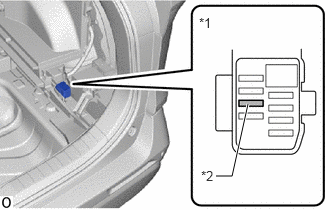
| *1 | No. 3 relay block and junction block assembly |
| *2 | IGCT No. 2 Fuse |
Turn the ignition switch off.
- HINT:
-
If the ignition switch cannot be turned off, remove the IGCT No. 2 Fuse from the No. 3 relay block and junction block assembly.
Disconnect the cable from the negative (-) auxiliary battery terminal.
While wearing insulated gloves, remove the service plug grip.
- NOTICE:
-
After removing the service plug grip, do not turn the ignition switch ON (READY), unless instructed by the repair manual because this may cause a malfunction.
Moving the damaged vehicle
- NOTICE:
-
When towing the vehicle, refer to the appropriate precautions for towing for the vehicle.
If any of the following conditions are met, tow the vehicle using a tow truck.
One or more of the high-voltage components and cables are damaged.
Components related to driving, the hybrid transaxle, the hybrid transmission or the fuel system are damaged.
The master warning light is on.
The READY light does not come on when attempting to turn the ignition switch ON (READY).
- CAUTION:
-
Before towing the vehicle using a tow truck, disconnect the cable from the negative (-) auxiliary battery terminal and remove the service plug grip.
- NOTICE:
-
Perform the following procedure if the master warning light turns on, or there are abnormal noises, unusual smells or strong vibrations while driving:
Park the vehicle in a safe place.
Apply the parking brake, and then move the shift lever to P. (w/o Electronic Shift Lever System)
Apply the parking brake, push the P position switch and confirm that park (P) has been selected. (w/ Electronic Shift Lever System)
Turn the ignition switch off, and disconnect the cable from the negative (-) auxiliary battery terminal.
While wearing insulated gloves, remove the service plug grip.
Actions required after moving the damaged vehicle
Procedure
If you see any liquid on the road surface, it could be highly alkaline electrolyte. Wearing rubber gloves and goggles, neutralize the electrolyte with saturated boric acid solution, and then apply red litmus paper to the liquid. Check that the paper does not turn blue. Wipe up the neutralized liquid with a shop rag or piece of cloth.
If there is liquid on the road surface, it could be carbonic acid ester based organic electrolyte. Wipe up the liquid using a cloth while wearing rubber gloves, goggles and an organic solvent mask. Do not leave electrolyte-contaminated cloths unattended. Place contaminated cloths in an appropriate airtight container and dispose of them according to local regulations.
Items to be prepared (when repairing a damaged vehicle)
Protective clothing (insulated gloves, rubber gloves, goggles and safety shoes)
20 liters (21.1 US qts, 17.6 Imp. qts) saturated boric acid solution (obtain 800 g (1.76 lb) of boric acid powder, put it into a container, and dissolve it in water)
Red litmus paper
A shop rag or piece of cloth (for wiping up the neutralized electrolyte)
Insulating tape (for insulating cables)
Electrical tester
Protective clothing (insulated gloves, rubber gloves, goggles, organic solvent mask, safety shoes and solvent resistant apron (for organic solvent))
Soap
ABC fire extinguisher (effective against both oil flames and electrical flames)
A shop rag or piece of cloth (for wiping up electrolyte)
Insulating tape (for insulating cables)
Electrical tester
Precautions to be observed when servicing a damaged vehicle
- CAUTION:
-
Always follow instructions to ensure safety.
Wear insulated or rubber gloves, goggles, and safety shoes.
Check the HV battery and immediate area for any electrolyte leakage.
- CAUTION:
- for Nickel Metal Hydride Battery:·
Do not touch any bare cables that could be high-voltage cables. If a cable must be touched or if accidental contact is possible, wear insulated gloves and insulate the cable using insulating tape.
·Do not touch any leaked liquid because it could be highly alkaline electrolyte. Wearing rubber gloves and goggles, neutralize the liquid with saturated boric acid solution and then apply red litmus paper to the liquid. Check that the paper does not turn blue. Wipe up the neutralized electrolyte with a shop rag or piece of cloth.
·If the electrolyte comes in contact with your skin, use a saturated boric acid solution or a large amount of water to wash it off. If the electrolyte comes in contact with an article of clothing, take it off immediately.
·If the electrolyte comes in contact with your eyes, call out loudly for help. Do not rub your eyes. Wash them immediately with a large amount of water and seek medical care.
·If electrolyte is swallowed, seek medical care immediately. Do not induce vomiting, unless instructed by the doctor.
- for Lithium-ion Battery:·
Do not touch any bare cables that could be high-voltage cables. If a cable must be touched or if accidental contact is possible, wear insulated gloves and insulate the cable using insulating tape.
·Visually check the HV battery and surrounding area for any electrolyte leakage. Do not touch any leaked liquid because it could be carbonic acid ester based organic electrolyte.
·The electrolyte is flammable. Keep all ignition sources such as open flame and hot objects away from the electrolyte.
·Electrolyte leaks may cause acute poisoning if a high concentration of the vapor from the electrolyte is inhaled. In the case of inhalation, move the affected person to a place with ample fresh air and let them lie quietly. Seek medical care.
·If the electrolyte comes in contact with your skin, wash the area thoroughly with soap and plenty of water, and seek medical care. If the electrolyte comes in contact with an article of clothing, take it off immediately. Prolonged contact with the electrolyte may cause skin irritation.
·If the electrolyte comes in contact with your eyes, call out loudly for help. Do not rub your eyes. Immediately flush them with a large amount of water for at least 15 minutes and seek medical care.
·If electrolyte is swallowed, seek medical care immediately. Do not induce vomiting, unless instructed by the doctor.
·Do not touch any leaked liquid because it could be carbonic acid ester based organic electrolyte. If contact is unavoidable, wipe up the liquid using a cloth while wearing rubber gloves, goggles and an organic solvent mask. Do not leave electrolyte-contaminated cloths unattended. Place contaminated cloths in an appropriate airtight container and dispose of them according to local regulations.
Do not touch any bare cables that could be high-voltage cables. If a cable must be touched or if accidental contact is possible, perform the following: 1) put on insulated gloves and goggles, 2) measure the voltage between the cable and body ground using an electrical tester, and 3) insulate the cable using insulating tape.
If damage to any of the high-voltage components and cables is suspected, cut the high-voltage circuit using the following procedure.
- CAUTION:
-
Do not touch any bare cables that could be high-voltage cables. If a cable must be touched or if accidental contact is possible, wear insulated gloves and insulate the cable using insulating tape.
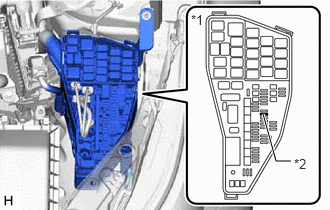
| *1 | No. 1 Engine Room Relay Block And No. 1 Junction Block Assembly |
| *2 | IG2-MAIN Fuse |
Turn the ignition switch off.
- HINT:
-
If the ignition switch cannot be turned off, remove the IG2-MAIN fuse from the No. 1 engine room relay block and No. 1 junction block assembly. Then confirm that the READY light is not illuminated.
Disconnect the cable from the negative (-) auxiliary battery terminal.
While wearing insulated gloves, remove the service plug grip.
- NOTICE:
-
After removing the service plug grip, do not turn the ignition switch ON (READY), unless instructed by the repair manual because this may cause a malfunction.
Precautions to be observed when towing
Tow the damaged vehicle with its front and rear wheels lifted off the ground.
- CAUTION:
-
Towing the damaged vehicle with its wheels on the ground will cause the motor to generate electricity. This electricity could, depending on the nature of the damage, leak and cause a fire.
Towing with all 4 wheels on the ground
- CAUTION:
- w/o Electronic Shift Lever System:·
If the vehicle needs to be towed using a cable or chain with all 4 wheels on the ground, do not exceed 30 km/h (18 mph) and tow only for a short distance and then have the vehicle towed by a truck.
·Make sure to turn the ignition switch to ON (IG), and move the shift lever to N.
·Do not turn off the ignition switch. Turning off the ignition switch may result in engagement of the steering lock, resulting in a hazardous situation or accident.
·If any abnormality in the damaged vehicle is present occurs during towing, stop towing immediately.
- w/ Electronic Shift Lever System:·
If the vehicle needs to be towed using a cable or chain with all 4 wheels on the ground, do not exceed 30 km/h (18 mph) and tow only for a short distance and then have the vehicle towed by a truck.
·Turn the ignition switch to ON (IG), move the shift lever to N and confirm that neutral (N) has been selected.
·Make sure not to turn the ignition switch off while the vehicle is being towed, as park (P) may be selected, which may result in damage or an accident.
·If any abnormality in the damaged vehicle occurs during towing, stop towing immediately.
- HINT:
-
Neutral (N) cannot be selected if the auxiliary battery is disconnected.
PRECAUTIONS FOR TOWING FRONT WHEEL DRIVE VEHICLES
Use one of the following methods to tow the vehicle.
If the vehicle has trouble with the chassis or drivetrain, use method 1 (flatbed truck).
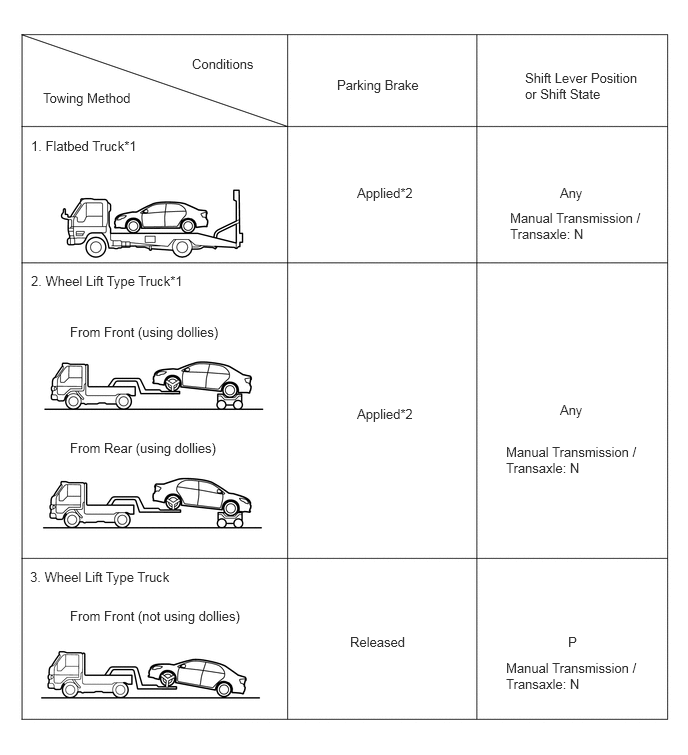
- NOTICE:
- ·
Do not use any towing method other than those shown above.
·*1: If the vehicle is tilted after parking on a level surface, the braking force may be insufficient as the electric parking brake determines how much braking force to apply by automatically detecting the slope of the road. (w/ Electric Parking Brake System)
- HINT:
-
*2: For the procedure to apply the maximum amount of braking force, refer to Precaution of Electric Parking Brake System.
If a tow truck is not available, in an emergency the vehicle may be temporarily towed using a cable or chain secured to the emergency towing eyelet(s). This should only be attempted on hard surfaced roads for as short of a distance as possible and at a vehicle speed of 30 km/h (18 mph) or less. A driver must be in the vehicle to steer and operate the brakes. The vehicle's wheels, drivetrain, axles, steering and brakes must be in good condition.
If a tow truck is not available, in an emergency the vehicle may be temporarily towed using a cable or chain secured to the emergency towing eyelet(s). This should only be attempted on hard surfaced roads for distances of less than 80 km (50 miles), and at speeds below 30 km/h (18 mph). A driver must be in the vehicle to steer and operate the brakes. The vehicle's wheels, drivetrain, axles, steering and brakes must be in good condition.
- NOTICE:
-
If the towing speed exceeds the above limits, or if the vehicle is towed for a long distance or in a backward direction with the front wheels on the ground, the drivetrain may be damaged.
Emergency towing procedure
Turn the ignition switch to ON.
Depress the brake pedal and move the shift lever to N.
Release the parking brake.
Release the brake pedal slowly.
Turn the ignition switch to ON.
Depress the brake pedal, move the shift lever to N and confirm that neutral (N) has been selected.
Release the parking brake.
Release the brake pedal slowly.
- NOTICE:
- ·
Use extreme caution when towing the vehicle. Avoid sudden starts or erratic driving maneuvers which place excessive stress on the emergency towing eyelet and the cables or chains.
·If the hybrid system is off, the power assist for the brakes and steering will not function, making steering and braking more difficult. (for HV Model)
·Do not turn off the ignition switch. Turning off the ignition switch may result in engagement of the steering lock or the parking lock, resulting in a hazardous situation or accident.
- HINT:
- w/ Electronic Shift Lever System:·
Neutral (N) cannot be selected if the auxiliary battery is discharged or if it has been disconnected.
·There is a possibility that neutral (N) cannot be selected when parts related to the electronic shift lever system are malfunctioning.
The towing methods shown below are dangerous and can damage the vehicle, so do not use them.
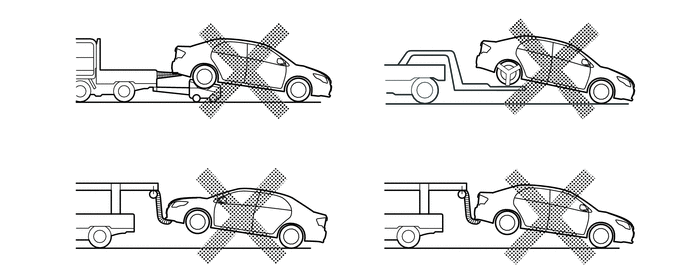
Do not tow the vehicle facing rearward with the front wheels on the ground.
- NOTICE:
- ·
If the vehicle is towed facing rearward with the front wheels on the ground, the drivetrain may overheat and be damaged.
·In addition, if the vehicle is equipped with a VSC system, the system may apply the brakes to the rotating wheels.
Do not use a sling-type towing method either from the front or rear.
- NOTICE:
-
If a sling-type tow truck is used, damage may occur to the vehicle body.
PRECAUTIONS FOR TOWING REAR WHEEL DRIVE VEHICLES
Use one of the following methods to tow the vehicle.
If the vehicle has trouble with the chassis or drivetrain, use method 1 (flatbed truck).
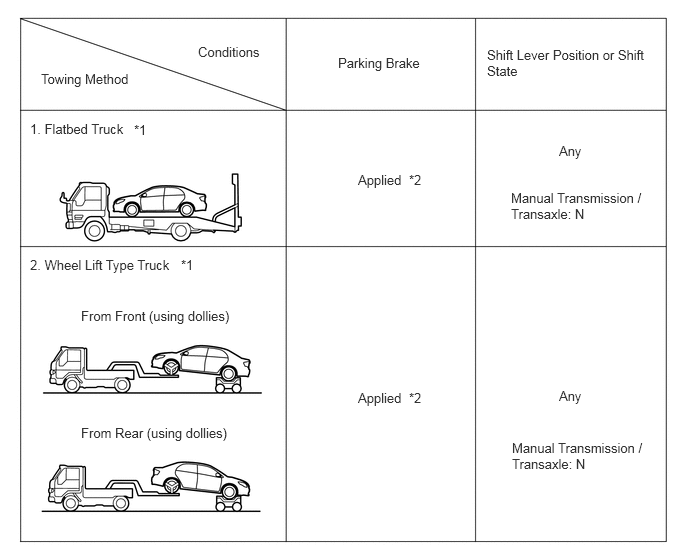
- NOTICE:
- ·
Do not use any towing method other than those shown above.
·*1: If the vehicle is tilted after parking on a level surface, the braking force may be insufficient as the electric parking brake determines how much braking force to apply by automatically detecting the slope of the road. (w/ Electric Parking Brake System)
- HINT:
-
*2: For the procedure to apply the maximum amount of braking force, refer to Precaution of Electric Parking Brake System.
If a tow truck is not available, in an emergency the vehicle may be temporarily towed using a cable or chain secured to the emergency towing eyelet(s). This should only be attempted on hard surfaced roads for as short of a distance as possible and at a vehicle speed of 30 km/h (18 mph) or less. A driver must be in the vehicle to steer and operate the brakes. The vehicle's wheels, drivetrain, axles, steering and brakes must be in good condition.
If a tow truck is not available, in an emergency the vehicle may be temporarily towed using a cable or chain secured to the emergency towing eyelet(s). This should only be attempted on hard surfaced roads for distances of less than 80 km (50 miles), and at speeds below 30 km/h (18 mph). A driver must be in the vehicle to steer and operate the brakes. The vehicle's wheels, drivetrain, axles, steering and brakes must be in good condition.
- NOTICE:
-
If the towing speed or distance exceeds the above limits, or the vehicle is towed in a backward direction with the wheels on the ground, the drivetrain or vehicle may be damaged.
Emergency towing procedure
Turn the ignition switch to ON.
Depress the brake pedal and move the shift lever to N.
Release the parking brake.
Release the brake pedal slowly.
Turn the ignition switch to ON.
Depress the brake pedal, move the shift lever to N and confirm that neutral (N) has been selected.
Release the parking brake.
Release the brake pedal slowly.
- NOTICE:
- ·
Use extreme caution when towing the vehicle. Avoid sudden starts or erratic driving maneuvers which place excessive stress on the emergency towing eyelet and the cables or chains.
·If the hybrid system is off, the power assist for the brakes and steering will not function, making steering and braking more difficult. (for HV Model)
·Do not turn off the ignition switch. Turning off the ignition switch may result in engagement of the steering lock or the parking lock, resulting in a hazardous situation or accident.
- HINT:
- w/ Electronic Shift Lever System:·
Neutral (N) cannot be selected if the auxiliary battery is discharged or if it has been disconnected.
·There is a possibility that neutral (N) cannot be selected when parts related to the electronic shift lever system are malfunctioning.
The towing methods shown below are dangerous and can damage the vehicle, so do not use them.
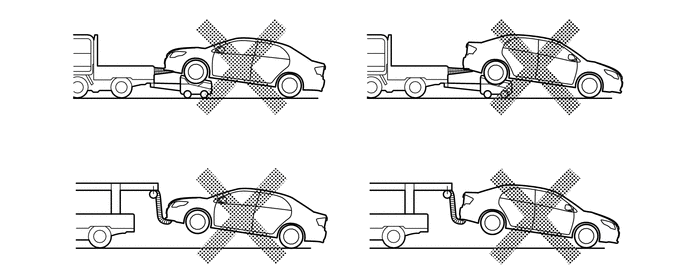
Do not tow the vehicle with only 2 wheels on the ground.
- CAUTION:
-
If the vehicle is towed with only the front wheels on the ground, the steering may move, causing the vehicle to become unstable.
- NOTICE:
-
If the vehicle is towed with only the rear wheels on the ground, the drivetrain may overheat and be damaged.
Do not use a sling-type towing method either from the front or rear.
- NOTICE:
-
If a sling-type tow truck is used, damage may occur to the vehicle body.
PRECAUTIONS FOR TOWING ALL WHEEL DRIVE VEHICLES
Use one of the following methods to tow the vehicle.
If the vehicle has trouble with the chassis or drivetrain, use method 1 (flatbed truck).
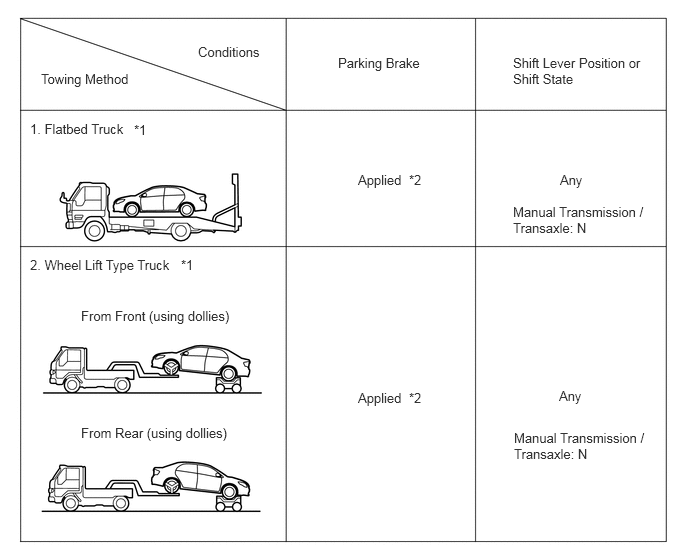
- NOTICE:
- ·
Do not use any towing method other than those shown above.
·*1: If the vehicle is tilted after parking on a level surface, the braking force may be insufficient as the electric parking brake determines how much braking force to apply by automatically detecting the slope of the road. (w/ Electric Parking Brake System)
- HINT:
-
*2: For the procedure to apply the maximum amount of braking force, refer to Precaution of Electric Parking Brake System.
If a tow truck is not available, in an emergency the vehicle may be temporarily towed using a cable or chain secured to the emergency towing eyelet(s). This should only be attempted on hard surfaced roads for as short of a distance as possible and at a vehicle speed of 30 km/h (18 mph) or less. A driver must be in the vehicle to steer and operate the brakes. The vehicle's wheels, drivetrain, axles, steering and brakes must be in good condition.
If a tow truck is not available, in an emergency the vehicle may be temporarily towed using a cable or chain secured to the emergency towing eyelet(s). This should only be attempted on hard surfaced roads for distances of less than 80 km (50 miles), and at speeds below 30 km/h (18 mph). A driver must be in the vehicle to steer and operate the brakes. The vehicle's wheels, drivetrain, axles, steering and brakes must be in good condition.
- NOTICE:
-
If the towing speed exceeds the above limits, or if the vehicle is towed for a long distance or in a backward direction with any of the wheels on the ground, the drivetrain may be damaged.
Emergency towing procedure
Turn the ignition switch to ON.
Depress the brake pedal and move the shift lever to N.
Release the parking brake.
Release the brake pedal slowly.
Turn the ignition switch to ON.
Depress the brake pedal, move the shift lever to N and confirm that neutral (N) has been selected.
Release the parking brake.
Release the brake pedal slowly.
- NOTICE:
- ·
Use extreme caution when towing the vehicle. Avoid sudden starts or erratic driving maneuvers which place excessive stress on the emergency towing eyelet and the cables or chains.
·If the hybrid system is off, the power assist for the brakes and steering will not function, making steering and braking more difficult. (for HV Model)
·Do not turn off the ignition switch. Turning off the ignition switch may result in engagement of the steering lock or the parking lock, resulting in a hazardous situation or accident.
- HINT:
- w/ Electronic Shift Lever System:·
Neutral (N) cannot be selected if the auxiliary battery is discharged or if it has been disconnected.
·There is a possibility that neutral (N) cannot be selected when parts related to the electronic shift lever system are malfunctioning.
The towing methods shown below are dangerous and can damage the vehicle, so do not use them.
Do not tow the vehicle with the front or rear wheels on the ground.
- NOTICE:
- ·
If the vehicle is towed with the front or rear wheels on the ground, the drivetrain may overheat and be damaged.
·In addition, if the vehicle is equipped with a VSC system, the system may apply the brakes to the rotating wheels.
Do not use a sling-type towing method either from the front or rear.
- NOTICE:
-
If a sling-type tow truck is used, damage may occur to the vehicle body.