2GR-FKS INTAKE / EXHAUST EXHAUST SYSTEM DETAILS EXHAUST PIPE
CONSTRUCTION
The exhaust pipes are made of stainless steel for improved rust resistance.
A thin-wall, ceramic type TWC is used.
A ball joint is used to join the front exhaust pipe assembly and center exhaust pipe assembly, and another ball joint is used to join the center exhaust pipe assembly and tail exhaust pipe assembly. As a result, in-vehicle sound has been muffled, vibration has been minimized, and weight reduction has been realized.
A ball joint mechanism consists of a flange with a round surface, 2 bolts that support the gasket, and a compression spring. Compared to a flexible pipe, a more compact structure can be achieved, thus enabling the ball joints to be mounted at the optimized position to dampen vibrations.
Vibrations caused by the engine and resonant frequency vibrations of the exhaust pipe are absorbed by the ball joints (flanges and rounded parts of the gasket), reducing vibrations and noise.
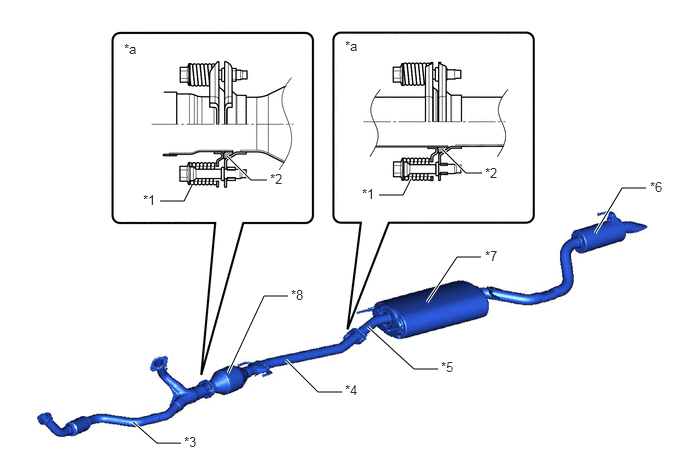
| *1 | Compression Spring | *2 | Gasket |
| *3 | Front Exhaust Pipe Assembly | *4 | Center Exhaust Pipe Assembly |
| *5 | Tail Exhaust Pipe Assembly | *6 | Sub Muffler |
| *7 | Main Muffler | *8 | TWC |
| *a | Ball Joint | - | - |
OPERATION
2-Way Exhaust Control System
In order to maintain quietness, and allow for high exhaust efficiency and high engine power output, a 2-way exhaust system is used for the main muffler. A control valve is used inside the main muffler to open the exhaust gas passage using the exhaust gas pressure. The control valve closes at low engine speeds by means of a return spring.
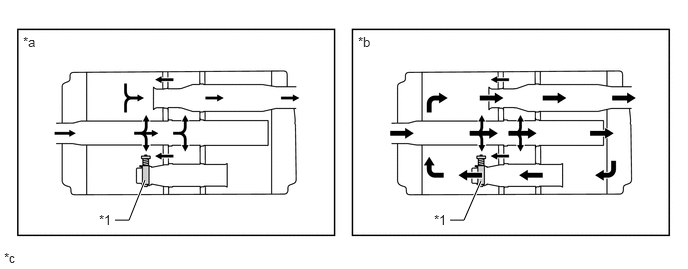
| *1 | Control Valve | - | - |
| *a | Low Engine Speed (Control Valve Closes) | *b | High Engine Speed (Control Valve Opens) |
| *c | The illustrations shown are examples only. | - | - |

|
Exhaust Gas | - | - |