TRANSFER / 4WD / AWD DYNAMIC TORQUE VECTORING AWD SYSTEM GENERAL GENERAL
OUTLINE
A GF2A type transfer that is compact and lightweight is used on FD15EF type rear differential models.
A dynamic torque vectoring AWD system is used.
The dynamic torque vectoring AWD system uses a disconnect mechanism (in the transfer and differential) and an electro magnetic control coupling sub-assembly (in the left and right differential) to perform optimal drive force distribution according to various driving conditions, achieving improved driving stability and fuel economy.
The disconnect mechanism connects the driveline when the vehicle starts off, allowing the vehicle to drive under tough conditions in AWD. Also, when the vehicle speed increases and a stable driving condition is achieved, it disconnects the driveline to help improve fuel efficiency.
The AWD system performs control in cooperation with the brake control system. The 4WD ECU assembly controls the drive torque distribution to the front and rear wheels in accordance with information received from the skid control ECU. These controls ensure a smooth acceleration and driving stability.
Multi-terrain select is used. When the driver performs a switch operation to select an appropriate mode for the road conditions, vehicle control switches to the optimal control for the road conditions. As a result, optimal driving performance is maintained, achieving superior off-road driveability.
SPECIFICATION
| Transfer Type | GF2A | |
| Gear Type | Hypoid Gear | |
| Gear Ratio | 0.435 | |
| Transfer Ring Gear | No. of Teeth | 39 |
| Transfer Driven Pinion Gear | No. of Teeth | 17 |
| Oil Type | Toyota Genuine Differential Gear Oil LX | |
| Oil Capacity | Liters (US qts, Imp. qts) | 0.39 (0.41, 0.35) |
| Weight (Reference) | kg (lb) | 15.4 (34.1) |
MAIN FEATURES
Dynamic Torque Vectoring AWD System Characteristics
| Feature | Outline |
|---|---|
| Traction Performance | Achieves stable start-off and acceleration performance. |
| Driving Stability Performance | Achieves stable cornering performance. |
| Fuel Economy | Connects only the necessary parts at the necessary time to achieve low fuel consumption. |
Multi-terrain Select AWD Control and Drive Force Distribution
| Multi-terrain Select | AWD Control | Vehicle Speed | ||
| 0 km/h to 25 km/h (0 mph to 16 mph) | 25 km/h to 40 km/h (16 mph to 25 mph) | 40 km/h (25 mph) or more | ||
| MUD & SAND | Front/rear distribution | Control equivalent to directly connected AWD (Maximum drive force distribution of 50:50) | Normal control | |
| Rear wheel left/right distribution | Left/right equal distribution control (50:50) | |||
| NORMAL | Front/rear distribution | Normal control | ||
| Rear wheel left/right distribution | Left/right equal distribution control (50:50) | Normal control | ||
| ROCK & DIRT | Front/rear distribution | Control equivalent to directly connected AWD (Maximum drive force distribution of 50:50) | Normal control | |
| Rear wheel left/right distribution | Left/right equal distribution control (50:50) | Normal control | ||
Front/Rear Drive Force Distribution
Drive force distribution to the front and rear is optimized according to various driving conditions. The disconnect mechanism stops the rotation of driveline parts (such as the propeller shaft) during constant-speed cruising, helping improve fuel efficiency. When AWD driving is necessary, the mechanism quickly connects the parts to achieve stable AWD performance.
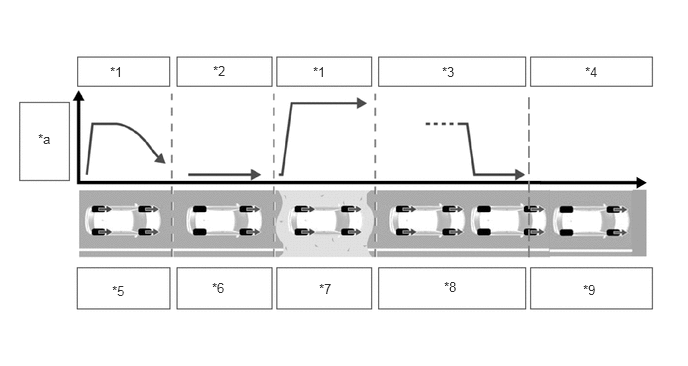
| *1 | Connect | *2 | Disconnect |
| *3 | Connected to Disconnected | *4 | Disconnected to Connected |
| *5 | Starting Off | *6 | Constant-speed Cruising |
| *7 | Variable Road except On Road (Mud, Snow, Sand etc...) | *8 | Acceleration to Normal Driving |
| *9 | Deceleration to Stopped | - | - |
| *a | Front/Rear Drive Force Distribution | - | - |