AUDIO / VIDEO REAR SEAT ENTERTAINMENT SYSTEM SYSTEM DESCRIPTION
OUTLINE
The Rear Seat Entertainment (RSE) system allows the front and rear seat occupants to select different audio-visual modes at the same time.
The rear seat occupants can control the audio-visual modes with the rear switch and volume assembly and listen to the audio using wireless headphones and speakers.
AVC-LAN communication is used between the television display assembly and radio and display receiver assembly.
The rear seat "DLNA" function is directly connected to the rear seat player via "Wi-Fi" and can display content data stored on a smartphone or tablet on the television display assembly.
The rear seat "Miracast" function is directly connected to the rear seat player via "Wi-Fi" and can display a smartphone or tablet on the television display assembly.
- HINT:
- ·
"Miracast" is a registered trademark of the Wi-Fi Alliance.
·"Wi-Fi" is a registered trademark of the Wi-Fi Alliance.
·"DLNA" is a registered trademark of the Digital Living Network Alliance.
·"Bluetooth" is a registered trademark of the Bluetooth SIG, Inc.
·"DLNA", "Miracast", "Bluetooth" and other "Wi-Fi" use the same 2.4 GHz band radio waves. As a result, if Bluetooth audio and "Miracast" are connected at the same time delays in operation speed and connection drops, etc., may occur.
FUNCTION OF MAIN COMPONENTS
| Component | Function |
|---|---|
| Television display assembly
·
Disc player ·
SD card slot |
·
Displays BD/DVD/SD video images. ·
Displays the audio-visual control screen. ·
Displays the adjustment screen. ·
Displays the diagnosis screen. The diagnosis screen appears when diagnostic mode is started. ·
Receives signals from the rear switch and volume assembly. ·
Outputs audio signals to wireless headphones in the form of infrared signals. |
| Radio and display receiver assembly | ·
Turns the RSE system on/off. ·
Receives audio signals from the television display assembly and outputs them to the speakers. ·
Enables or disables the function of the rear switch and volume assembly for the television display assembly. |
| Rear switch and volume assembly | Outputs various control signals of the RSE system to the television display assembly in the form of infrared signals. |
| Wireless headphones | ·
Receives audio signals from the television display assembly in the form of infrared signals. ·
Volume adjustment of the wireless headphones can be done by using the volume control on the wireless headphones. |
| HDMI terminal | Allows an external device to be connected. |
DISC PLAYER OUTLINE
A disc player uses a laser pickup to read digital signals recorded on CDs, DVDs or BDs. By converting the digital signals to analog, music and other content can be played.
- CAUTION:
-
Do not look directly at the laser pickup because the disc player uses an invisible laser beam. Be sure to operate the player only as instructed.
- NOTICE:
- ·
Do not disassemble any part of the disc player.
·Do not apply oil to the disc player.
·Do not insert anything but a CD, a DVD or a BD into the disk player.
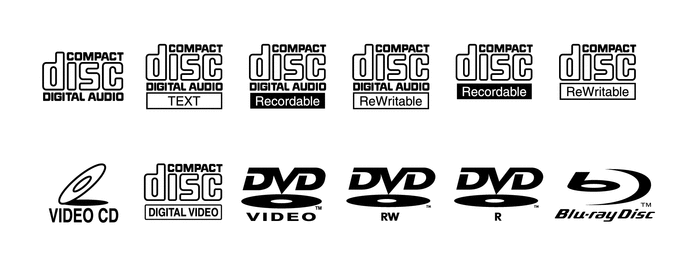
Usable discs
Precautions for use of discs
- NOTICE:
- ·
Copy-protected CDs cannot be played.
·CD-Rs, CD-RWs, DVD-Rs or DVD-RWs may not be played depending on the recording conditions or characteristics of the discs, or due to damage, dirt, or deterioration caused by leaving the discs in the cabin for a long time.
·Unfinalized CD-Rs, CD-RWs, DVD-Rs and DVD-RWs cannot be played.
·NTSC and PAL discs can be played.
·DualDiscs that mate DVD recorded material on one side with CD digital audio material on the other cannot be played.
·Keep discs away from dirt. Be careful not to damage discs or leave fingerprints on them.
·Hold discs by the outer edge and center hole with the label side up.
·Leaving a disc exposed halfway out of the slot for a long time after pressing the disc eject button may cause deformation of the disc, making the disc unusable.
·If discs have adhesive tape, stickers, disc labels, or any traces of such labels attached, the discs may not be ejected or player malfunctions may result.
·Keep discs away from direct sunlight. (Exposure to direct sunlight may cause deformation of the disc, making the disc unusable.)
·Do not use odd-shaped disks because they may cause player malfunctions.
·Do not use discs whose recording portion is transparent or translucent because they may not be inserted, ejected, or played normally.
·Use only 4.7 in. (12 cm) discs.
·Do not use 3 in. (8 cm) CDs, either with or without adapters.
·Blu-ray 3DTM discs can only be played in 2D.
·This system can play DVDs that store data recorded in the AVCHD format.
- HINT:
- ·
When it is cold or raining, if the windows fog up, mist and condensation may form in the player. In such a case, a disc may skip or stop in the middle of play. Ventilate or dehumidify the cabin for a while before using the player.
·The disk may skip if the player experiences strong vibrations when the vehicle is driven on rough road or similar uneven surfaces.
Cleaning
- NOTICE:
-
Do not use a lens cleaner because it may cause a malfunction in the pickup portion of the player.
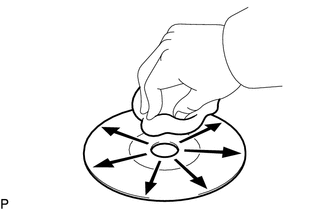
If dirt is on the disc surface, wipe it clean with a soft dry cloth such as an eyeglass cleaner for plastic lenses from the inside to the outside in a radial direction.
- NOTICE:
- ·
Pressing on the disc by hand or rubbing the disc with a hard cloth may scratch the disc surface.
·Use of solvents such as record spray, antistatic agents, alcohol, benzine, thinners or a chemical cloth may cause damage to the disc, making the disc unusable.
COMMUNICATION SYSTEM
AVC-LAN Outline
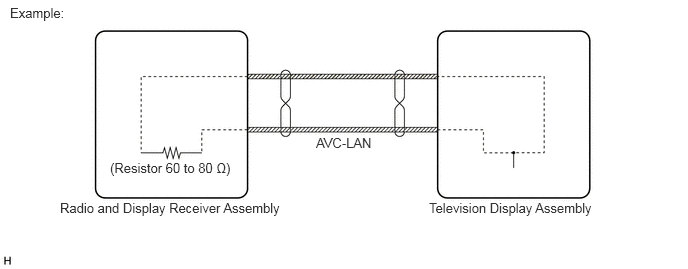
Components of the rear seat entertainment system communicate with each other via the AVC-LAN communication.
The AVC-LAN uses a twisted pair of wires for its communication lines.
The master unit of the AVC-LAN is the radio and display receiver assembly.
- HINT:
- ·
The radio and display receiver assembly has the resistance (60 to 80 Ω) necessary for communication.
·If a short or open circuit occurs in the AVC-LAN circuit, communication is interrupted and the system will not operate normally.
SD CARD OUTLINE
Usable discs
Usable discs are SD, SDHC and SDXC.
- HINT:
-
The SDHC and SDXC can be used with an adapter.
Playable music files
Playable music file standards are equivalent with the standards of the USB system compatible music files that can be played on the disc player.
Playable video files
| Profile | Simple Profile, Advanced Simple Profile |
| Video codec | MPEG4 Video |
| Audio codec | MPEG-4 AAC-LC (AAC Low Complexity) |
| Resolution (pixel) | 1920 X 1080 or less |
| Bit rate | Maximum 6 Mbps |
| Frame rate | ·
Interlaced video: Maximum 60 fps ·
Progressive video: Maximum 30 fps |
| Profile | Baseline Profile, Main Profile, High Profile |
| Video codec | H.264/AVC Video |
| Audio codec | MPEG-4 AAC-LC (AAC Low Complexity) |
| Resolution (pixel) | Maximum 1920 x 1080 |
| Bit rate | Maximum 20 Mbps |
| Frame rate | ·
Interlaced video: Maximum 60 fps ·
Progressive video: Maximum 30 fps |
| Profile | MP@HL, MP@ML |
| Video codec | MPEG-2 PS (Program Stream) |
| Audio codec | MPEG-1 Audio Layer 2, Dolby Digital |
| Resolution (pixel) | Maximum 1920 x 1080 |
| Bit rate | Maximum 12 Mbps |
| Frame rate | ·
Interlaced video: Maximum 60 fps ·
Progressive video: Maximum 30 fps |
| Profile | Simple Profile, Main Profile, Advanced Profile |
| Video codec | WMV (VC-1) |
| Audio codec | WMA (WMA Professional and Lossless are not supported.) |
| Resolution (pixel) | Maximum 1920 x 1080 |
| Bit rate | ·
Simple and Main Profile: Maximum 15 Mbps ·
Advanced Profile: Maximum 20 Mbps |
| Frame rate | ·
Interlaced video: Maximum 60 fps ·
Progressive video: Maximum 30 fps |
| Profile | Refer to other tables in this section for compatible MPEG-4, H.264/AVC and WMV profiles. |
| To be played back video and audio codec | ·
Video: H.264/AVC Video Audio: MPEG-4 AAC-LC, MP3 ·
Video: MPEG-4 Video Audio: MPEG-4 AAC-LC, MP3 ·
Video: WMV (VC-1) Audio: MP3 |
| Resolution (pixel) | Maximum 1920 x 1080 |
| Bit rate | Refer to other tables in this section for compatible MPEG-4, H.264/AVC and WMV profiles. |
| Frame rate | ·
Interlaced video: Maximum 60 fps ·
Progressive video: Maximum 30 fps |
| Profile | Baseline Profile |
| To be played back video and audio codec | H.264/AVC Video |
| Audio codec | MPEG-4 AAC |
| Resolution (pixel) | 640 x 480 and 640 x 360 |
| Bit rate | Video: Maximum 1.5 Mbps, Audio: Maximum 128 kbps |
| Frame rate | 30 fps |
SD card compatible devices
Memory cards are restricted to the following sizes based on SD standards.
SD: From 512 MB to 2 GB
SDHC: From 4 GB to 32 GB
SDXC: From 48 GB to 512 GB
- HINT:
- ·
Mini SD cards and Micro SD cards can be used, but must be used with an adaptor card.
·Multi Media Card (MMC) cannot be used.
HDMI TERMINAL OUTLINE
The terms HDMI, High-Definition Multimedia Interface and HDMI logo are a trademark or registered trademarks of HDMI Licensing Administrator, Inc. in the U.S. and other countries.

With a compatible portable device connected using the HDMI cable, the video files can be played on the television display assembly.
HDMI compatible format
Compatible video signal: 480p, 576p, VGA
Compatible sound signal: LPCM 2ch
DIAGNOSIS FUNCTION
When diagnostic mode is started, the television display assembly shows the "REAR Check" screen.