AUTOMATIC TRANSMISSION SYSTEM > HYDRAULIC TEST |
| MEASURE LINE PRESSURE |
|
Warm up the ATF.
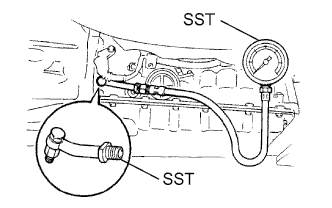
Remove the test plug from the front side of the transmission case and connect SST.
Fully apply the parking brake and chock the 4 wheels.
Start the engine and check the idling speed.
Keep your left foot firmly on the brake pedal and move the shift lever to D.
Measure the line pressure when the engine is idling.
Depress the accelerator pedal as much as possible with your right foot. Quickly read the highest line pressure reading when the engine speed reaches stall speed.
Perform the measure line pressure test again with the shift lever on R.
| Condition | Shift Lever on D | Shift Lever on R |
| Idling | 363 to 422 kPa (3.7 to 4.3 kgf/cm2, 53 to 61 psi) | 608 to 706 kPa (6.2 to 7.2 kgf/cm2, 88 to 102 psi) |
| Stall | 932 to 1,177 kPa (9.5 to 12.0 kgf/cm2, 135 to 171 psi) | 1,569 to 1,912 kPa (16.0 to 19.5 kgf/cm2, 228 to 277 psi) |
| Problem | Possible Cause |
| Measured values at all positions are higher than specified |
|
| Measured values at all positions are lower than specified |
|
| Pressure is low when shift lever is on D only |
|
| Pressure is low when shift lever is on R only |
|