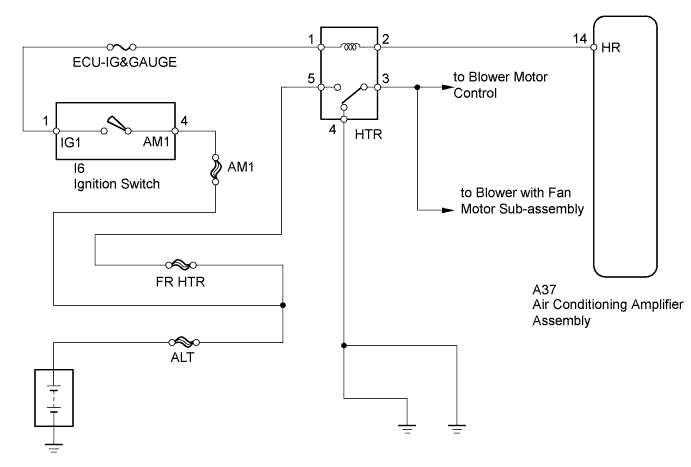
AIR CONDITIONING SYSTEM (for Automatic Air Conditioning System) > Heater Relay Circuit |
| 1.INSPECT HTR RELAY |
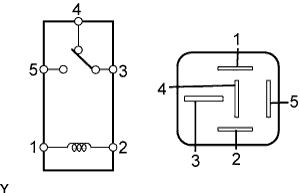 |
Remove the HTR relay from the driver side junction block.
Measure the resistance according to the value(s) in the table below.
| Tester Connection | Condition | Specified Condition |
| 3 - 4 | Battery voltage is not applied to terminals 1 and 2 | Below 1 Ω |
| 3 - 5 | 10 kΩ or higher | |
| 3 - 4 | Battery voltage is applied to terminals 1 and 2 | 10 kΩ or higher |
| 3 - 5 | Below 1 Ω |
|
| ||||
| OK | |
 |
| 2.CHECK HARNESS AND CONNECTOR (AIR CONDITIONING AMPLIFIER - BATTERY) |
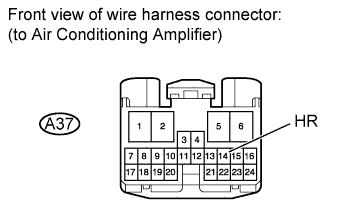 |
Disconnect the A37 amplifier connector.
Measure the voltage according to the value(s) in the table below.
| Tester Connection | Switch Condition | Specified Condition |
| A37-14 (HR) - Body ground | Ignition switch ON | 11 to 14 V |
|
| ||||
| OK | |
|
| 3.CHECK AIR CONDITIONING AMPLIFIER ASSEMBLY (HR VOLTAGE) |
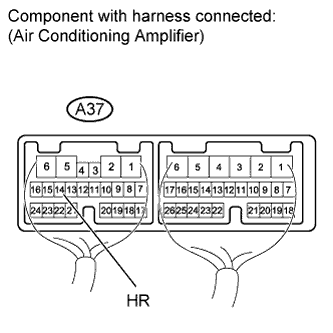 |
Remove the air conditioning amplifier with its connectors still connected.
Measure the voltage according to the value(s) in the table below.
| Tester Connection | Switch Condition | Specified Condition |
| A37-14 (HR) - Body ground | Ignition switch off Blower switch OFF | Below 1 V |
| Ignition switch ON Blower switch ON | Below 1 V | |
| Ignition switch ON Blower switch OFF | 11 to 14 V |
|
| ||||
| OK | ||
 | ||
| ||
