Home › HEATER & AIR CONDITIONING SYSTEM › AIR CONDITIONING › AIR CONDITIONING SYSTEM (for Automatic Air Conditioning System)

AIR CONDITIONING SYSTEM (for Automatic Air Conditioning System) > Vehicle Speed Signal Circuit

for Preparation Click here

HINT:
Check that the speedometer in the combination meter operates normally before inspecting the vehicle speed signal circuit.


DESCRIPTION

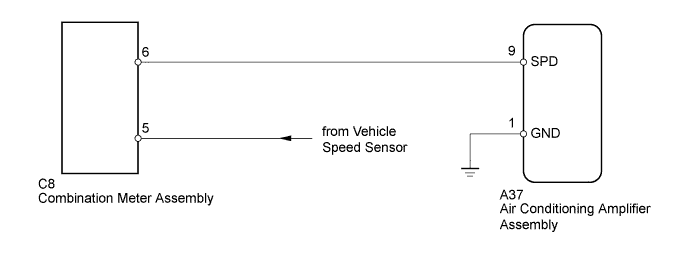
The air conditioning amplifier monitors signals from the vehicle speed sensor via the combination meter. The air conditioning amplifier uses these signals to adjust the thermistor (A/C ambient temperature sensor) signal.
If the speedometer does not operate normally, troubleshoot the meter/gauge system (Click here).

WIRING DIAGRAM


E171029E01


INSPECTION PROCEDURE

1.CHECK AIR CONDITIONING AMPLIFIER ASSEMBLY (SPD VOLTAGE)


    E170958E03
  1. Remove the air conditioning amplifier with its connectors still connected.

  1. Move the shift lever to N.

  1. Raise the vehicle.

  1. Turn the ignition switch to ON.

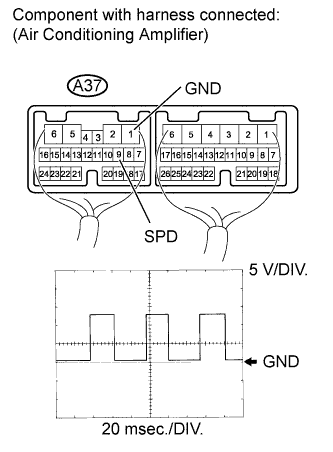
  1. Using an oscilloscope, check the waveform of the amplifier.
    Measurement Condition 
    Item
    Content
    Tester Connection
    A37-9 (SPD) - A37-1 (GND)
    Tool Setting
    5 V/DIV., 20 msec./DIV.
    Condition
    Engine is running and speedometer indicates speed of 20 km/h (12 mph)

    OK:
    Waveform is as shown in the illustration.

    HINT:
    As the vehicle speed increases, the wavelength becomes shorter.


NG
Go to step 2
OK

PROCEED TO NEXT SUSPECTED AREA SHOWN IN PROBLEM SYMPTOMS TABLE (Click here)  

2.CHECK HARNESS AND CONNECTOR (COMBINATION METER - AIR CONDITIONING AMPLIFIER)


    E170959E03
  1. Disconnect the C8 meter connector.

  1. Disconnect the A37 amplifier connector.

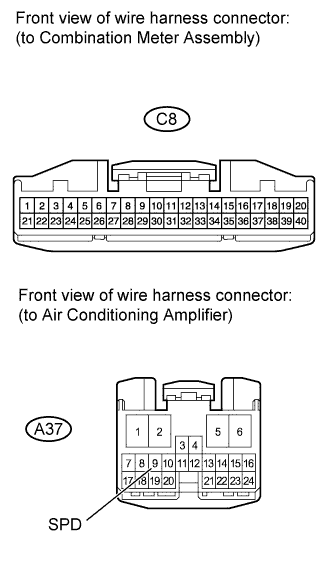
  1. Measure the resistance according to the value(s) in the table below.

    Standard Resistance:
    Tester Connection
    Condition
    Specified Condition
    C8-6 - A37-9 (SPD)
    Always
    Below 1 Ω
    A37-9 (SPD) - Body ground
    Always
    10 kΩ or higher


NG
REPAIR OR REPLACE HARNESS OR CONNECTOR
OK

PROCEED TO NEXT SUSPECTED AREA SHOWN IN PROBLEM SYMPTOMS TABLE (Click here)