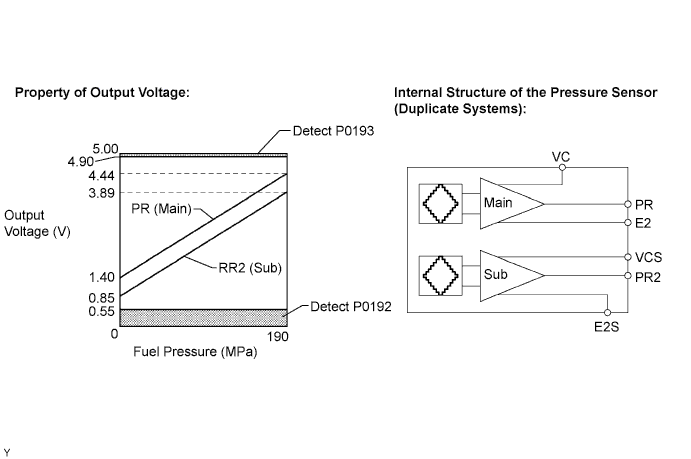
DTC P0087 Fuel Rail / System Pressure - Too Low |
DTC P0190 Fuel Rail Pressure Sensor Circuit |
DTC P0192 Fuel Rail Pressure Sensor Circuit Low Input |
DTC P0193 Fuel Rail Pressure Sensor Circuit High Input |
| DTC No. | DTC Detection Condition | Trouble Area |
| P0087 | Fuel pressure sensor output voltage stays at fixed value (1 trip detection logic) |
|
| P0190 | Fuel pressure sensor output voltage is 0.55 V or less, or 4.9 V or more for 0.5 seconds (1 trip detection logic) |
|
| P0192 | Fuel pressure sensor output voltage is 0.55 V or less for 0.5 seconds (1 trip detection logic) |
|
| P0193 | Fuel pressure sensor output voltage is 4.9 V or more for 0.5 seconds (1 trip detection logic) |
|
| Engine Speed | Fuel Pressure |
| Idling | Approximately 28000 to 40000 kPa |
| 3,000 rpm (No engine load) | Approximately 30000 to 60000 kPa |
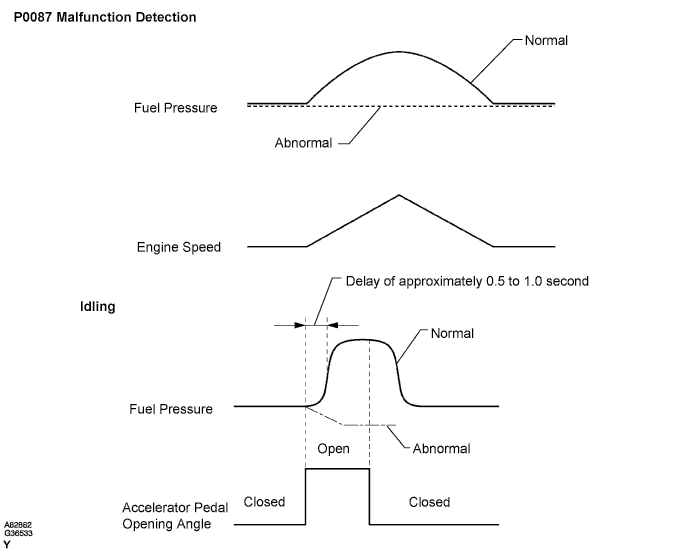
| Required Sensors | Fuel pressure sensor |
| Frequency of operation | Continuous |
| Duration | 1 second |
| MIL operation | 1 driving cycle |
| Required Sensors | Fuel pressure sensor |
| Frequency of operation | Continuous |
| Duration | 0.5 seconds |
| MIL operation | 1 driving cycle |
| Required Sensors | Fuel pressure sensor |
| Frequency of operation | Continuous |
| Duration | 0.5 seconds |
| MIL operation | 1 driving cycle |
| Required Sensors | Fuel pressure sensor |
| Frequency of operation | Continuous |
| Duration | 0.5 seconds |
| MIL operation | 1 driving cycle |
| Item | Specification | Specification |
| Minimum | Maximum | |
| Engine speed | 500 rpm | - |
| Battery voltage | 8 V | - |
| Fuel volume | 5 mm3
| - |
| The monitor will not run if the fuel pressure sensor circuit (P0190, P0192 and P0193) is malfunctioning. | ||
| Detection Criteria | Threshold |
| Changing value of fuel pressure | Virtually no fluctuation |
| Detection Criteria | Threshold |
| Fuel pressure sensor output voltage | Less than 0.55 V or more than 4.9 V |
| Detection Criteria | Threshold |
| Fuel pressure sensor output voltage | Less than 0.55 V |
| Detection Criteria | Threshold |
| Fuel pressure sensor output voltage | More than 4.9 V |
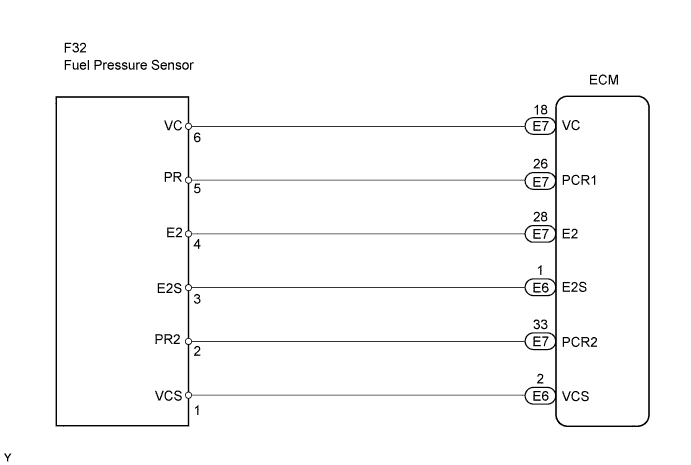
| 1.READ VALUE USING INTELLIGENT TESTER (FUEL PRESS) |
Connect the intelligent tester to the DLC3.
Start the engine and turn the intelligent tester ON.
Enter the following menus: Powertrain / Engine and ECT / Data List / Fuel Press.
Read the values.
| Engine Speed | Fuel Pressure |
| Idling | Approximately 28000 to 40000 kPa |
| 3,000 rpm (No engine load) | Approximately 30000 to 60000 kPa |
|
| ||||
| OK | |
 |
| 2.CHECK IF DTC OUTPUT RECURS |
Connect the intelligent tester to the DLC3.
Turn the ignition switch ON (IG) and turn the tester ON.
Enter the following menus: Powertrain / Engine and ECT / DTC.
Clear the DTC(s).
Let the engine idle for 60 seconds, and then repeat quick engine RPM accelerations (to 2,500 rpm) for 30 seconds.
Enter the following menus: Powertrain / Engine and ECT / DTC.
Read the DTC(s).
| Display (DTC Output) | Proceed to |
| P0087, P0190, P0192 and/or P0193 | A |
| No output | B |
|
| ||||
| A | ||
 | ||
| ||
| 3.CHECK HARNESS AND CONNECTOR (FUEL PRESSURE SENSOR - ECM) |
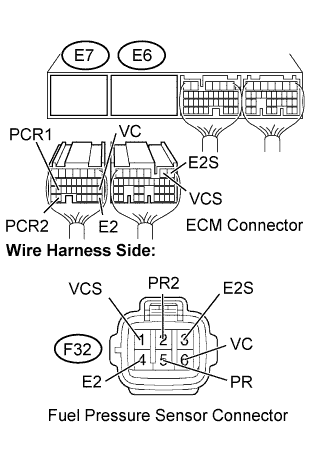 |
Disconnect the E6 and E7 ECM connector.
Disconnect the F32 fuel pressure sensor connector.
Measure the resistance of the wire harness side connectors.
| Tester Connection | Specified Condition |
| E7-26 (PCR1) - F32-5 (PR) | Below 1 Ω |
| E7-33 (PCR2) - F32-2 (PR2) | Below 1 Ω |
| E6-2 (VCS) - F32-1 (VCS) | Below 1 Ω |
| E7-18 (VC) - F32-6 (VC) | Below 1 Ω |
| E7-28 (E2) - F32-4 (E2) | Below 1 Ω |
| E6-1 (E2S) - F32-3 (E2S) | Below 1 Ω |
| Tester Connection | Specified Condition |
| E7-26 (PCR1) or F32-5 (PR) - Body ground | 10 kΩ or higher |
| E7-33 (PCR2) or F32-2 (PR2) - Body ground | 10 kΩ or higher |
| E6-2 (VCS) or F32-1 (VCS) - Body ground | 10 kΩ or higher |
| E7-18 (VC) or F32-6 (VC) - Body ground | 10 kΩ or higher |
| E7-28 (E2) or F32-4 (E2) - Body ground | 10 kΩ or higher |
| E6-1 (E2S) or F32-3 (E2S) - Body ground | 10 kΩ or higher |
|
| ||||
| OK | ||
| ||
| ||

