ENGINE OIL COOLER > INSTALLATION |
| 1. INSTALL OIL COOLER ASSEMBLY |
Install 2 new gaskets to the oil cooler.
Install the oil cooler to the oil cooler cover with the 4 nuts.
| 2. INSTALL OIL COOLER COVER SUB-ASSEMBLY |
Install a new gasket and the oil cooler cover with the 13 bolts.
Connect the No. 2 vacuum transmitting pipe with the 2 nuts.
Connect the oil pressure switch connector.
| 3. INSTALL OIL FILTER SUB-ASSEMBLY |
Check and clean the oil filter installation surface.
Apply clean engine oil to the gasket of a new oil filter.
Lightly screw the oil filter into place by hand. Tighten it until the gasket contacts the seat.
![]() |
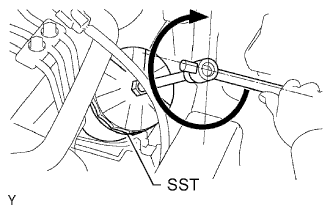
Using SST, tighten the oil filter. Depending on the space available, choose from the following.
If enough space is available, use a torque wrench to tighten the oil filter.
If enough space is not available to use a torque wrench, tighten the oil filter 3/4 of a turn by hand or with a common wrench.
| 4. INSTALL STARTER ASSEMBLY |
| 5. INSTALL FUEL SUPPLY PUMP ASSEMBLY |
| 6. INSTALL COMMON RAIL ASSEMBLY |
| 7. ADD ENGINE OIL |
Add new engine oil.
| Oil Grade | Oil Viscosity (SAE) |
| G-DLD1, API CF-4 or CF (You may also use API CE or CD) | - 5W-30 - 10W-30 - 15W-40 - 20W-50 |
| Item | Specified Condition |
| Drain and refill without oil filter change | 6.6 liters (7.0 US qts, 5.8 Imp. qts) |
| Drain and refill with oil filter change | 6.9 liters (7.3 US qts, 6.1 Imp. qts) |
| Dry fill | 7.4 liters (7.8 US qts, 6.5 Imp. qts) |
Install the oil filler cap.
| 8. BLEED AIR FROM FUEL SYSTEM |
![]() |
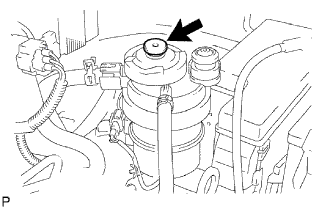
Using the hand pump mounted on the fuel filter cap, bleed the air from the fuel system. Continue pumping until the pump resistance increases.
Check if the engine starts.
When the engine can be started, proceed to the next step.
If the engine cannot be started, bleed the air again using the hand pump until the hand pump resistance increases (refer to the procedures above). Then start the engine.
Turn the ignition switch off.
Connect the intelligent tester to the DLC3.
Turn the ignition switch to ON and turn the intelligent tester on.
Clear the DTCs (Click here).
Start the engine.*1
![]() |
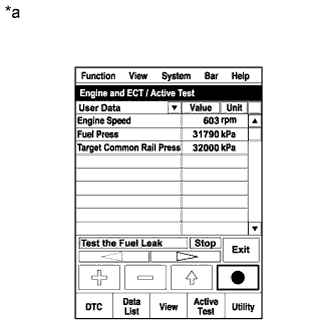
Enter the following menus: Powertrain / Engine and ECT / Active Test / Test the Fuel Leak.*2
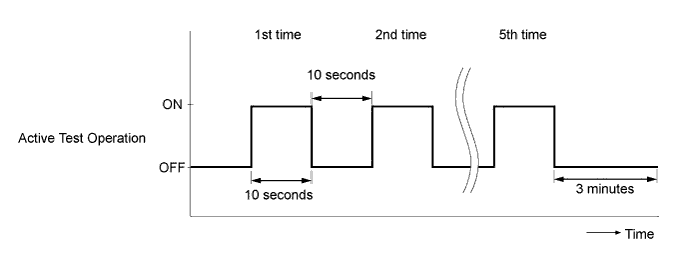
| *a | Reference (Active Test Operation) |
Perform the following test 5 times with on/off intervals of 10 seconds: Active Test / Test the Fuel Leak.*3
Allow the engine to idle for 3 minutes or more after performing the Active Test for the fifth time.

Enter the following menus: Powertrain / Engine and ECT / DTC.
Read Current DTCs.
Clear the DTCs (Click here).
Repeat steps *1 to *3.
Enter the following menus: Powertrain / Engine and ECT / DTC.
Read Current DTCs.
| 9. ADD ENGINE COOLANT |
Tighten the radiator drain cock plug by hand.
Tighten the cylinder block drain cock plug.
Fill the radiator with TOYOTA Super Long Life Coolant (SLLC) to the B line of the radiator reservoir.
| Item | Specified Condition |
| for Automatic Transmission | 11.1 liters (11.7 US qts, 9.8 Imp. qts) |
| for Manual Transmission | 9.8 liters (10.4 US qts, 8.6 Imp. qts) |
Press the inlet and outlet radiator hoses several times by hand, and then check the level of the coolant.
If the coolant level drops below the B line, add TOYOTA SLLC to the B line.
Install the radiator reservoir cap.
Using a wrench, install the vent plug.
Bleed air from the cooling system.
Warm up the engine until the thermostat opens. While the thermostat is open, circulate the coolant for several minutes.
Maintain the engine speed at 2500 to 3000 rpm.
Press the inlet and outlet radiator hoses several times by hand to bleed air.
Stop the engine and wait until the coolant cools down to ambient temperature.
After the coolant cools down, check that the coolant level is at the F line.
If the coolant level is below the F line, add TOYOTA SLLC to the F line.
| 10. INSPECT FOR COOLANT LEAK |
Fill the radiator with coolant and attach a radiator cap tester.
Warm up the engine.
Using the radiator cap tester, increase the pressure inside the radiator to 118 kPa (1.2 kgf/cm2, 17 psi), and check that the pressure does not drop.
If the pressure drops, check the hoses, radiator and water pump for leaks. If no external leaks are found, check the heater core, cylinder block and head.
| 11. INSPECT FOR FUEL LEAK |
Check that there are no leaks from any part of the fuel system when the engine is stopped. If there is fuel leakage, repair or replace parts as necessary.
Start the engine and check that there are no leaks from any part of the fuel system. If there is fuel leakage, repair or replace parts as necessary.
Disconnect the return hose from the common rail.
Start the engine and check for fuel leaks from the return pipe.
If there is fuel leakage, replace the common rail.
Connect the intelligent tester to the DLC3.
Start the engine and push the intelligent tester main switch on.
Select the Fuel Leak test from the Active Test mode on the intelligent tester.
If the intelligent tester is not available, fully depress the accelerator pedal quickly. Increase the engine speed to the maximum and maintain that speed for 2 seconds. Repeat this operation several times.
Check that there are no leaks from any part of the fuel system.
Reconnect the return hose to the common rail.
| 12. INSPECT FOR OIL LEAK |
Start the engine. Make sure that there are no oil leaks from the areas that were worked on.
| 13. INSTALL NO. 1 ENGINE UNDER COVER |