INSTALLATION
Removal / installation · Vehicles built Jun 2011 – Jul 2012
Versions by build date: Jun 2011 – Jul 2012 Aug 2012 – Jul 2013 from Aug 2013
| 1. INSTALL THROTTLE BODY |

Install a new gasket on the intake manifold.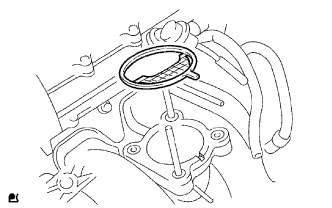

- HINT:
- Align the protrusion of the gasket with the groove of the intake manifold.
Install the throttle body with the 2 bolts and 2 nuts.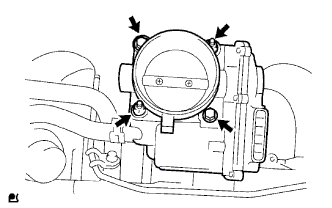
- Torque:
- 9.0 N*m{ 92 kgf*cm , 80 in.*lbf }
Connect the 2 water by-pass hoses to the throttle body.
Connect the throttle position sensor and control motor connector.
| 2. INSTALL INTAKE AIR CONNECTOR |
| 3. ADD ENGINE COOLANT |
Tighten all the plugs and fill the radiator with TOYOTA Super Long Life Coolant (SLLC).
- Torque:
- 13 N*m{ 133 kgf*cm , 10 ft.*lbf } for cylinder block drain cock plug
- Standard capacity:
Item
Specified Condition
Manual transmission
w/ Heater
7.8 liters (8.2 US qts, 6.9 Imp. qts)
w/o Heater
7.0 liters (7.4 US qts, 6.2 Imp. qts)
Automatic transmission
w/ Heater
8.1 liters (8.6 US qts, 7.1 Imp. qts)
w/o Heater
7.3 liters (7.7 US qts, 6.4 Imp. qts)
Fill the radiator reservoir with TOYOTA Super Long Life Coolant (SLLC) to the F line.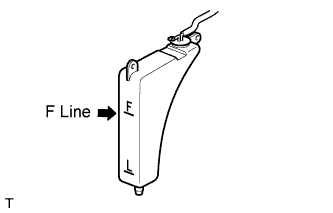
- HINT:
- TOYOTA vehicles are filled with TOYOTA SLLC at the factory. In order to avoid damage to the engine cooling system and other technical problems, only use TOYOTA SLLC or similar high quality ethylene glycol based non-silicate, non-amine, non-nitrite, non-borate coolant with long-life hybrid organic acid technology (coolant with long-life hybrid organic acid technology is a combination of low phosphates and organic acids).
- Please contact your TOYOTA dealer for further details.
- NOTICE:
- Never use water as a substitute for engine coolant.
- TOYOTA vehicles are filled with TOYOTA SLLC at the factory. In order to avoid damage to the engine cooling system and other technical problems, only use TOYOTA SLLC or similar high quality ethylene glycol based non-silicate, non-amine, non-nitrite, non-borate coolant with long-life hybrid organic acid technology (coolant with long-life hybrid organic acid technology is a combination of low phosphates and organic acids).
Press the inlet and outlet radiator hoses several times by hand, and then check the level of the coolant.
If the coolant level drops below the F line, add TOYOTA SLLC to the F line.
Install the radiator cap.
Bleed air from the cooling system.
Warm up the engine until the thermostat opens. While the thermostat is open, circulate the coolant for several minutes.
Maintain the engine speed at 2,500 to 3,000 rpm.
Press the inlet and outlet radiator hoses several times by hand to bleed air.
- CAUTION:
- When pressing the radiator hoses:
- Wear protective gloves.
- Be careful as the radiator hoses are hot.
- Keep your hands away from the radiator fan.
- Wear protective gloves.
Stop the engine and wait until the coolant cools down to ambient temperature.
- CAUTION:
- Do not remove the radiator cap while the engine and radiator are still hot. Pressurized, hot engine coolant and steam may be released and cause serious burns.
Check the coolant level in the radiator reservoir.
If the coolant level is below the L line, add SLLC to the reservoir F line.
| 4. CONNECT CABLE TO NEGATIVE BATTERY TERMINAL |
| 5. PERFORM INITIALIZATION |
Perform initialization (Click here).
- NOTICE:
- Certain systems need to be initialized after disconnecting and reconnecting the cable from the negative (-) battery terminal.
| 6. CHECK FOR ENGINE COOLANT LEAKS |
Check for engine coolant leaks (Click here).