P0488 Exhaust Gas Recirculation Throttle Position Control Range / Performance
Diagnostic trouble codes · Vehicles built Aug 2012 – Jul 2013
Versions by build date: Jun 2011 – Jul 2012 Aug 2012 – Jul 2013 Aug 2013 – Jul 2014 from Aug 2014
DESCRIPTION
The ECM opens and closes the throttle valve using the rotary solenoid type actuator. The exhaust gas recirculation volume is controlled by opening and closing the valve. Also, engine vibration and noise is reduced by closing the valve when the engine is stopped.| DTC No. |
DTC Detection Condition |
Trouble Area |
| P0488 |
When either condition below is met:
|
|
- HINT:
- After confirming DTC P0488, check the throttle position.
- Reference:
Condition
Throttle Valve Position
Moment when accelerator pedal is further depressed or released at 2,500 rpm
Opening angle varies smoothly
MONITOR DESCRIPTION
The ECM opens and closes the throttle valve by adjusting the duration of current flowing to the rotary solenoid (duty ratio). If the throttle valve does not move smoothly or is stuck, the duty ratio during the valve movement control increases or decreases greatly, the ECM will determine that the throttle valve has a malfunction and illuminate the MIL.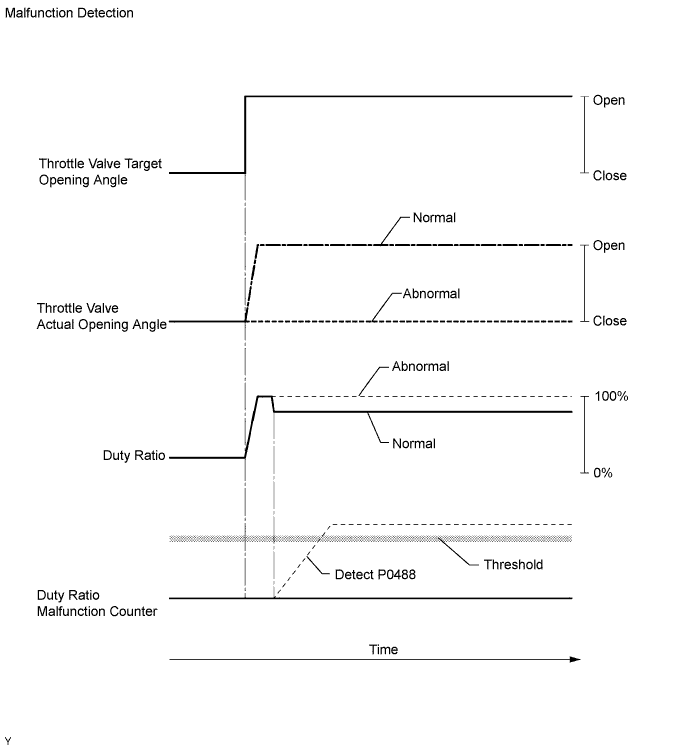

WIRING DIAGRAM
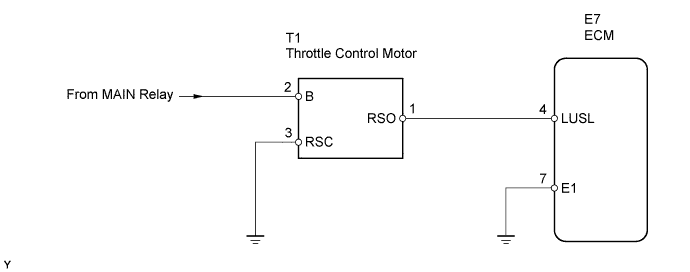
INSPECTION PROCEDURE
- HINT:
- Read freeze frame data using the intelligent tester. Freeze frame data records the engine conditions when a malfunction is detected. When troubleshooting, freeze frame data can help determine if the vehicle was running or stopped, if the engine was warmed up or not, and other data from the time the malfunction occurred.
- After warming up the engine, DTC P0488 is set 1 second or more after quickly accelerating the engine from idling.
- Read freeze frame data using the intelligent tester. Freeze frame data records the engine conditions when a malfunction is detected. When troubleshooting, freeze frame data can help determine if the vehicle was running or stopped, if the engine was warmed up or not, and other data from the time the malfunction occurred.
- NOTICE:
- If the ECM is replaced, the new ECM needs initialization (Click here).
| 1. CHECK OTHER DTC OUTPUT (IN ADDITION TO DTC P0448) |

Connect the intelligent tester to the DLC3.
Turn the ignition switch ON and turn the intelligent tester ON.
Enter the following menus: Powertrain / Engine / DTC.
Read the DTCs (Click here).
- Result:
Display (DTC Output)
Proceed to
P0488
A
P0488 and P0122 and/or P0123
B
- HINT:
- If any other codes besides P0488 are output, perform troubleshooting for those DTCs first.
|
|
||||

| A | |
 |
| 2. CHECK IF DTC OUTPUT RECURS (DTC P0448 OUTPUT) |
Connect the intelligent tester to the DLC3.
Turn the ignition switch ON and turn the intelligent tester ON.
Enter the following menus: Powertrain / Engine / DTC / Clear.
Clear the DTCs (Click here).
Start the engine and perform a quick engine acceleration from idling to 3,000 rpm 3 times.
Enter the following menus: Powertrain / Engine / DTC.
Read the DTCs (Click here).
- Result:
Display (DTC output)
Proceed to
P0488
A
No output
B
- HINT:
- The normal operation of the throttle valve is as follows.
- Reference:
Condition
Throttle Position
Moment when accelerator pedal is further depressed or released at 3,000 rpm
Opening angle varies smoothly
|
|
||||
| A | |
|
| 3. CHECK ECM (LUSL SIGNAL) |
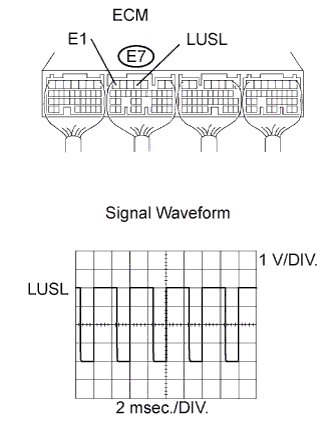 |
While revving the engine, check the waveform of the ECM connector using an oscilloscope.
- Standard voltage:
Tester Connection
Specified Condition
E7-4 (LUSL) - E7-7 (E1)
Correct waveform is shown
Tool Setting
Condition
1 V/DIV., 2 msec./DIV.
Racing engine with warm engine
- HINT:
- The waveform varies depending on the diesel throttle signal operation.
|
|
||||
| OK | |
|
| 4. CHECK WIRE HARNESS (THROTTLE CONTROL MOTOR - ECM) |
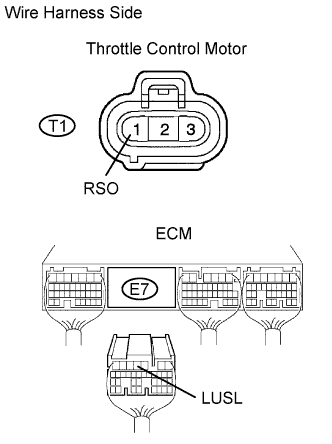 |
Disconnect the T1 motor connector.
Disconnect the E7 ECM connector.
Measure the resistance of the wire harness side connectors.
- Standard resistance:
Tester Connection
Specified Condition
T1-1 (RSO) - E7-4 (LUSL)
Below 1 Ω
T1-1 (RSO) or E7-4 (LUSL) - Body ground
10 kΩ or higher
|
|
||||
| OK | ||
 |
||
| ||