2KD-FTV INTAKE / EXHAUST EXHAUST MANIFOLD W/ TURBOCHARGER(w/o EGR Cooler) INSPECTION
PROCEDURE

 1.VISUALLY CHECK TURBOCHARGER SUB-ASSEMBLY
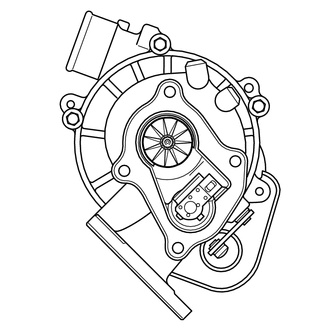
| *1 | Turbine Wheel |
Check for deformation and cracks in the turbine wheel on the exhaust side.
If the turbine wheel is cracked or deformed, replace the turbocharger sub-assembly.
2.INSPECT AXIAL PLAY OF TURBINE SHAFT
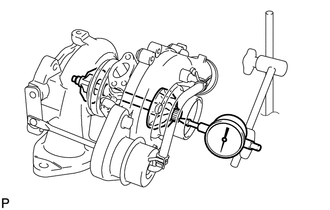
Move the turbine shaft in the axial direction and measure the axial play of the turbine shaft using a dial indicator.
- Maximum axial play:
0.08 mm (0.00314 in.)
- NOTICE:
-
Make sure the turbocharger sub-assembly and dial indicator are securely fixed in place when performing the measurement.
If the axial play is more than the maximum, replace the turbocharger sub-assembly.
3.INSPECT RADIAL PLAY OF TURBINE SHAFT
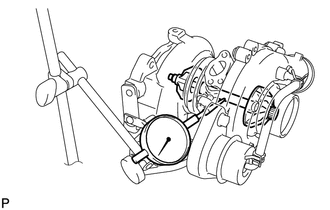
Insert the needle of a dial indicator into the oil outlet hole and set it against the center of the turbine shaft.
Move the turbine shaft in the radial direction and measure the radial play of the turbine shaft using the dial indicator.
- Maximum radial play:
0.110 mm (0.00433 in.)
If the radial play is more than the maximum, replace the turbocharger sub-assembly.
4.CHECK TURBINE SHAFT ROTATION
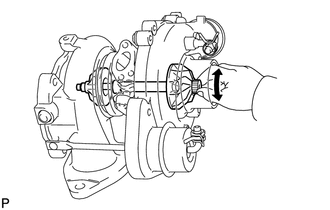
Rotate the turbine wheel with your fingers and check that it rotates smoothly.
- HINT:
-
Even if it takes a little effort to rotate the turbine wheel, this is not a problem.
If the turbine wheel does not rotate smoothly, replace the turbocharger sub-assembly.
5.INSPECT ACTUATOR AND WASTE GATE VALVE OPERATION
Disconnect the actuator hose from the compressor housing.
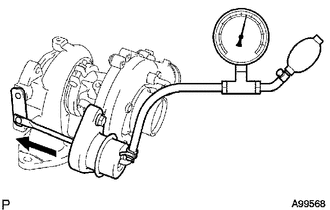
Using SST, apply pressure to the actuator.
- SST
- 09992-00242
- Valve opening pressure:
Specified pressure* (See table below)
- NOTICE:
-
Never apply more than the predetermined maximum pressure* to the actuator.
- HINT:
-
*: For the specifications, refer to the table below.
- Specifications:
Valve Opening Pressure
(kPa: Gauge Pressure)Maximum Pressure
(kPa: Gauge Pressure)Rod Stroke
(Reference)108 136 2.0 to 4.50 mm
(0.0787 to 0.177 in.)
Check that the actuator push rod moves and that the waste gate valve opens.
If the rod does not move, replace the turbocharger sub-assembly.
Reconnect the actuator hose to the compressor housing.