2KD-FTV INTAKE / EXHAUST EXHAUST MANIFOLD W/ TURBOCHARGER(w/ EGR Cooler) INSPECTION
PROCEDURE

 1.VISUALLY CHECK TURBOCHARGER SUB-ASSEMBLY
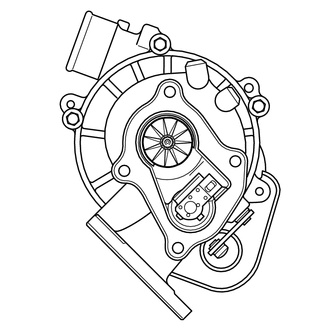
| *1 | Turbine Wheel |
Check for deformation and cracks in the turbine wheel on the exhaust side.
If the turbine wheel is cracked or deformed, replace the turbocharger sub-assembly.
2.INSPECT AXIAL PLAY OF TURBINE SHAFT
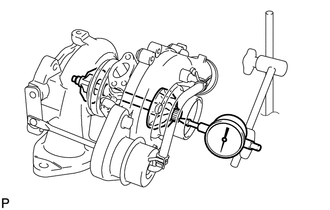
Move the turbine shaft in an axial direction and measure the axial play of the turbine shaft using the dial indicator.
- Maximum axial play:
0.08 mm (0.00314 in.)
- NOTICE:
-
Turbocharger sub-assembly and dial indicators are surely fixed when performing measurement.
If the axial play is more than the maximum, replace the turbocharger sub-assembly.
3.INSPECT RADIAL PLAY OF TURBINE SHAFT
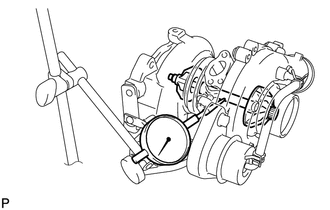
Insert the needle of a dial indicator into the oil outlet hole, and set it in the center of the turbine shaft.
Move the turbine shaft in a radial direction and measure the radial play of the turbine shaft using the dial indicator.
- Maximum radial play:
0.110 mm (0.00433 in.)
If the radial play is more than the maximum, replace the turbocharger sub-assembly.
4.CHECK TURBINE SHAFT ROTATION
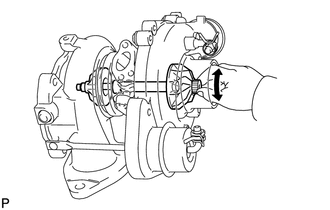
Rotate the turbine wheel with your finger and check that it rotates smoothly.
- HINT:
-
Even if it takes effort a little to rotate the turbine wheel, this is not a problem.
If the turbine wheel does not rotate smoothly, replace the turbocharger sub-assembly.
5.INSPECT ACTUATOR AND WASTE GATE VALVE OPERATION
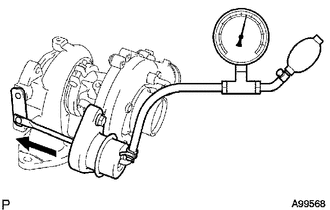
Disconnect the actuator hose from the compressor housing.
Using SST, apply pressure to the actuator.
- SST
- 09992-00242
- Valve opening pressure:
Specified pressure* (See attached table below)
- NOTICE:
-
Never apply more than predetermined maximum pressure* to the actuator.
- HINT:
-
*: For the specifications, refer to the table below.
Check that the actuator push rod moves and that the waste gate valve opens.
- Specifications:
Valve Opening Pressure
(kPa: Gauge Pressure)Maximum Pressure
(kPa: Gauge Pressure)Rod Stroke
(Reference)108 136 2.0 to 4.50 mm
(0.0787 to 0.177 in.)
If the rod does not move, replace the turbocharger sub-assembly.
Reconnect the actuator hose to the compressor housing.