DTC P1604 Startability Malfunction |
| DTC Detection Drive Pattern | DTC Detection Condition | Trouble Area |
| After engine is started |
|
|
| After starting the engine (engine speed is 500 rpm or more), the engine speed drops to 200 rpm or less within 2 seconds*2 (1 trip detection logic). *2: This DTC may be stored when the engine stalls due to clutch misoperation. |
| DTC No. | Data List |
| P1604 |
|
![]() |
| In order to start the engine, the starting system, glow system, fuel system and the components related to compression must be functioning properly. |
| The cause of the problem can be narrowed down by checking if the engine cranks normally. |
| Starting system (when cranking is abnormal) |
The engine cannot be started if a sufficient cranking speed cannot be obtained. The following are possible causes of an insufficient cranking speed.
Problem with the immobiliser system (Engine does not crank).
Problem with the battery (Cranking speed is low).
Problem with the starter (Cranking speed is low).
| Glow system (when cranking is normal) |
When there is a problem with the glow system, the intake air temperature does not rise adequately and the fuel combustion temperature is not reached. Therefore, there is no initial combustion or it takes time for the engine to start. The following are possible causes.
Engine coolant temperature sensor malfunction.
Glow plug malfunction.
Glow relay malfunction.
| Fuel system (when cranking is normal) |
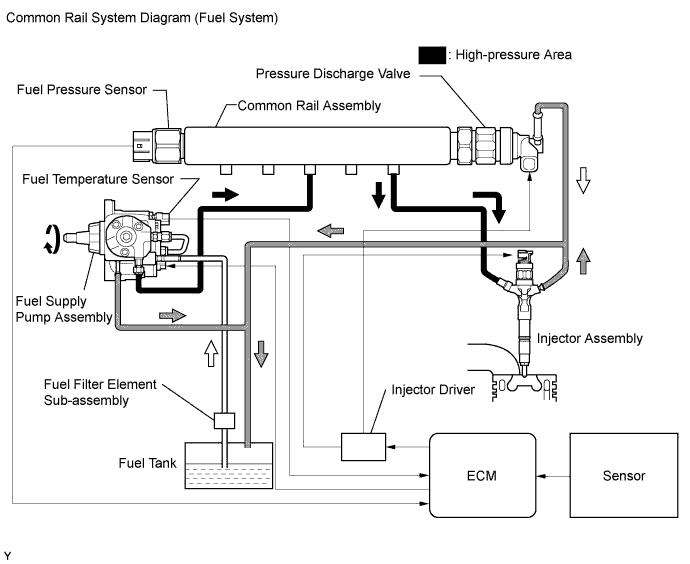
The engine cannot be started if fuel is not supplied. A minimum fuel pressure of 25000 kPa or higher must be supplied to start the engine. The following are possible causes of insufficient fuel pressure.
Fuel line clog.
Lack of fuel.
Fuel frozen.
Low quality fuel.
Air in fuel pipe.
Fuel filter element sub-assembly clog.
Problem with fuel supply pump assembly.
Problem with common rail assembly.
Problem with injector assemblies.

| Engine assembly |
There may be a problem with the engine unit itself if there is no problem with cranking, the glow system or fuel system.
Engine friction too high.
Insufficient compression.
| 1.READ OUTPUT DTC (RECORD STORED DTC AND FREEZE FRAME DATA) (PROCEDURE 1) |
Connect the intelligent tester to the DLC3.
Turn the ignition switch to ON and turn the tester on.
Enter the following menus: Powertrain / Engine and ECT / DTC.
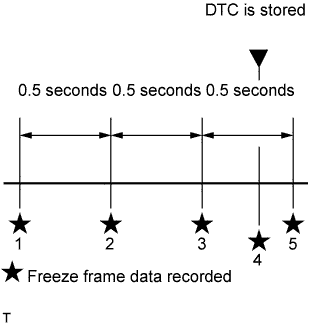
Record the stored DTCs and freeze frame data.
| NEXT | |
| 2.CHECK FOR ANY OTHER DTCS OUTPUT (IN ADDITION TO DTC P1604) |
Connect the intelligent tester to the DLC3.
Turn the ignition switch to ON and turn the tester on.
Enter the following menus: Powertrain / Engine and ECT / DTC.
Read the DTCs.
| Result | Proceed to |
| P1604 is output | A |
| P1604 and other DTCs are output | B |
|
| ||||
| A | |
| 3.TAKE SNAPSHOT DURING STARTING AND IDLING (PROCEDURE 3) |
Connect the intelligent tester to the DLC3.
Turn the ignition switch to ON and turn the tester on.
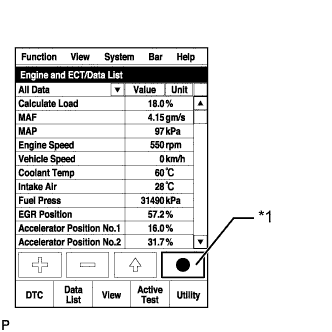
Enter the following menus: Powertrain / Engine and ECT / Data List / All Data.
![]() |
Take a snapshot of the following Data List items with the intelligent tester during "ignition switch to ON (5 seconds) → Starting → Idling (10 seconds)".
| *1 | Snapshot Button |
| NEXT | |
| 4.DETERMINE CAUSE OF PROBLEM (CHECK FREEZE FRAME DATA AND SNAPSHOT) |
Determine the cause of the problem based on the freeze frame data recorded in procedure 1 and the Data List values recorded when starting the engine in procedure 3.
| Judgment of Data List Values | Problem Cause | Normal Condition | Diagnosis Note |
| "Coolant Temp" in freeze frame data is below 35°C (95°F) | Engine starting trouble which occurred with cold engine | - |
|
| "Coolant Temp" in freeze frame data is below 35°C (95°F). Currently, no engine starting trouble (cranking time less than 4 seconds) after warming up engine ("Coolant Temp" is 60°C (140°F) or higher). | Engine starting trouble which only occurs with cold engine |
| Judgment of Data List Values | Problem Cause | Normal Condition | Diagnosis Note |
| "Engine Speed" in freeze frame data is less than 120 rpm | Engine starting trouble may have occurred because engine speed was too low |
|
|
| "Engine Speed" in Data List is less than 120 rpm when cranking engine |
| Judgment of Data List Values | Problem Cause | Normal Condition | Diagnosis Note |
| "Battery Voltage" in freeze frame data is below 6 V | Engine starting trouble may have occurred because battery is fully depleted | During cranking: 6 V or higher | The battery may be fully depleted or the battery terminals may be loose. |
| "Battery Voltage" in Data List is below 6 V when cranking engine |
| Judgment of Data List Values | Problem Cause | Normal Condition | Diagnosis Note |
| "Fuel Press" in freeze frame data is below 10000 kPa | Problem supplying fuel to fuel supply pump assembly (low pressure side)
| When in a stable condition such as when the engine is idling after being warmed up, the fuel pressure is within +/-5000 kPa of the target fuel pressure | Disconnect the inlet hose from the fuel supply pump assembly (low pressure side), operate the hand pump and check that fuel is being supplied. |
| Fuel Press is less than 10000 kPa from the value of Fuel Press when cranking started | |||
| "Fuel Press" in freeze frame data is below 25000 kPa | Problem supplying fuel to fuel supply pump assembly (low pressure side) or problem on high pressure side
| When in a stable condition such as when the engine is idling after being warmed up, the fuel pressure is within +/-5000 kPa of the target fuel pressure
|
|
| Fuel Press is below Target Common Rail Pressure by 15000 kPa or more | |||
| Fuel Press increases to a value that is higher than Target Common Rail Pressure immediately after cranking, and, remains higher than Target Common Rail Pressure |
| When in a stable condition such as when the engine is idling after being warmed up, the fuel pressure is within +/-5000 kPa of the target fuel pressure |
|
| Judgment of Data List Values | Problem Cause | Normal Condition | Diagnosis Note |
| "Injection Feedback Val #1 (to #4)" in freeze frame data is more than 3.0 mm3/st | Injector assembly malfunction or compression problem | -3.0 to 3.0 mm3/st | If an injector assembly is malfunctioning, even though the engine starts, idling is rough. |
| "Injection Feedback Val #1 (to #4)" in Data List is more than 3.0 mm3/st when idling |
| Judgment of Data List Values | Problem Cause | Normal Condition | Diagnosis Note |
| "Injection Volume" in Data List is more than 12 mm3/st and "Injection Feedback Val #1 (to #4)" is within range of 3.0 mm3/st when idling after warming up engine | Injector assemblies of all cylinders malfunctioning | - | - |
| Judgment of Data List Values | Problem Cause | Normal Condition | Diagnosis Note |
| "Main Injection Period" in freeze frame data or Data List is 0 μs |
| - | Indicates that fuel injection control has stopped. |
| Judgment of Data List Values | Problem Cause | Normal Condition | Diagnosis Note |
| "Immobiliser Communication" in freeze frame data or Data List is OFF | Engine immobiliser system | ON | Fuel injection has stopped due to engine immobiliser system. |
| Judgment of Data List Values | Problem Cause | Normal Condition | Diagnosis Note |
| "Immobiliser Fuel Cut History" in freeze frame data is OFF to ON | Fuel injection has stopped due to engine immobiliser system.
| OFF |
|
| Judgment of Data List Values | Problem Cause | Normal Condition | Diagnosis Note |
"Engine Speed (Starter Off)" in freeze frame data is low (approximately below 500 rpm)
| Engine stalled or starting troubles occurred due to cranking being stopped before the engine has completely started. | - | Compare it with the Data List when cranking normally and if the value is evidently low (approximately below 500 rpm), the problem probably occurred due to user operation, so give advice about how to operate the vehicle. |
| NEXT | ||
| ||