PARK ASSIST / MONITORING TOYOTA PARKING ASSIST-SENSOR SYSTEM OPERATION CHECK
CHECK INITIAL CHECK FUNCTION
Turn the ignition switch to ON and turn the back sonar or clearance sonar switch on. After approximately 0.4 seconds, check that the buzzer sounds for 0.7 to 1.3 seconds.

- HINT:
- ·
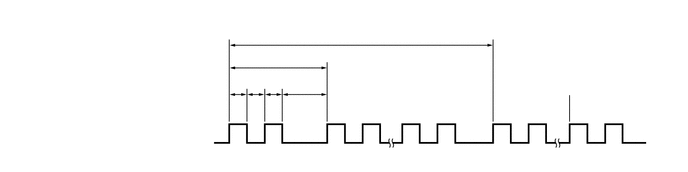
If the system detects an open in any sensor circuit, or any sensor does not work (unable to detect because the sensor is wet or frozen), the buzzer operates as shown in the illustration above.
·If the buzzer sounds due to a sensor or circuit malfunction, turning the ignition switch off and then ON will return the system to normal if the malfunction is no longer present.
MALFUNCTION BUZZER
Open circuit indication
If there is an open circuit between the ultrasonic sensor and the rear clearance warning ECU assembly, or a sensor is malfunctioning, the buzzer sounds as shown in the illustration.
- HINT:
-
Troubleshoot according to each inspection procedure (See page Audio / Visual / Telematics>PARK ASSIST / MONITORING>TOYOTA PARKING ASSIST-SENSOR SYSTEM>PROBLEM SYMPTOMS TABLE).
Frozen indication
If a sensor is covered with foreign matter, such as mud or snow, the buzzer sounds as shown in the illustration.
- HINT:
-
Troubleshoot according to each inspection procedure (See page Audio / Visual / Telematics>PARK ASSIST / MONITORING>TOYOTA PARKING ASSIST-SENSOR SYSTEM>PROBLEM SYMPTOMS TABLE).
DETECTION RANGE MEASUREMENT CHECK
- NOTICE:
-
Apply the parking brake securely so that the vehicle does not move.
Turn the ignition switch to ON.
Turn the back sonar or clearance sonar switch on.
Move the shift lever to R.
Move a φ 60 mm (2.36 in.) pole around the sensors to measure the detection ranges of the sensors.
- NOTICE:
- ·
These detection ranges are applicable when positioning a pole with a diameter of φ60 mm (2.36 in.) parallel or perpendicular to the ground.
·The ranges vary depending on the measuring method and type of obstacle (such as walls).
·For close-range and medium-range detection, the values shown are for when using a pole with a diameter of φ60 mm (2.36 in.). For long range detection, the values shown are for when using walls.
·The No. 1 ultrasonic sensor side view detection range hatched area*1 represents the cross section of the top view of the detection range along the lines labeled A. The hatched area*1 does not represent the entire side view detection range.
Rear sensor detection range
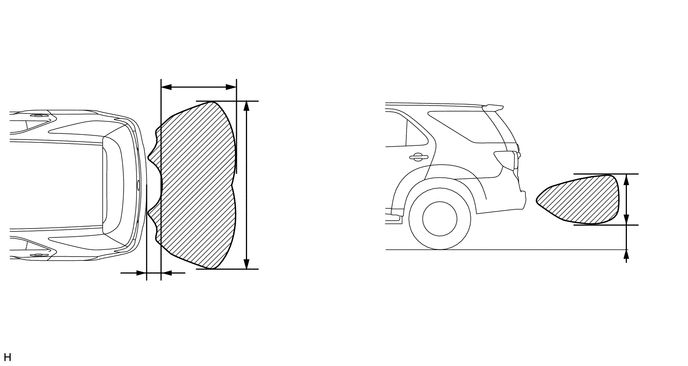
When the ultrasonic sensors detect an obstacle with the back sonar or clearance sonar switch on, check that the buzzer sounds.
| Ignition Switch | Back Sonar or Clearance Sonar Switch | Vehicle Speed | Shift Lever Position |
|---|---|---|---|
| ON | On | 10 km/h (6 mph) or less | R |
Check that the buzzer sounds with the back sonar or clearance sonar switch on.
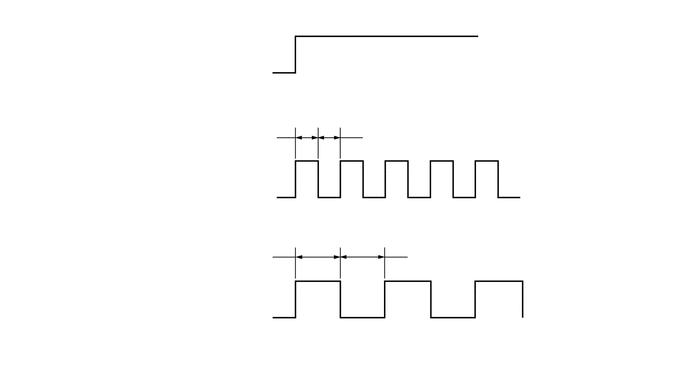
| Detection | Distance |
|---|---|
| 1. Close-range detection | Within 500 +/-50 mm (19.7 +/-1.97 in.)*1 |
| 2. Middle-range detection | 500 +/-50 to 1000 +/-100 mm (19.7 +/-1.97 to 39.4 +/-3.94 in.)*1 |
| 3. Long-range detection | 1000 +/-100 to 1500 +/-150 mm (39.4 +/-3.94 to 59.1 +/- 5.91 in.)*2 |
*1: A φ 60 mm (2.36 in.) pole is used as an obstacle.
*2: A wall is used as an obstacle.
- HINT:
-
Ultrasonic waves are used to measure the detection range. However, the detection range may vary depending on the ambient temperature.