INTRODUCTION FEATURES GENERAL/CONTROL/DETAILS PERFORMANCE
OUTLINE
1GR-FE Engine
The 1GR-FE engine is a V-type, 6-cylinder, 4.0-liter, 24-valve DOHC engine.
On this engine, the Dual Variable Valve Timing-intelligent (Dual VVT-i) system, Electronic Throttle Control System-intelligent (ETCS-i), and air injection system* are used. These control functions have been optimized to further improve engine performance and fuel economy, and to reduce exhaust emissions.
*: Models for compliant with EURO 5 and EURO 6 emission regulations
| Engine Type | 1GR-FE | |
|---|---|---|
| Item | No. of Cylinders and Arrangement | 6-cylinder, V-type |
| Valve Mechanism | 24-valve DOHC, Chain Drive (with Dual VVT-i) | |
| Displacement | 3956 cm3 (241.4 cu. in.) | |
| Maximum Output [ECE-NET] | 183 kW @ 5600 rpm*1 | |
| 207 kW @ 5600 rpm*2 | ||
| 202 kW @ 5600 rpm*3 | ||
| Maximum Torque [ECE-NET] | 381 N*m @ 4400 rpm*1, *3 | |
| 387 N*m @ 4400 rpm*2 | ||
*1: Models for Russia, Belarus and Kazakhstan.
*2: Models for Ukraine, Azerbaijan and Taiwan.
*3: Except models for Russia, Belarus, Kazakhstan, Ukraine, Azerbaijan and Taiwan.
2TR-FE Engine
The 2TR-FE engine is an in-line 4-cylinder, 2.7-liter, 16-valve DOHC engine.
On this engine, the Dual Variable Valve Timing-intelligent (Dual VVT-i) system, Electronic Throttle Control System-intelligent (ETCS-i), and air injection system are used. These control functions have been optimized to further improve engine performance and fuel economy, and to reduce exhaust emissions.
| Engine Type | 2TR-FE | |
|---|---|---|
| Item | No. of Cylinders and Arrangement | 4-cylinder, In-line |
| Valve Mechanism | 16-valve DOHC, Chain Drive (with Dual VVT-i) | |
| Displacement | 2694 cm3 (164.4 cu. in.) | |
| Maximum Output [ECE-NET] | 120 kW @ 5200 rpm*1 | |
| 122 kW @ 5200 rpm*2 | ||
| Maximum Torque [ECE-NET] | 246 N*m @ 3900 rpm | |
*1: Models for Russia.
*2: Except models for Russia.
1KD-FTV Engine
The 1KD-FTV TOYOTA Direct injection 4 stroke common-rail Diesel engine (D-4D) is an in-line 4-cylinder, 3.0-liter, 16-valve DOHC, turbocharged diesel engine with intercooler. This engine uses a direct injection system and common-rail system to achieve high performance, clean emissions, low noise and low vibration.
| Engine Type | 1KD-FTV | |
|---|---|---|
| Item | No. of Cylinders and Arrangement | 4-cylinder, In-line |
| Valve Mechanism | 16-valve DOHC, Belt and Gear Drive | |
| Displacement | 2982 cm3 (182.0 cu. in.) | |
| Maximum Output [EEC] | 127 kW @ 3400 rpm*1 | |
| 120 kW @ 3400 rpm*2 | ||
| Maximum Torque [EEC] | 410 N*m @ 1600 to 2800 rpm*1 | |
| 400 N*m @ 1600 to 2800 rpm*2 | ||
*1: Models compliant with EURO 4 emission regulation
*2: Except models compliant with EURO 4 emission regulation
5L-E Engine
The 5L-E engine is an inline 4-cylinder, 3.0-liter, 8-valve OHC diesel engine. In addition, an Electronic Fuel Injection (EFI) system is used to achieve cleaner emissions.
| Engine Type | 5L-E | |
|---|---|---|
| Item | No. of Cylinders and Arrangement | 4-cylinder, In-line |
| Valve Mechanism | 8-valve OHC, Belt Drive | |
| Displacement | 2986 cm3 (182.2 cu. in.) | |
| Maximum Output [EEC] | 70 kW @ 4000 rpm | |
| Maximum Torque [EEC] | 197 N*m @ 2400 rpm | |
1GD-FTV Engine
The 1GD-FTV TOYOTA Direct injection 4 stroke common-rail Diesel engine (D-4D) is an in-line 4-cylinder, 2.8-liter, 16-valve DOHC, turbocharged diesel engine. This engine uses the direct injection system and common-rail system to achieve high performance, clean emissions, low noise and low vibrations.
An intercooler is provided. This lowers the intake air temperature and improves power output.
| Engine Type | 1GD-FTV | |
|---|---|---|
| Item | No. of Cylinders and Arrangement | 4-cylinder, In-line |
| Valve Mechanism | 16-valve DOHC, Chain Drive | |
| Displacement | 2755 cm3 (168.1 cu. in.) | |
| Maximum Output [EEC] | 130 kW @ 3400 rpm | |
| Maximum Torque [EEC] | 450 N*m @ 1600 to 2400 rpm*1 | |
| 420 N*m @ 1400 to 2600 rpm*2 | ||
*1: Models with automatic transmission
*2: Models with manual transmission
Manual Transmission
RA61F 6-speed, R150F and G52F 5-speed manual transmissions are used.
Automatic Transmission
A750F 5-speed and AC60F 6-speed automatic transmissions are used.
Suspension
A double-wishbone independent suspension is used for the front.
A 4-link coil spring with lateral rod type suspension is used for the rear.
A rear air suspension system is used.
An Adaptive Variable Suspension system (AVS) is used.
A Kinetic Dynamic Suspension System (KDSS) is used.
Brake
A ventilated disc brake is provided for the front brake.
A drum in type ventilated disc brake is provided for the rear brake.
A duo-servo drum brake is provided for the parking brake.
A brake control system equipped with an Anti-lock Brake System (ABS), Multi-terrain Anti-lock Brake System (Multi-terrain ABS), Electronic Brake force Distribution (EBD), brake assist, Traction Control (TRC), Active Traction Control (A-TRC), Vehicle Stability Control (VSC), hill-start assist control, downhill assist control, trailer sway control and CRAWL is provided.
Steering
A rack and pinion type steering gear with a hydraulic power steering assist is used.
A Variable Flow Control (VFC) power steering is used.
A manual tilt and telescopic mechanism and a power tilt or power telescopic system is used.
Drive Mode Select
The drive mode select is a function where control characteristics switches of the powertrain (engine control system), chassis [Adaptive Variable Suspension system (AVS)*, power steering system] and air conditioning (air conditioning system) are integrated. This function optimally controls each system according to the driving mode selected by the driver.
*: Models with AVS
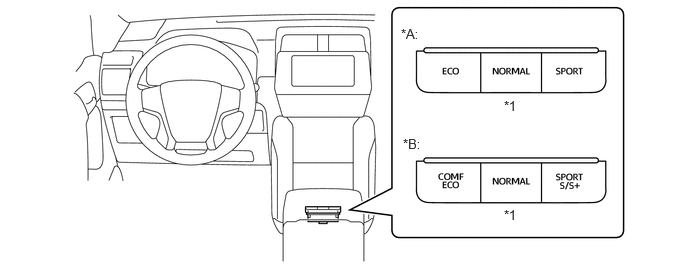
| *A | Models without AVS | *B | Models with AVS |
| *1 | Drive Mode Select | - | - |
Each drive mode of the drive mode select is provided with the following control characteristics:
| Drive Mode | Powertrain | Chassis | Air Conditioning |
|---|---|---|---|
| Power Steering System | Air Conditioning System | ||
| NORMAL | NORMAL | NORMAL | NORMAL |
| ECO | ECO | NORMAL | ECO |
| SPORT | POWER | SPORT | NORMAL |
| Drive Mode | Powertrain | Chassis | Air Conditioning | |
|---|---|---|---|---|
| AVS | Power Steering System | Air Conditioning System | ||
| NORMAL | NORMAL | NORMAL | NORMAL | NORMAL |
| COMFORT | NORMAL | COMFORT | NORMAL | NORMAL |
| ECO | ECO | NORMAL | NORMAL | ECO |
| SPORT S | POWER | NORMAL | NORMAL | NORMAL |
| SPORT S+ | POWER | SPORT | SPORT | NORMAL |
- HINT:
- ·
When L4F or L4L is selected while in transfer drive mode, drive mode select cannot be used.
·When 2nd start mode is selected, powertrain control performs control for 2nd start mode.
The control characteristics in each drive mode are as follows:
| Drive Mode | Control Characteristics |
|---|---|
| NORMAL | Performs control for normal driving. |
| ECO | Performs control for driving with improved fuel efficiency by generating torque more gently than NORMAL mode according to accelerator pedal depression while suppressing air conditioning cooling and heating operations. |
| SPORT | Performs control suitable for sporty driving by improving the acceleration response by controlling the transmission and engine and also improving the steering feeling. |
| Drive Mode | Control Characteristics |
|---|---|
| NORMAL | Performs control for normal driving. |
| ECO | Performs control for driving with improved fuel efficiency by generating torque more gently than NORMAL mode according to accelerator pedal depression while suppressing air conditioning cooling and heating operations. |
| SPORT S | Improves accelerator response by controlling the transmission and engine to perform control for driving that requires powerful acceleration. |
| SPORT S+ | Comprehensively controls the AVS and power steering system in addition to the transmission and engine control system of SPORT S mode to ensure maneuverability and stability to perform control for sporty driving. |
| COMFORT | Mainly uses the lower damping force range with the AVS compared to NORMAL mode, performing control to achieve a comfortable ride. |