HEATING / AIR CONDITIONING REFRIGERANT(for HFC-134a(R134a)) REPLACEMENT
PROCEDURE

 1.RECOVER REFRIGERANT FROM REFRIGERATION SYSTEM
Start the engine.
Operate the cooler compressor under the conditions shown below:
| Item | Condition |
| Operating time | 3 minutes or more |
| Temperature setting | Max cool |
| Blower speed | High |
| Engine | Idling |
| A/C switch | On |
This causes most of the compressor oil from the various components of the A/C system to collect in the A/C compressor.
- HINT:
-
It is not necessary to operate the cooler compressor if the A/C does not operate because of the compressor.
Stop the engine.
Recover the refrigerant from the A/C system using a refrigerant recovery unit.
- HINT:
-
Use the refrigerant recovery unit in accordance with the manufacturer's instruction manual.
2.CHARGE REFRIGERANT
- SST
- 09985-20010 (09985-02130, 09985-02150, 09985-02090, 09985-02110, 09985-02010, 09985-02050, 09985-02060, 09985-02070)
Perform vacuum purging using a vacuum pump.
Charge refrigerant HFC-134a (R134a).
| Air Conditioning Type | Refrigerated Cool Box | Refrigerant Charging Amount |
|---|---|---|
| for Single Air Conditionig System, Type A | w/ Refrigerated Cool Box | 570 to 630 g (20.2 to 22.2 oz) |
| w/o Refrigerated Cool Box | 520 to 580 g (18.4 to 20.4 oz) | |
| for Single Air Conditionig System, Type B | w/ Refrigerated Cool Box | 570 to 630 g (20.2 to 22.2 oz) |
| w/o Refrigerated Cool Box | 570 to 630 g (20.2 to 22.2 oz) | |
| for Dual Air Conditionig System | w/ Refrigerated Cool Box | 770 to 830 g (27.2 to 29.2 oz) |
| w/o Refrigerated Cool Box | 740 to 800 g (26.2 to 28.2 oz) |
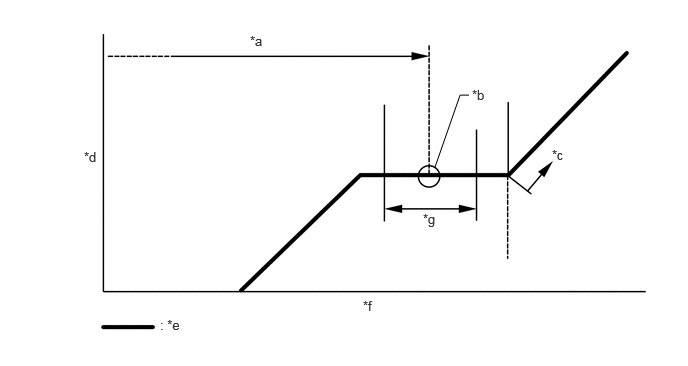
| *a | Standard Charge Amount | *b | Mean Value in Proper Range |
| *c | Overcharged | *d | High Pressure |
| *e | Sub-cool System | *f | Refrigerant Amount |
| *g | +/-30 g (+/-1.05 oz) | - | - |
- NOTICE:
- ·
Do not operate the cooler compressor before charging refrigerant as the cooler compressor will not work properly without any refrigerant, and will overheat.
·Approximately 100 g (3.53 oz.) of refrigerant may need to be charged after bubbles disappear. The refrigerant amount should be checked by measuring its quantity, and not with the sight glass.
3.WARM UP ENGINE
Warm up the engine at less than 1850 rpm for 2 minutes or more after charging the refrigerant.
- NOTICE:
-
Be sure to warm up the compressor when turning the A/C switch is on after removing and installing the cooler refrigerant lines (including the compressor), to prevent damage to the compressor.
4.CHECK FOR REFRIGERANT GAS LEAK
After recharging the refrigerant gas, check for refrigerant gas leakage using a gas leak detector.
Perform the operation under these conditions:
Stop the engine.
Secure good ventilation (the gas leak detector may react to volatile gases other than refrigerant, such as evaporated gasoline or exhaust gas).
Repeat the test 2 or 3 times.
Make sure that some refrigerant remains in the refrigeration system. When compressor is off: approximately 392 to 588 kPa (4.0 to 6.0 kgf/cm2, 57 to 85 psi).
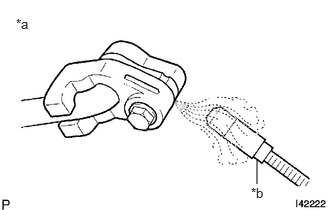
| *a | Inspect for Leak |
| *b | Gas Leak Detector |
Using a gas leak detector, check the refrigerant line for leakage.
If a gas leak is not detected on the drain hose, remove the blower motor control (blower resistor) from the cooling unit. Insert the gas leak detector sensor into the unit and perform the test.
Disconnect the connector and wait for approximately 20 minutes. Bring the gas leak detector close to the pressure switch and perform the test.